

Improved Mechanical Reaper (1894)
U.S. Patent No. 520,892, granted on June 5, 1894, to George W. Murray, describes an automated, low-cost agricultural reaper designed to cut small grain, gather it into uniform bundles, and automatically drop them at regular intervals. George W. Murray, an inventor from Rembert, South Carolina, developed this machine to streamline harvesting for small-scale farmers by reducing manual labor.
This invention solved two major issues common in late 19th-century harvesting equipment: the inability to easily adjust cutting heights for uneven crops, and the reliance on manual operators to bundle and dump the harvested grain.
The Core Innovation: The Gravity-Triggered “Auto-Dump” Cradle
The defining feature of Murray’s reaper is its automatic dumping mechanism. Instead of requiring a worker to manually trip a lever to drop collected grain, Murray engineered a weight-sensitive system at the end of the conveyor belt.
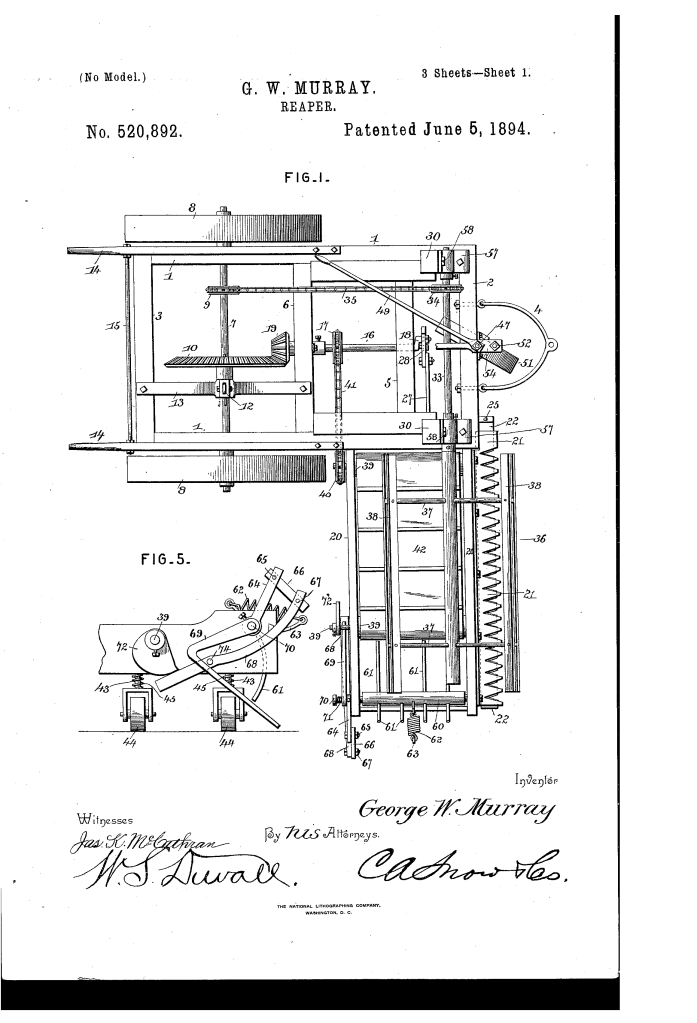
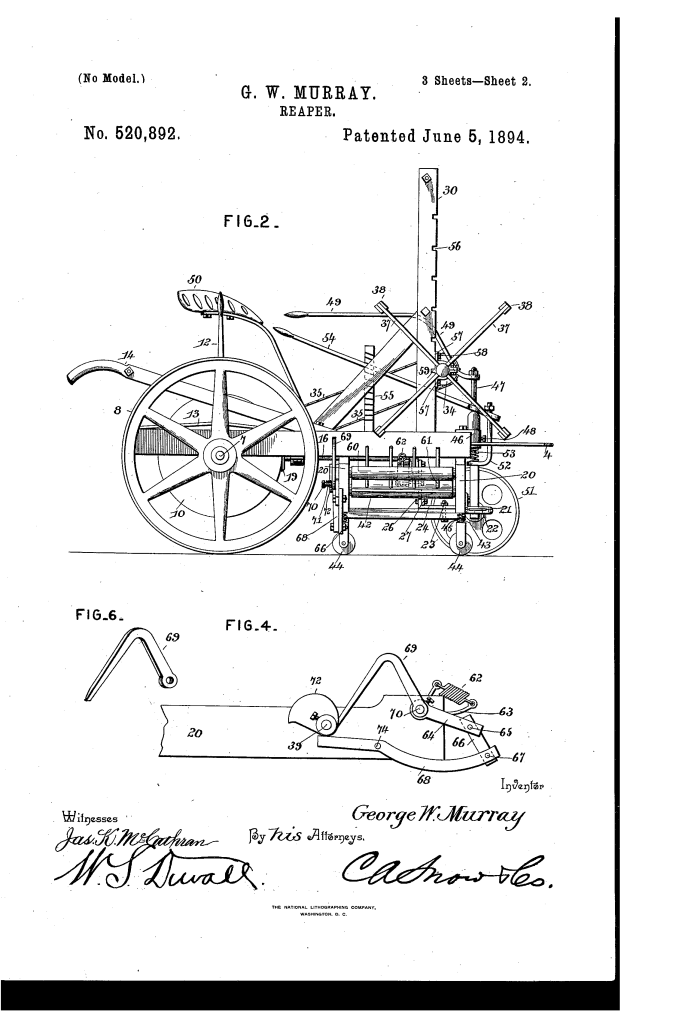
- The Receiving Cradle (61)At the outer edge of the canvas carrier belt, Murray positioned a series of curved iron arms. These arms act as a cradle to catch the loose grain as it falls off the conveyor.
- The Spring Counterweight (62)The cradle is held upright by a calibrated coiled spring. As long as the pile of grain is light, the arms stay raised, accumulating a neat bundle (or gavel).
- The Cam-Actuated UnloadingOnce the grain reaches a specific weight, its gravity overcomes the tension of the spring, depressing the curved arms. This physical drop shifts a splined bell-crank lever directly into the path of a rotating cam on the conveyor roll, which instantly forces the cradle down to dump the bundle cleanly onto the ground.
How the Apparatus Functions
The entire reaping and bundling sequence runs mechanically off the rotation of the main ground wheels:
| Step | Action | Mechanical Purpose |
| 1. Feeding | The rotating reel blades (38) sweep standing grain toward the machine. | Ensures the grain falls uniformly onto the cutting platform. |
| 2. Severing | A rapid, reciprocating cutter-bar (22) shears the grain at the base. | Driven by a pitman rod linked directly to the main axle. |
| 3. Transport | The cut grain drops onto an endless canvas apron or carrier (42). | Moves the loose stalks continuously toward the outer side of the frame. |
| 4. Bundling | Grain accumulates on the spring-loaded curved arms (61). | Holds the grain until a uniform bundle weight is achieved. |
| 5. Dumping | The weighted cradle drops, engaging the cam (72) to dump the bundle. | Resets automatically via spring tension once the weight is cleared. |
Technical Design Features
- Adjustable Cutting Height: The main framework is suspended on loose vertical spindles equipped with heavy coiled springs (45, 53). By pulling a notched hand lever (54) near the driver’s seat, the operator can compress the springs to cut low near the butts or release it to reap high near the tops.
- Master Shifting Gear (10): A hand lever allows the operator to slide the main master gear along the axle, completely disengaging the cutting and carrying mechanisms for safe transport down roads.
- Caster-Wheel Suspension: The carrier frame uses trailing caster wheels on swivels, allowing the heavy extension arm to track fluidly over uneven field terrain without binding.
About the Inventor: George W. Murray
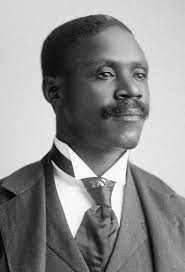
George Washington Murray was an extraordinary figure of the post-Reconstruction American South—a teacher, farmer, prolific inventor, and U.S. Congressman.
- Patents: Born into slavery in 1853, Murray went on to secure eight patents in the early 1890s, focusing on labor-saving agricultural attachments, including seed planters, fertilizer distributors, a cotton chopper, and this mechanical reaper.
- Political Legacy: Elected to the 53rd and 54th U.S. Congresses representing South Carolina, Murray was a fierce advocate for protecting voting rights and highlighting the scientific and industrial achievements of African American inventors.
- Impact: Murray’s designs targeted the economic realities of Southern tenant farmers and smallholders, aiming to provide affordable mechanization that didn’t require massive capital investment.
Summary of Claims
The patent explicitly claims:
- A reaper framework mounted on spring-supported caster spindles paired with a hand lever to adjust the physical cutting height against the spring tension.
- A transverse shaft positioned at the discharge end of a conveyor belt, featuring curved grain-receiving arms held upright by a spring until overcome by the weight of the grain.
- A mechanical trip system consisting of a splined bell-crank lever and a rotating cam attached to the conveyor roll that forces a positive, complete dump of the accumulated bundle.
