
Razor Stropping Device (1896)
U.S. Patent No. 554,867, granted on February 18, 1896, to Henry Grenon, describes an automated mechanical framework designed to safely and evenly hone straight razors. Henry Grenon, an inventor based in New Haven, Connecticut, solved a common 19th-century grooming hazard: maintaining a razor’s razor-sharp bevel edge without dulling it or cutting the leather strop through human error during manual flipping.
This specific invention addressed the delicate challenge of blade maintenance—creating a smooth, gear-driven system where pushing and pulling a carrier automatically flipped the razor edge-up onto its back before setting the opposite side down against the leather.
The Innovation: Automatic Motion Reversal & Gear-Driven Flip
Traditionally, stropping required a barber or individual to flip the razor manually at the end of every stroke. A slight slip in wrist angle could gouge the leather strop or nick the delicate edge.
Grenon’s breakthrough was a floating carrier and gear-wheel assembly that converted the linear forward-and-backward sliding motion of the user’s hand into a precise, limited rotary action that flipped the razor automatically.
How the Friction Flip Works
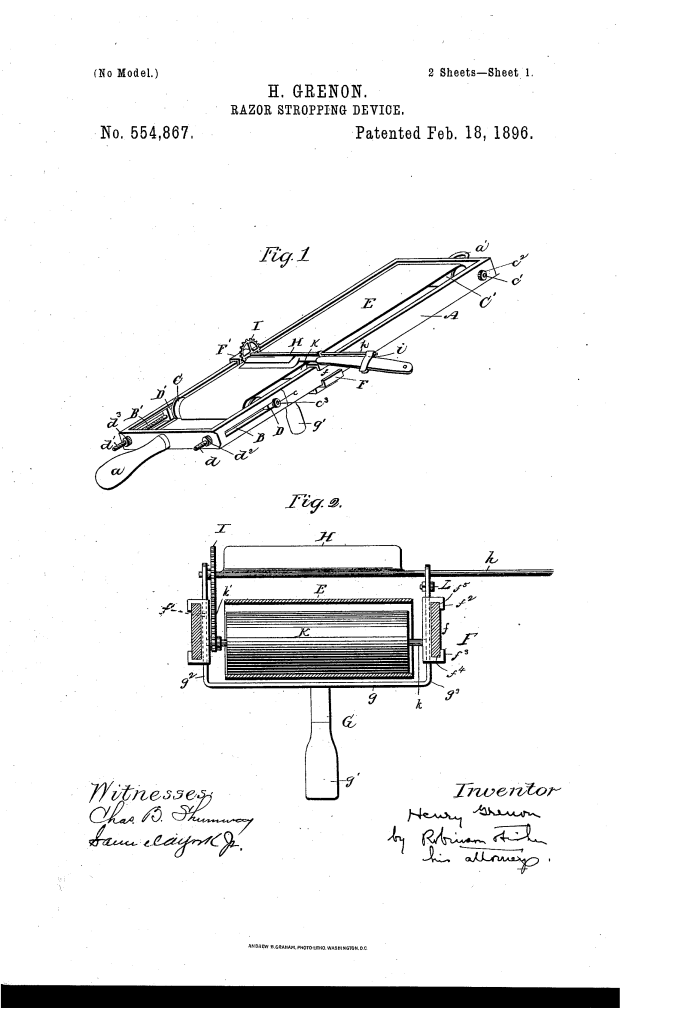
- Linear-to-Rotary Transfer: As the user slides the handling carrier along the frame, a bottom friction roller (K) presses against the suspended leather strop (E).
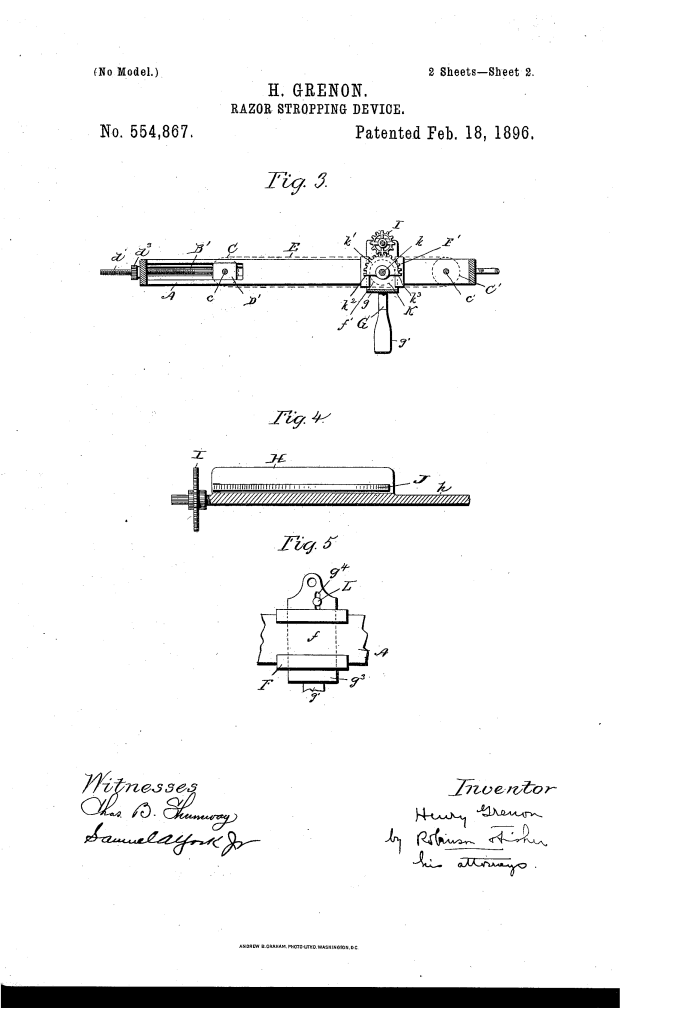
- Gear Engagement: The motion rotates the friction roller, which drives a connected gear wheel (k) meshed directly with a cog-wheel (I) on the blade holder’s shaft (h).
- Automatic Edge-Flipping: Moving the carrier forward forces the blade down onto the strop. When the user reverses direction, the friction wheel immediately rotates backward, swinging the blade up and over on its back to land safely on its opposite side.
Technical Components
The apparatus uses a rigid structure combined with adjustable tensioning and movement controls:
| Component | Label | Function |
| Main Frame & Handle | A, a | Steel outer rectangular housing fitted with a handgrip at one end and a swivel loop (a) to anchor the device to a wall hook. |
| Endless Leather Strop | E | The continuous sharpening band suspended over internal rollers (C, C). |
| Tension Adjusters | D, D, d1, d2 | Mortised sliding blocks with longitudinal screws and nuts that let the user tighten or loosen the strop as the leather stretches over time. |
| Sliding Travelers | F, F | Recessed side-mounts that embrace the outer steel frame, allowing smooth longitudinal travel back and forth. |
| Floating Carrier | G | The central unit housing the razor holder; fitted into the travelers to allow controlled vertical and horizontal movement. |
| Gears & Blade Clamp | I, k, H, J | Interlocking gear wheels (I, k) connected to a spring-loaded clamp (H, J) that firmly holds various sizes of razor blades. |
How the Apparatus Functions
Operation relies on a simple four-step sequence that guarantees consistent pressure and proper contact angles:
- Mounting: The razor blade is inserted into the clamp (H), where an internal curved leaf spring (J) accommodates different blade thicknesses, while a spring-clamp secures the razor’s handle.
- Forward Stroke: The user grabs the carrier handle (g) and pushes forward while applying light downward pressure. The friction roller (K) rotates against the strop, turning gear k to bring the cutting edge into flush contact with the leather.
- Pressure Limitation: Shoulders cut into the gear teeth (k1, k2) hit the carrier wall, while an adjustable thumb-screw (L) limits vertical play. This prevents the user from pressing too hard and damaging the blade.
- Reverse Stroke: Reversing the pulling motion immediately turns the friction roller in the opposite direction. The gears lift the blade off the leather, rotate it across its back, and lay the opposite edge down onto the strop.
Historical Context & Impact
Henry Grenon’s invention was patented during an era when personal hygiene technology was undergoing rapid mechanization.
- Standardization of Blade Care: Before safety razors with disposable blades dominated the market in the early 20th century, straight razors required daily maintenance. Grenon’s device removed the skilled hand-eyewear technique previously required only of trained barbers.
- Mechanical Efficiency: By utilizing simple friction and gear ratios to govern blade flipping, the apparatus removed human error, making daily shaving faster, safer, and less destructive to expensive cutleries.
About the Inventor: Henry Grenon
Henry Grenon was an 19th-century African American inventor based in New Haven, Connecticut.
- Patents & Portfolio: Beyond his 1896 razor stropping device (U.S. Patent No. 554,867), Grenon secured multiple consumer and utilitarian patents near the turn of the century, including a Collar and Cuff Smoother (Design Patent No. D31,755 in 1899) and a Holder for Cans (U.S. Patent No. 906,871 in 1908).
- Legacy: Operating in an era before widespread automation in personal care products, Grenon’s design stood out for its mechanical elegance and remains a clear early precedent for later automated sharpening machines.
Summary of Claims
The patent explicitly claims:
- The Sliding Assembly: The combination of an outer frame, an internal endless strop, sliding travelers, and a vertically flexible carrier that holds the blade mechanism.
- Friction-Driven Gearing: A mechanism consisting of a friction-roller bearing against the strop and gearing that translates linear motion along the frame into controlled rotation of the blade-holder.
- Rotary Travel Stops: Gear wheels fitted with defined shoulders (k1, k2) to strictly limit the arc of rotation, preventing the blade from over-rotating or pressing too heavily against the stropping surface.
