
Railway Telegraphy (Granville T. Woods, No. 388,803)
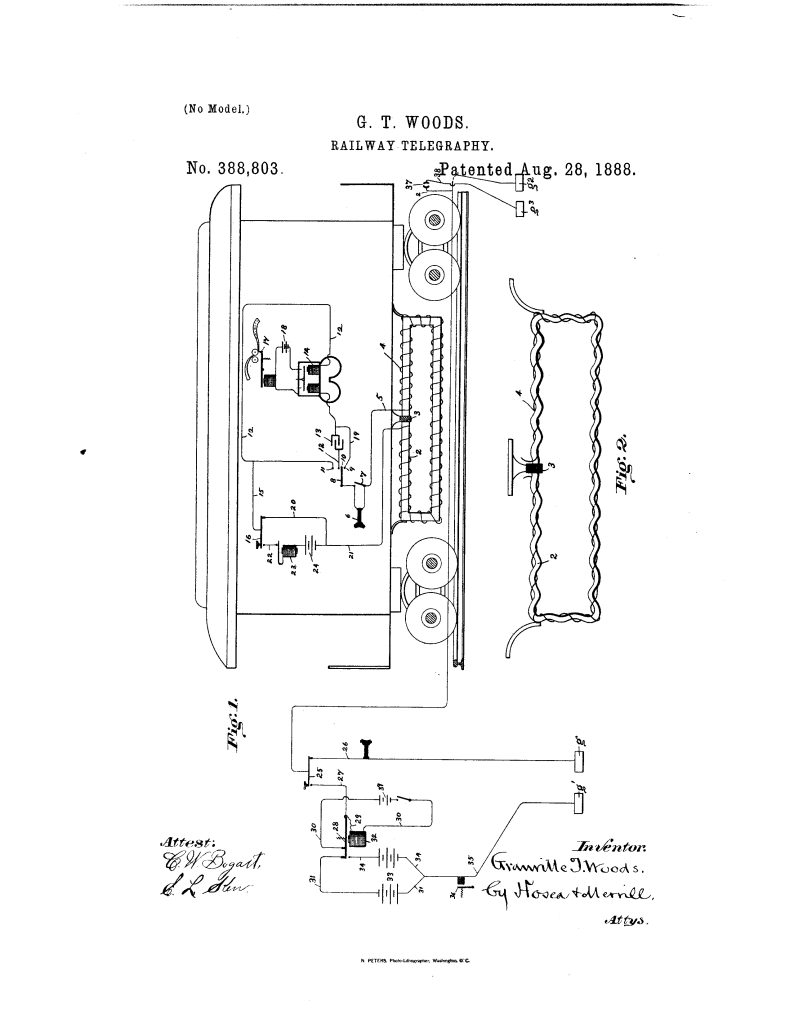
The patent by Granville T. Woods of Cincinnati, Ohio, describes a system for Railway Telegraphy (Patent No. 388,803, 1888). This invention is a pioneering form of induction telegraphy, allowing moving trains to communicate with fixed stations and other moving vehicles without a direct physical connection. Woods’s primary objective was to increase the strength and reliability of the electrical impulses sent through the air (induction) while simplifying the infrastructure required. His innovation centers on a uniquely shaped induction coil carried beneath the car and a sophisticated pole-changing circuit at the sending station.
Inventor Background: Granville T. Woods
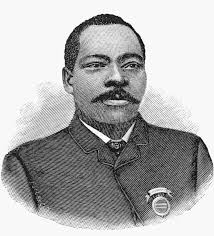
Granville T. Woods (1856–1910) was an incredibly prolific African American inventor, often referred to as the “Black Edison.” He held over 50 patents, many of which revolutionized the railroad industry. His invention of the Induction Telegraph (or “Multiplex Railway Telegraph”) was a major safety advancement, as it allowed dispatchers to track trains and permitted engineers to communicate in real-time, preventing many collisions. Woods famously successfully defended his patents in court against lawsuits from Thomas Edison, proving his independent genius.
Key Mechanical & Electrical Systems
The system bridges the gap between a moving train and a stationary line through electromagnetic induction.
1. The Spiral Induction Core (2)
- The Design: Beneath the railway car, Woods placed a bar of soft iron (2) bent into a spiral or waved line, formed into a large rectangle.
- Insulated Break (3): The ends of the bar do not touch; they are separated by an insulating block (3).
- Function: By bending the bar into a spiral, the copper wire (4) wound around it is brought into parallelism with the main line conductor on the ground. According to Ampere’s Law, this alignment ensures that the magnetic fields of both the moving coil and the fixed wire coincide, creating a much stronger signal than a standard straight coil.
2. The Railway Conductor (1)
- The Line: A single permanent conductor (1) is laid along the tracks, protected from the elements.
- Action: This wire carries the telegraph signals from the station. As the train moves over it, the induction coil (2) “picks up” the signal through the air via electromagnetic waves, translating them back into audible or printed messages for the train operator.
3. The Sending Station & Pole-Changer (28, 32, 33) (Key Innovation)
- Vibrating Armature (28): The station uses a circuit-breaker (32) that causes an armature to vibrate rapidly.
- Split Battery (33): This vibration alternates the connection between two halves of a battery.
- Function: This acts as a pole-changer, sending a signal made of rapid current reversals. These reversals increase the inductive power and clear the line of “static effects,” ensuring a crisp, clear message even over long distances.
4. The Car Circuit (13, 14, 6)
- Condenser (13) & Relay (14): The incoming signal is filtered through a condenser and sent to a relay, which can operate a printing device (17) to record the message.
- Telephone Shunt (6, 7): An operator can also use a telephone receiver (6) to listen to the signal directly by adjusting a switch.
Improvements Over Previous Telegraphy
| Feature | Standard “Wired” Telegraphs | Woods’s Induction Telegraphy |
| Connectivity | Required constant physical contact (brushes). | Wireless induction; no physical contact needed. |
| Reliability | Contact brushes wore out or sparked. | No moving contact parts; lower maintenance. |
| Signal Strength | Weak induction over distances. | Spiral core (2) maximizes electromagnetic coupling. |
| Static Control | Vulnerable to atmospheric interference. | Pole-changer keeps the line clear of static. |
Significance to Engineering and Transportation
Granville T. Woods’s railway telegraphy influenced the development of wireless communication and modern rail safety.
- The Foundations of Wireless: Woods’s use of electromagnetic induction to send data through the air was a critical step in the evolution of radio and wireless technology, appearing years before Marconi’s famous experiments.
- Enhanced Rail Logistics: By allowing trains to communicate while in motion, Woods solved the “blind spot” problem of early rail travel, directly leading to more efficient scheduling and collision prevention.
- Coil Geometry Optimization: His realization that the shape of a core could amplify inductive effects is a foundational principle in transformer and antenna design.
- Industrial Resilience: His ability to manufacture and sell these complex systems through his own company (Woods Electric Co.) proved the commercial viability of Black-led high-tech innovation in the 19th century.
