
Railway Telegraphy (Granville T. Woods, No. 373,383)
The patent by Granville T. Woods of Cincinnati, Ohio, describes a system for Railway Telegraphy (Patent No. 373,383, 1887). This invention represents a landmark in wireless communication, specifically utilizing static induction to transmit messages between moving trains and stationary telegraph lines. Woods’s system allowed the metal roofs of railway cars to act as “plates” in a massive condenser, enabling electrical impulses to “jump” through the air from the trackside wires to the moving train without any physical contact.
Inventor Background: Granville T. Woods
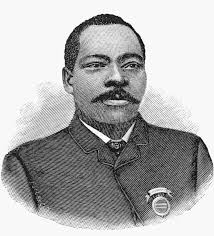
Granville T. Woods (1856–1910) was a prolific African American inventor often called “The Black Edison.” His work on railway telegraphy was driven by the urgent need for train safety; before his inventions, a moving train was effectively isolated, making it impossible for dispatchers to warn engineers of obstacles or track errors. By harnessing static conduction, Woods created a way to turn the existing network of telegraph poles into a broadcast system for moving vehicles. This invention was so foundational that it was eventually contested in a patent dispute by Thomas Edison—which Woods won.
Key Mechanical Components & Functions
The system is based on the principles of capacitance and induction, treating the air gap between the car and the wires as a dielectric.
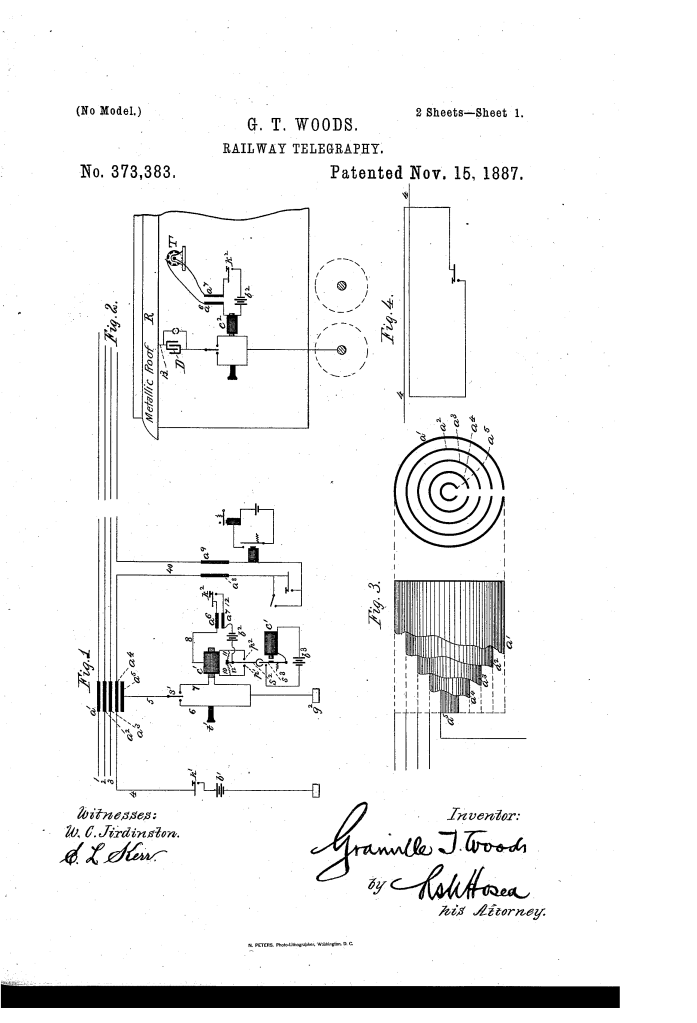
1. The Line Condenser Plates (a, 5)
- Interposed Plates: Woods placed metallic plates (a) into the existing telegraph lines along the tracks. These plates became part of the conducting line without breaking the electrical flow for standard telegraphy.
- Ground Plate (5): A second plate (5) is connected to the ground through signaling instruments.
- Function: These plates form a “condenser” (capacitor). They store a static charge that can be modulated into signals, which then propagate along the wires as a high-potential field.
2. The Concentric Cylindrical Condenser (Fig. 3)
- Design: A preferred form of the condenser consists of concentric curved plates with insulation in between.
- Function: This shape provides a greater “condensing surface” in a smaller area, allowing the telegraph lines to be charged more efficiently and successively, which prevents electrical “leakage” to the ground.
3. The Automatic Pole-Changer (s2)
- Oscillating Switch: A vibrating arm (s2) acts as a pole-changer in a local circuit.
- Vibration: It is automatically moved back and forth by an armature.
- Function: This rapidly reverses the battery current through an induction coil (c’). These rapid reversals create high-tension static impulses that can effectively leap across the gap to the car roof.
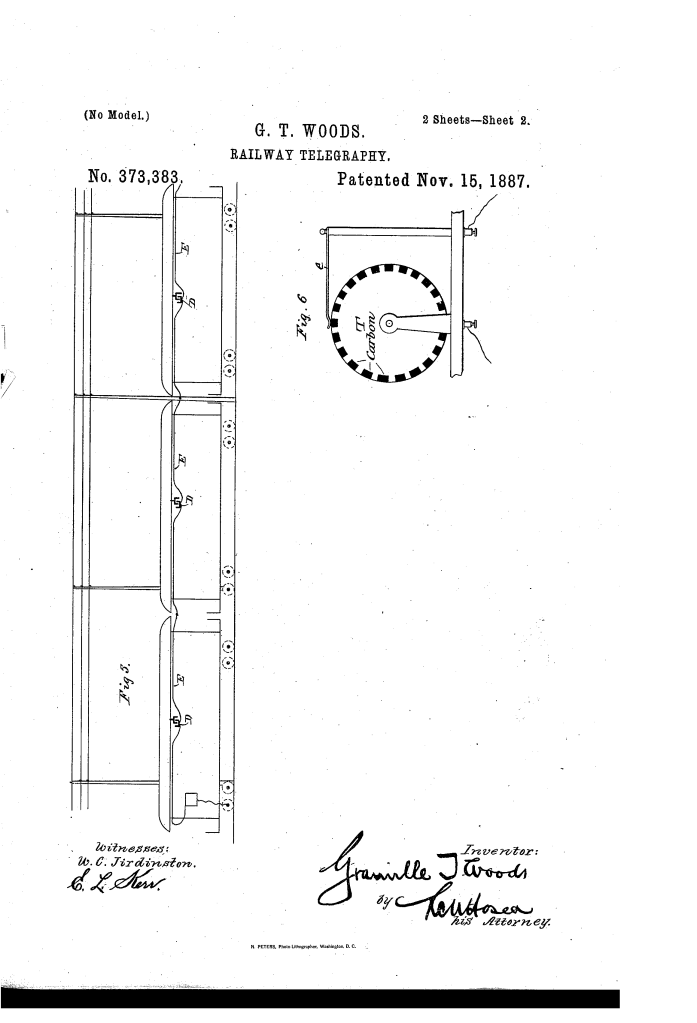
4. The Metallic Car Roof as an Antenna (R)
- The Receiver: The metal roof (R) of the railway car serves as a large induction plate.
- Common Conductor: In a train with multiple cars, each car’s roof is connected via a condenser (D) to a common conducting wire (E) running the length of the train.
- Function: This pools the “accumulated effect” of all the car roofs together, concentrating the signal at the operator’s receiving instrument (a telephone receiver).
The Signaling Logic: Buzzing and Silence
The system didn’t just send clicks; it sent sounds.
- Audio Signals: The rapid movement of the pole-changer created a continuous “buzzing” sound in the receiver.
- Morse Interpretation: The operator used a key (k2) to interrupt this buzzing.
- Result: Short bursts of buzzing were read as dots, and longer bursts as dashes. Periods of silence indicated the intervals between signals. This allowed for much higher accuracy than traditional sounders.
Improvements Over Existing Systems
| Feature | Standard “Voltaic” Telegraphy | Woods’s Static System |
| Connection | Required physical wire contact. | Wireless; uses static induction through air. |
| Mobility | Only worked at fixed stations. | Works on moving trains at any speed. |
| Interference | Static on lines was a “nuisance.” | Uses static as the primary medium for signaling. |
| Multi-Car Use | Signal lost in long trains. | Concentrates signals from multiple roofs into one device. |
Significance to Electronic Engineering
Granville T. Woods’s railway telegraphy influenced the development of radio frequency (RF) technology and mobile networking.
- Air-Gap Transmission: Woods proved that the atmosphere could be used as a medium for data transmission, a concept essential to the later development of radio.
- Signal Concentration: His method of linking car roofs to a common conductor is an early mechanical version of a phased array antenna, where multiple receptors combine their signals for better gain.
- Parallel Signal Paths: By utilizing existing telegraph wires as “conductors of case” without interfering with their primary use, Woods anticipated multiplexing—the ability to send different types of data over the same physical line.
- Static Shunts: His use of a condenser-shunt (a8, a9) to protect local keys from high-tension static is a direct precursor to modern surge protectors and static-discharge filters.
