
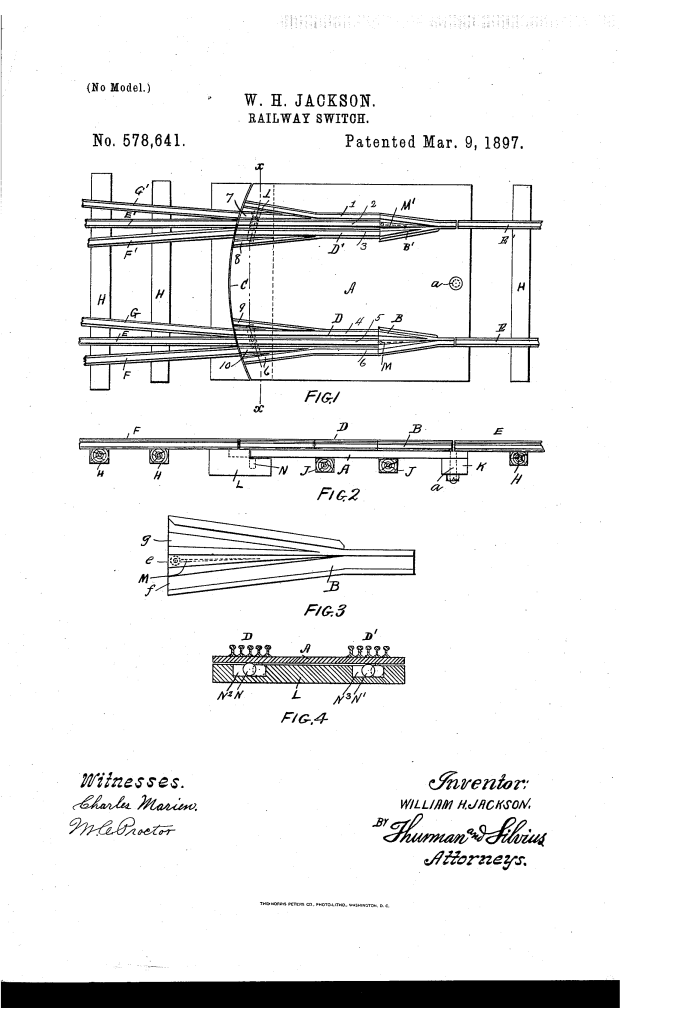
Railway-Switch (William H. Jackson, No. 578,641)
The patent by William H. Jackson of Indianapolis, Indiana, describes an improvement in a Railway-Switch (Patent No. 578,641, 1897). The primary object is to provide a safety-switch that is reliable for single or double sidings and which prevents railway-cars from being derailed should a switch be set for a wrong track. The design focuses on ensuring cars can always traverse the main track or leave a siding without issue, regardless of the switch setting.
Inventor Background: William H. Jackson
William H. Jackson was an inventor residing in Indianapolis, Indiana, a major railway center. His work is characterized by a focus on rail safety and automated mechanisms. This patent, along with his other switch designs, demonstrates his sustained effort to reduce operator error and physical damage on the American railway network by engineering fail-safe track components.
Invention and Mechanism
The invention is a large, pivoted switch table that integrates multiple safety-rails and spring-loaded frogs, creating a system that guides wheels correctly even when misalignment occurs.
1. The Pivoted Switch Table
- Table (A): The entire switch mechanism is mounted on a large, heavy metal table (A), which is pivoted at one end (on the head-block K) by a central bolt (
).
- Roller Support: The opposite (tail) end (C) of the table is supported by rollers () working in limited recesses (
).
- Function: The table swivels on the central pivot, and the rollers allow the tail end to travel transversely to align with the main track (E), the left siding (F), or the right siding (G).
2. Spring-Rail Safety System (Key Innovation)
The switch-rails are not rigidly connected but are integrated with multiple spring-rails designed to yield only for outgoing traffic.
- Switch-Rails (D, D’): The main movable rails are secured to the table (A).
- Bevel-Pointed Spring-Rails (7, 8, 9, 10): The rails have a complex assembly of tapered, spring-loaded rails (e.g., 7, 8, 9, 10) positioned against the main switch-rails.
- Function: These spring-rails are normally held pressed against the adjoining rail. They are designed to permit a wheel-flange to pass outward (from the siding to the main track) by yielding, but they prevent the wheel from passing in the other direction unless the table is correctly aligned.
- Result: This ensures a train can always leave a siding or traverse the main line without derailment, even if the main switch-table is set for the wrong track.
3. Safety Frogs
- Frogs (B, B’): The frogs (the intersection where wheels cross) are constructed with shifting points () that are pivoted and normally spring-held toward the outside of the track.
- Function: This spring pressure holds the frog point in the safest position but allows the wheel flange to pass through when leaving the turnout, minimizing the risk of the wheel hitting the point and derailing.
Concepts Influenced by This Invention
Jackson’s safety switch influenced subsequent railway design by pioneering complex mechanical systems to achieve fail-safe guidance, particularly utilizing spring tension to control traffic direction.
- Spring Switches (Point Control): The design’s reliance on spring-loaded, yielding rails (7, 8, 9, 10) to guide wheels and permit movement in one direction (outward from the siding) while resisting the opposite influenced the development of the modern spring switch . Spring switches are widely used today to allow trains to trail through a turnout without stopping to manually throw the switch, which then automatically returns to its original position.
- Integrated Safety Guidance: The concept of mounting multiple intersecting rails and safety mechanisms (frogs and spring-rails) on a single, unified, pivoted table influenced the design of modern special trackwork (e.g., diamonds and complex turnouts), ensuring all components move and remain aligned as a single unit.
- Minimizing Derailment Risk: The explicit goal of using mechanical means to prevent derailment when the switch is set for the wrong track influenced the design philosophy behind modern track components that include redundant safety features like guard rails and specially shaped frogs.
