
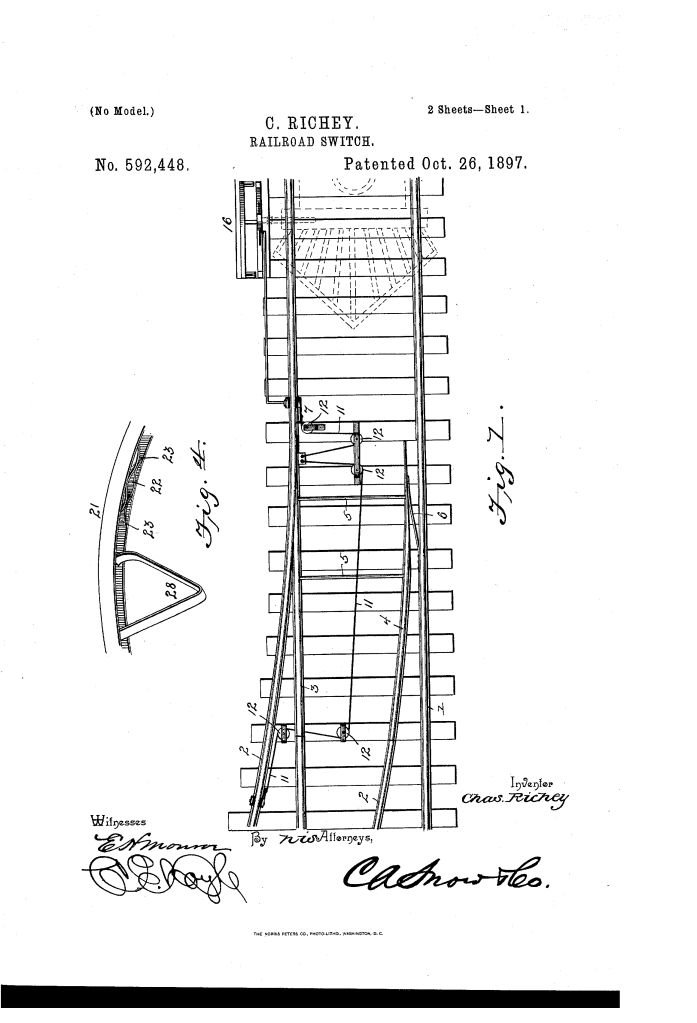
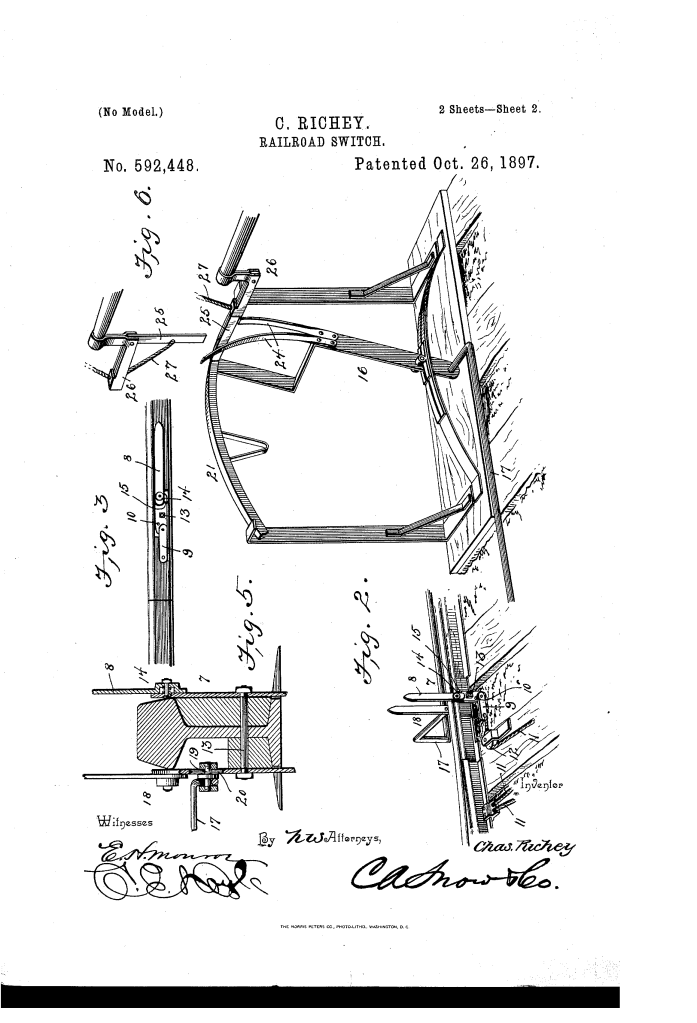
Railroad-Switch (Charles Richey, No. 592,448)
The patent by Charles Richey of Atlanta, Georgia, describes a novel railway switch mechanism (Patent No. 592,448, 1897).1 The primary object is to provide a construction that allows the setting of the switch-rails (for the main or siding track) to be accomplished exclusively by means carried by the rolling-stock (e.g., the locomotive), preventing manual or accidental adjustment.2
Invention and Mechanism
The system combines a track-side, wheel-actuated trip mechanism with a manually-set lever that is controlled remotely by an engineer on the locomotive.
1. Wheel-Actuated Trip Mechanism
- Pivotal Trip (7): A mechanism mounted on the main-track rail, having a long arm (8) in the path of the wheels.3 It is connected by flexible means (11) to the switch-rails (3, 4).
- Function (Setting to Siding): When a wheel hits and depresses the trip (7), it pulls the connection (11) and moves the switch-rails to open the siding-track (2).4 The trip is then returned to its upright position by a return spring (29).
- Reversibility/Non-Actuation: The long arm (8) is jointed (break-joint 14) above its fulcrum. When a train passes over the trip in the opposite direction, the joint folds, allowing the train to pass without affecting the switch-rails.5
2. Remote Control and Locking Mechanism (Engineer Actuated)
- Switch-Lever (16): This lever is connected to the trip (7) and used to position the trip for either main-track or siding-track operation.
- Actuating-Arm (25): A movable arm carried by the pilot of the engine (rolling-stock), controllable by the engineer via a cord (27).6
- To Permanently Open Main Track (Trip Disabled): The engineer uses the actuating-arm (25) to swing the lever (16), pulling the trip (7) into a horizontal position (Fig. 3). The lever is then held by a spring-loaded clasp (22), keeping the trip out of the path of passing wheels.7
- To Set for Siding Track (Trip Enabled): The engineer uses the arm (25) to move the lever (16) out of the clasp and compress a strong return-spring (28). When the arm slips off, the spring throws the lever (16) back to its starting position, setting the trip (7) upright in the path of the train’s wheels, allowing the first wheel to open the switch for the siding.
Historical Significance and the Inventor
- Automation for Safety: Richey’s system ensured that critical switch-setting could only be done by the train itself (via the trip) or by an authorized operator (the engineer) using the remote arm, restricting manual interference and increasing operational safety.
- The Engineer’s Remote Control: The invention is significant for providing the engineer with a remote, non-contact method of changing the track configuration ahead of the train, a step toward modern signal-based train control.
- The Inventor (Charles Richey): Charles Richey (sometimes noted as Charles V. Richey) was an African-American inventor who resided in Atlanta, Georgia, and later Washington, D.C. Besides his Railroad Switch patents, he also patented a Fire Escape bracket (1897) and a Combined Cot, Hammock, and Stretcher (1898), demonstrating versatility in safety and utility mechanisms.8 Historical records also note his connection to the U.S. Army’s 25th Infantry and his subsequent advocacy regarding the Brownsville Incident.9
Concepts Influenced by This Invention
Richey’s switch mechanism influenced subsequent railway and control systems by pioneering mechanical methods for remote actuation and fail-safe automation.
- Remote Mechanical Actuation in Rail: The core concept of using a deployable element carried by the rolling stock (arm 25) to mechanically interact with and adjust a track-side mechanism influenced the design of early train-based signaling and control systems, such as mechanical automatic train stop (ATS) systems that used physical arms.
- Single-Directional Trip Devices: The break-joint (14) on the trip to allow movement in one direction (train approaching) but prevent it in the other (train leaving) is a crucial mechanical principle. This concept is fundamental to directional track sensors, check valves, and detent mechanisms where movement or actuation must be restricted based on the direction of travel.
- Interference Locking for Safety: The use of the spring-clasp (22) to hold the lever (16) in the “safe” position (main track open) and require deliberate effort to move it influenced the design of safety interlocks in critical infrastructure, where the default state is the safest state, and manual intervention is locked out by a strong mechanical barrier.The following YouTube video further discusses Charles V. Richey’s life and his invention of the railroad switch: Black innovators day 18 – Charles V. Richey inventor of the railroad switch.
