
Quick Disconnect Valved Coupling (1960)
U.S. Patent No. 2,948,553, granted on August 9, 1960, to Vincent A. Gill and Harrison J. Britton, represents a major advancement in high-pressure fluid transfer technology. In the 1950s, aerospace and industrial systems required couplings that could be connected and disconnected instantly without leaking or losing line pressure.
The Gill and Britton invention introduced a dual-ball-valve system where both valves rotate in perfect synchronization. When disconnected, both sides are independently sealed; when connected, they create a “straight-through” flow with zero pressure drop.
The Mechanical “Phase-Sync” System
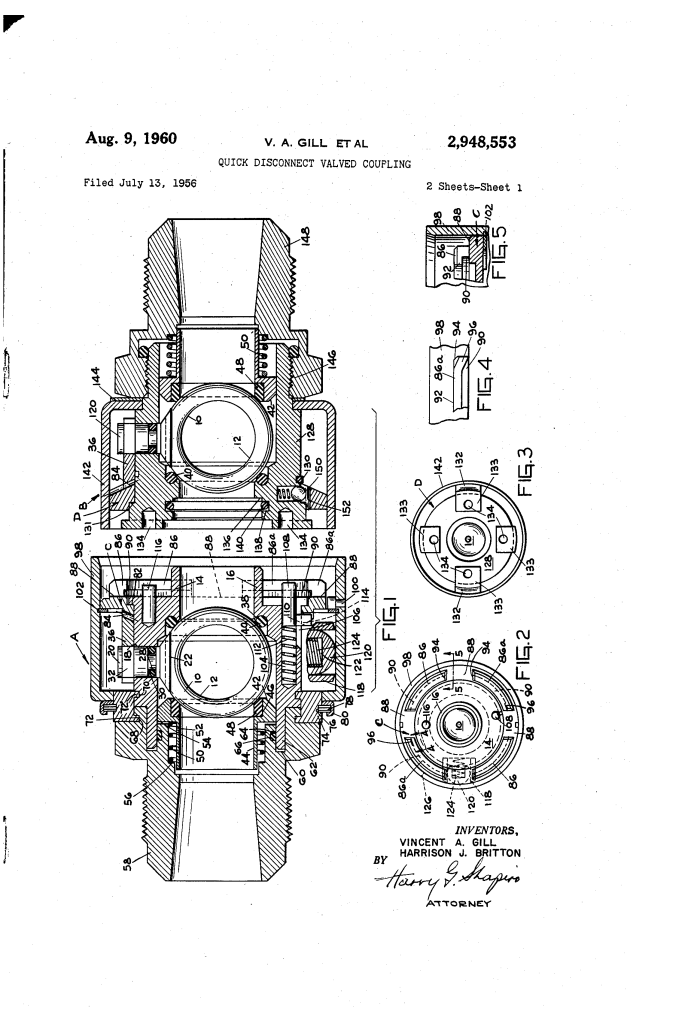
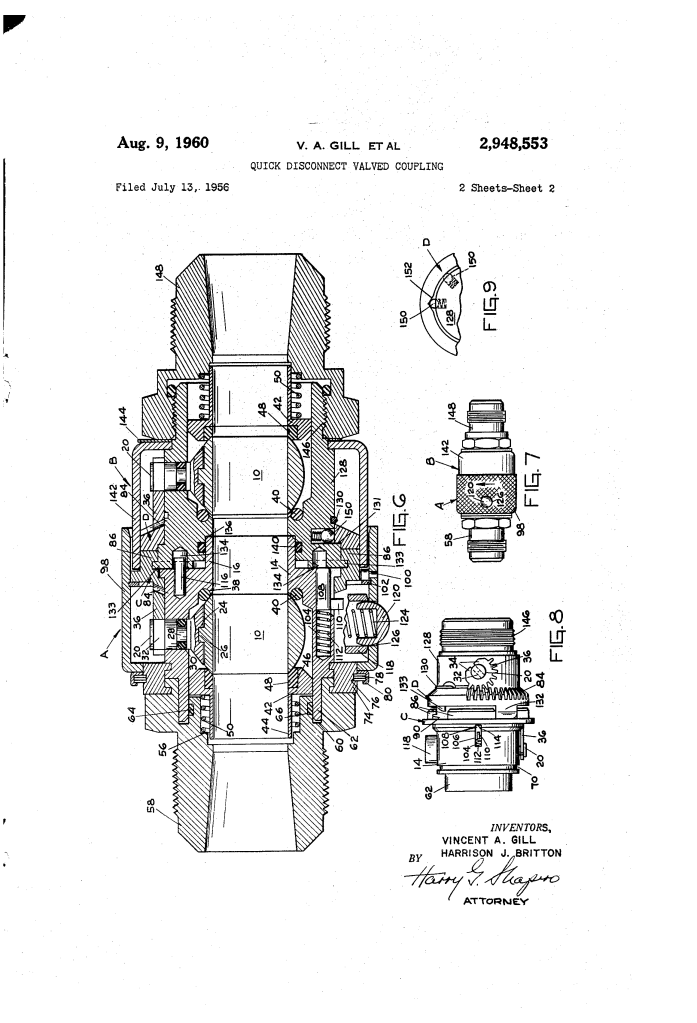
The coupling consists of two halves: Member A (Nipple) and Member B (Socket). Both contain a spherical plug valve (10) (a ball valve) with a bore hole (12) that matches the diameter of the connected hose.
1. The Gear Actuation
Instead of pushing the valves open (which is difficult under high pressure), this coupling uses a gear segment (36) attached to each valve shaft.
- Actuating Ring (C): When the operator rotates the external collar (98), a gear track on the ring engages the gear segment on the valve.
- Synchronized Opening: As Ring C rotates, it physically pushes against lugs (132) on the opposite ring (Ring D). This forces the valves in both the Nipple and Socket to rotate exactly in phase.
2. The Automatic Safety Locks
Safety was a primary concern for Gill and Britton. The coupling features several ingenious locking mechanisms:
- The Disconnected Lock: When the members are apart, a locking pin (108) is forced by a spring into a notch (114). This prevents the valve from being opened accidentally by someone tampering with the collar.
- The Connection Trigger: The locking pin is only depressed—and the valve unlocked—when the two coupling halves are physically pressed together.
- The Sight-and-Feel Indicator: Once the coupling is fully rotated (usually 45°), a lock ball (120) clicks into an aperture (126). This provides a tactile “click” and a visual signal that the line is fully open and secure.
Leak-Proof Sealing Technology
High-pressure couplings often fail at the seals. This patent introduced a “squeeze-fit” architecture:
- Teflon Sealing Rings (40, 48): The inventors used Teflon for its low friction and chemical resistance.
- Floating Valve Design: The ball valve is not fixed rigidly. It has a slight clearance (0.001″) in its drive tongue.
- Pressure-Assisted Sealing: When the valve is closed, a compression spring (50) urges the retainer ring against the ball, which in turn squeezes against the O-ring seat. The higher the fluid pressure, the tighter the ball is pressed against the seal.
Step-by-Step Operation
| Phase | Mechanical Action | Result |
| 1. Alignment | The Nipple (A) is inserted into the Socket (B). | The aligning pin (116) ensures the gear teeth are positioned correctly. |
| 2. Unlocking | Physical contact depresses the locking pin (108). | The internal gear system is now “live” and ready to rotate. |
| 3. Coupling | The operator twists the collar 45°. | The lugs lock the two halves together against “blow-apart” forces. |
| 4. Flow | The gears rotate both ball valves to the “open” position. | A clear, unobstructed tunnel is formed for the fluid. |
Technical Advantages
- Zero Pressure Drop: Because the bore is a “straight-through” tubing effect, the fluid doesn’t slow down or create turbulence.
- Swivel Connection: A special connection between the body and the hose fitting allows the coupling to be rotated without twisting (and potentially damaging) the high-pressure hose.
- Protection: The “rugged collar” and “rugged cover” protect the delicate gear segments from dirt, impact, and tampering.
About the Inventors and Assignee
Vincent A. Gill and Harrison J. Britton were engineers based in New Jersey. The patent was assigned to The Weatherhead Company of Cleveland, Ohio. Weatherhead was a titan in the fluid power industry (later acquired by Eaton Corporation), providing critical components for WWII aircraft and subsequent NASA space programs.
