
Ticket Punch with Clipping Receptacle (1893)
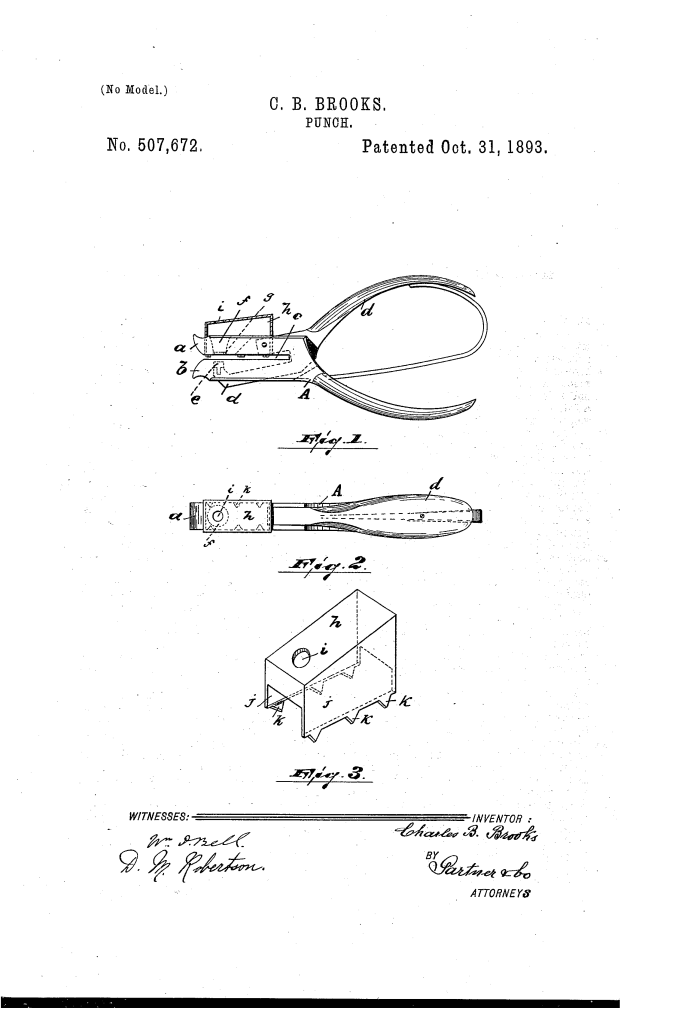
U.S. Patent No. 507,672, granted on October 31, 1893, to Charles B. Brooks, introduces a practical and clean improvement to the standard conductor’s ticket punch. Charles B. Brooks, an inventor residing in Newark, New Jersey, designed a simple yet highly effective attachment to manage the physical waste generated during daily transit operations.
This invention solved a distinct and messy problem of the late 19th-century transportation industry: how to stop thousands of tiny paper ticket clippings from scattering across the floors and furniture of passenger train cars, creating an untidy environment and an extra burden for cleanup crews.
The Innovation: The Removable “Clipping Box”
Traditional ticket punches cut a clean hole through a passenger’s paper ticket, but immediately dropped the loose scrap onto the floor. Brooks’s breakthrough was the development of a specialized, form-fitting receptacle or box (h) that mounts directly over the lower jaw of the punch to catch and store the paper clippings at the moment of impact.
Why the Integrated Receptacle?
- Cleanliness: It prevents paper clippings from flying wildly over the floor and furniture of the car, confining them securely within the device.
- Visibility: It features a clever, dual-aperture design that ensures the conductor can still see the ticket clearly through the tool before making a cut.
- Universal Adaptability: The box is engineered to be easily resized, adjusted, or entirely removed from the punch framework whenever a suitable time and place for emptying the waste is found.
Key Mechanical Components
The apparatus modifies the standard two-jaw pivot punch by introducing a perfectly aligned, nested collection system:
| Component | Function |
| Lower Jaw (A) | Divided into upper ($a$) and lower ($b$) portions by a horizontal slot ($c$) where the passenger’s ticket is inserted. |
| Upper Jaw ($d$) & Punch ($e$) | The lever-action arm containing the cutting tool that descends to stamp out the ticket shape. |
| Receptacle Box ($h$) | The storage housing that sits over the jaw, featuring an asymmetrical design that is wider at the rear to maximize clipping capacity. |
| Top Aperture ($i$) | A viewing hole built into the top of the box. It features a smaller diameter than the cutting hole below it, allowing the conductor to precisely line up the ticket before punching. |
| Securing Prongs ($k$) | Depending side-projections on the box that bend under the lower surface of the jaw to tightly clamp the receptacle in place. |
How the Apparatus Functions
The mechanical sequence ensures that clipping collection occurs automatically without interrupting the rapid workflow of a ticket collector:
- Alignment: The conductor inserts the paper ticket into the horizontal slot ($c$). Because the box aperture ($i$) is smaller and registers perfectly with the lower cutting edge ($g$), the conductor maintains full visual confirmation of the stamping site.
- Depression: The upper jaw ($d$) is pressed downward, forcing the removable punch section ($e$) into the conical hole ($f$) of the lower jaw.
- Shearing: The ticket is sheared cleanly against the cutting edge ($g$).
- Containment: Instead of falling to the floor, the resulting paper clipping is pushed directly into the sealed interior of the receptacle box ($h$), safely isolated at the rear of the device until it is intentionally emptied.
Historical and Scientific Impact
Charles B. Brooks’s ticket punch enhancement reflects the growing late-19th-century industrial focus on municipal cleanliness, efficiency, and ergonomics in public transit systems.
- Sanitation and Labor Efficiency: By containing the waste at the source, train and trolley companies dramatically reduced the labor hours required to sweep and clean passenger cars at terminal stations.
- Passenger Comfort: Keeping the floors free of thousands of slippery paper dots improved the overall aesthetic and comfort of travel during the golden age of rail.
- Simplicity of Retrofitting: Because the patent relied on simple, bendable securing prongs ($k$), transit lines could easily upgrade their existing inventories of ticket punches without purchasing entirely new, expensive machinery.
About the Inventor: Charles B. Brooks
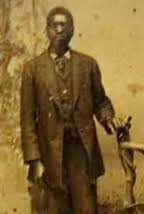
Charles B. Brooks was a notable late-19th-century African American inventor based in Newark, New Jersey. Operating during a prolific era of American mechanical innovation, Brooks is best known for his utility designs aimed at solving everyday operational inefficiencies. In addition to his improvements to the ticket punch, Brooks later received a major patent in 1896 for a mechanical street-sweeping truck equipped with rotating brushes, further cementing his legacy as an innovator dedicated to public sanitation and functional urban design.
Summary of Claims
The patent explicitly claims:
- The combination of a slotted punch jaw having a cutting edge and aperture with a removable receptacle placed over the upper end of the jaw.
- A receptacle featuring an aperture of smaller diameter than, and registering with, the primary cutting aperture.
- This specific geometric alignment allows for the inspection of the ticket prior to punching while simultaneously depositing and securing the punched-out portion within the attached box.
