
Automotive Protective Device | Curtis L. Bryant | Patent No. 1,999,171
The patent by Curtis L. Bryant describes a Protective Device for Automobiles (Patent No. 1,999,171), issued on April 30, 1935. This invention is an integrated, roof-mounted housing containing spring-loaded, retractable waterproof covers designed to encapsulate a vehicle’s body entirely when stationary.
The “Why”
In the early 1930s, automotive finishes (such as nitrocellulose lacquers) were highly susceptible to degradation from UV rays, “weather elements,” and industrial soot. Standard car covers of the era were bulky, separate tarpaulins that were difficult to fold, store, and transport. Bryant identified the “pain point” of inconvenient vehicle preservation, seeking to create a “compact device” that stayed attached to the car, allowing a single user to deploy full-body protection in seconds without struggling with loose, dirty fabrics.
The Inventor: Curtis L. Bryant
Curtis Bryant’s design reflects an engineering philosophy of Modular Integration. Writing during the Great Depression—a time when an automobile was often a family’s most prized and vulnerable asset—Bryant focused on the “harmony of design.” His work shows a keen awareness of the shift toward streamlining in 1930s industrial design, ensuring the housing unit matched the aesthetic of the car’s roofline rather than appearing as a clumsy afterthought.
Key Systems Section
Roof-Mounted Kinetic Housing
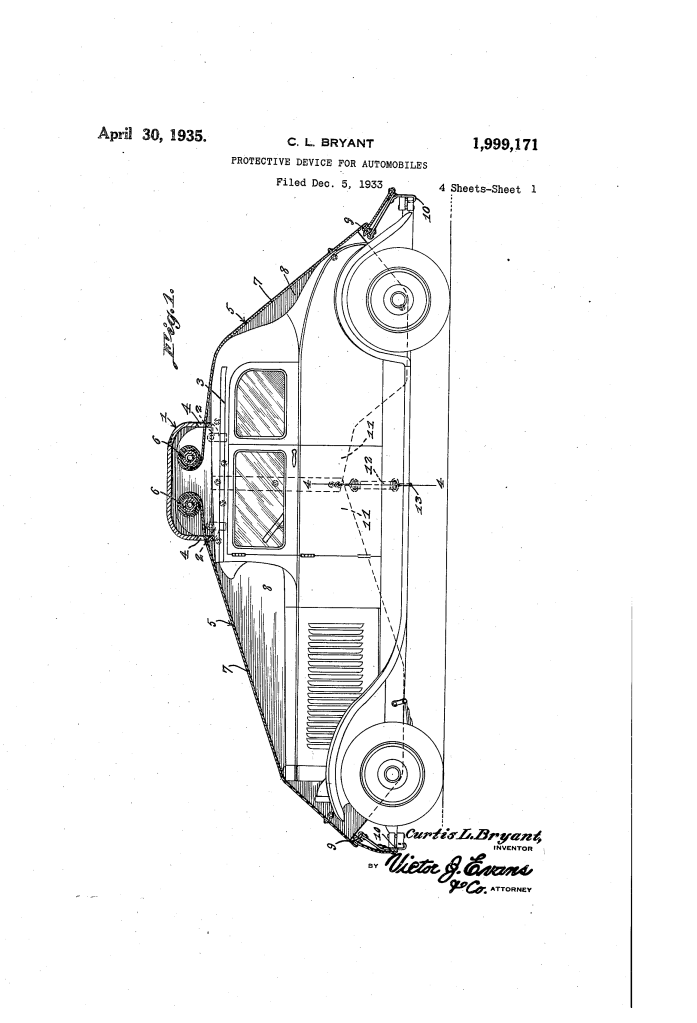
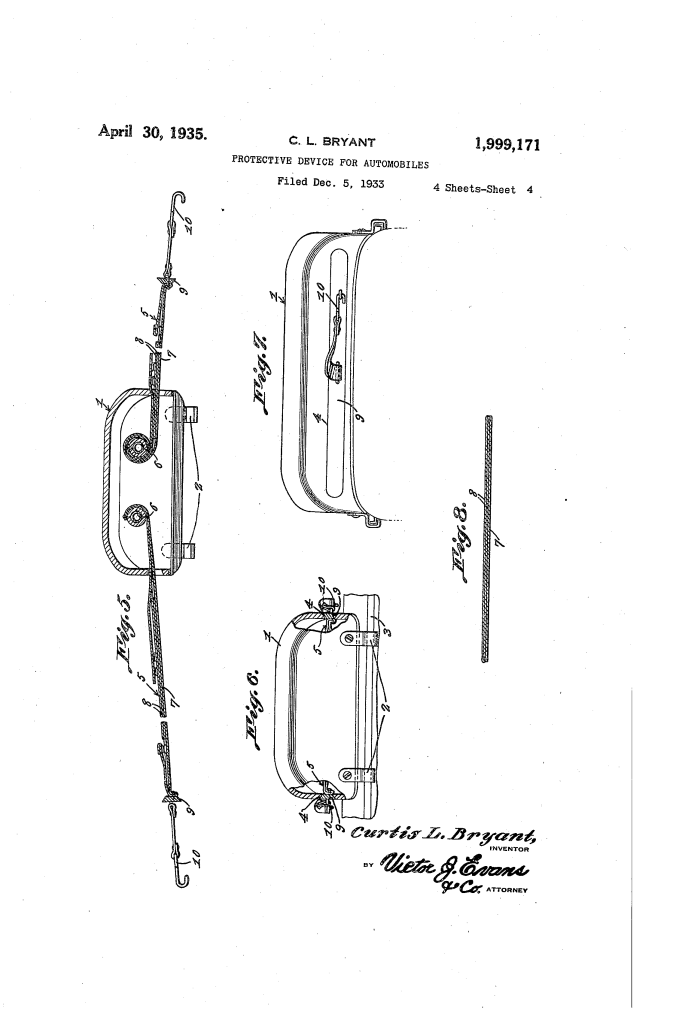
- Gutter-Engagement Rails: The housing ($1$) features securing elements ($2$) that slide directly into the automobile’s rain gutters ($3$). This allows for a “no-drill” installation that uses the car’s existing structural geometry.
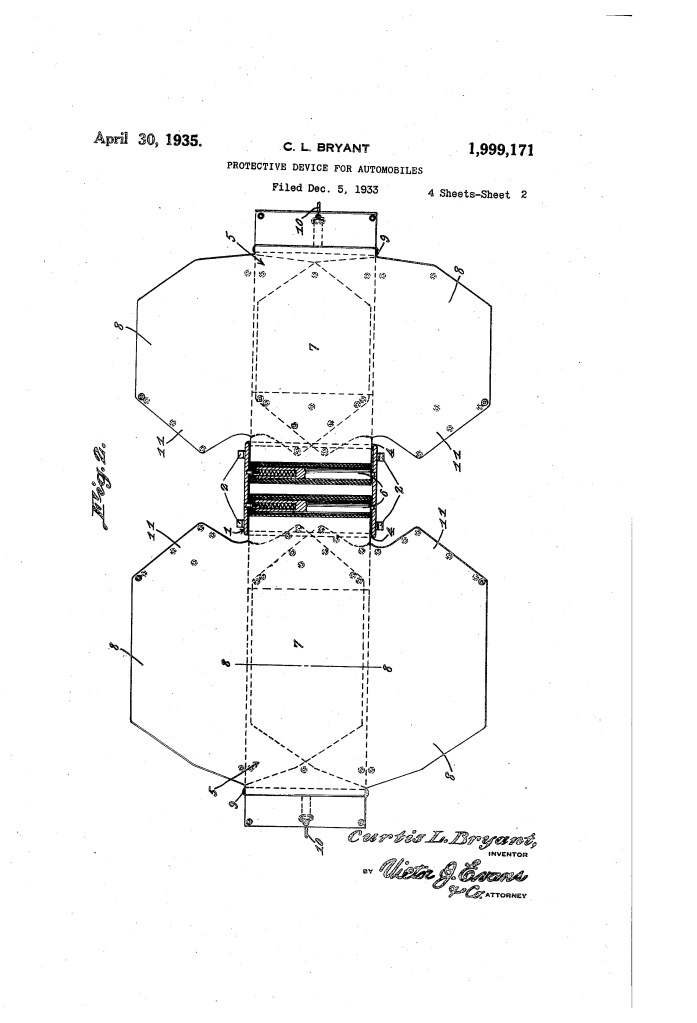
- Spring-Loaded Rollers: Inside the housing are two self-winding rollers ($6$). These use internal torsion springs to provide the “retractive force” necessary to stow the heavy waterproof material automatically.
Telescopic Cover Architecture
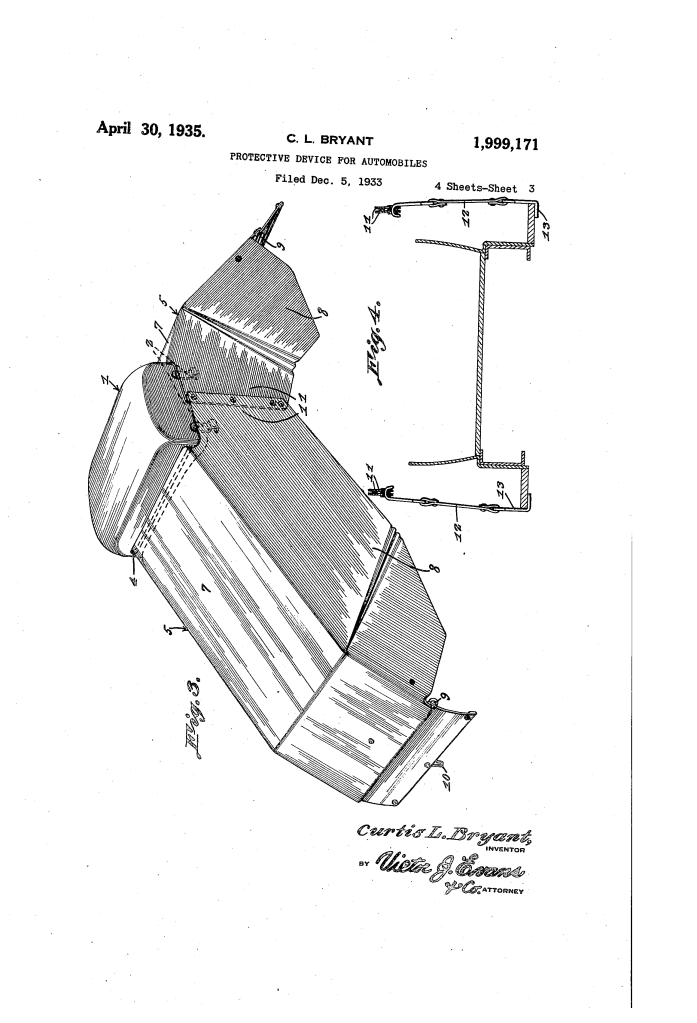
- Bilateral Deployment: The device uses two separate cover elements ($5$) that feed through front and rear slots ($4$). One covers the hood and front grille; the other covers the trunk and rear assembly.
- Flap-and-Fastener Logic: Each main strip ($7$) features side flaps ($8$). These are not merely draped; they are engineered with “separable fasteners” and anchoring straps ($12$) that tension the fabric against the running boards, creating a wind-resistant seal.
Mechanical Anchoring
- Bumper Tensioning: The free ends of the covers utilize hook elements ($10$) designed to catch the front and rear bumpers. This uses the car’s furthest longitudinal points to keep the fabric taut, preventing water from pooling on the roof.
Comparison: 1930s Vehicle Protection vs. Bryant’s Innovation
| Feature | Standard “Car Tarps” (1930s) | Bryant’s Integrated Device |
| Storage | Must be folded and kept in the trunk. | Permanently stowed in a roof housing. |
| Deployment | Requires two people to drape and center. | Single-user “pull-and-hook” operation. |
| Fitment | Loose-fitting; prone to wind-lofting. | Anchored to bumpers and running boards. |
| Maintenance | Fabric gets dirty and transfers grit to the trunk. | Self-contained; rollers keep the “clean” side protected. |
Significance
- Precursor to Modern Car Capsules: Bryant’s idea of a “fitted” protective environment is the direct ancestor to modern inflatable and retractable car shields.
- Early “Quick-Deploy” Tech: The use of spring-tensioned rollers for large-scale fabric deployment is a principle now seen in modern retractable awnings and commercial cargo covers.
- Aerodynamic Forethought: By designing the housing to “harmonize with the design of the automobile,” Bryant anticipated the modern trend of aerodynamic roof boxes (e.g., Thule racks).
