
Protective Appliance (Robber’s Trap), Harry & Mary E. Jackson, Patent No. 2,053,035
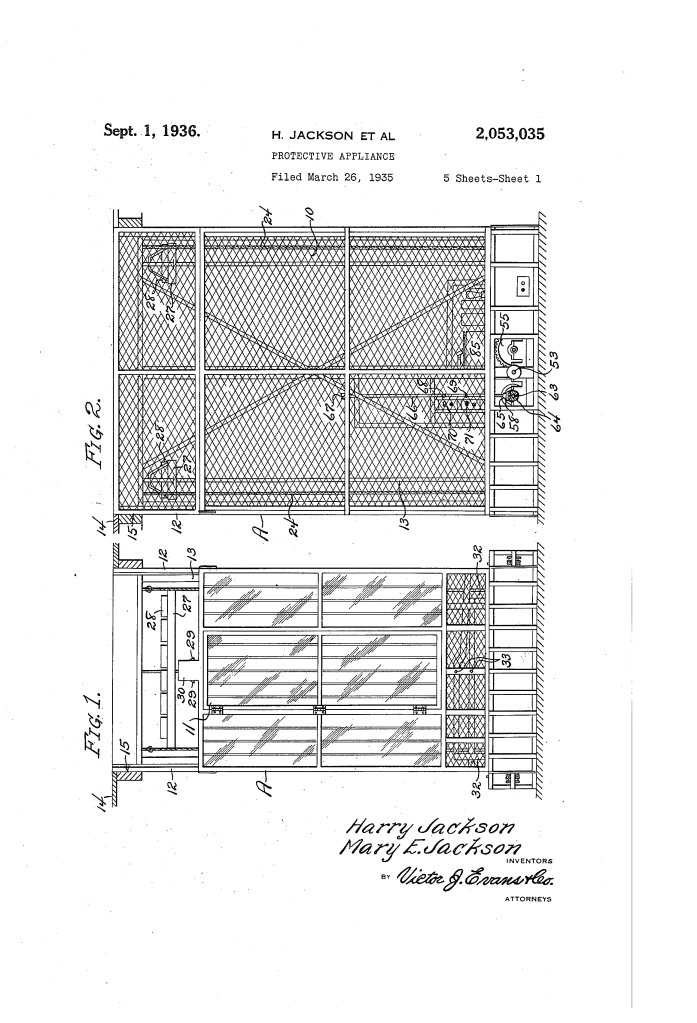
The patent by Harry Jackson and Mary E. Jackson of Harrisburg, Pennsylvania, describes a Protective Appliance (Patent No. 2,053,035), filed in 1935 and granted in 1936. This invention is an automated, electro-mechanical trapping system designed to be concealed beneath a floor—specifically in high-security areas like bank vaults—which, when triggered, instantly elevates a steel cage around an intruder, sealing them inside and simultaneously alerting the authorities.
The “Why”
During the mid-1930s, the United States was grappling with the “Public Enemy” era of the Great Depression, characterized by high-profile bank robberies and violent heists. Standard security relied almost entirely on human intervention (armed guards) or delayed police response. The Jacksons identified a critical pain point: the inability to safely detain a criminal on-site without risking the lives of employees or allowing the perpetrator to flee before help arrived. They sought to create a “fail-safe” mechanism that removed the human element of confrontation.
Inventor Section: Engineering Philosophy
Harry and Mary Jackson were a husband-and-wife inventing team whose work exemplifies the “Pre-Digital Automation” philosophy. Operating during the height of the Jim Crow era, Black inventors often focused on practical, high-utility industrial and safety solutions that could be marketed to large institutions (banks, government buildings) where their technical merit would be undeniable. Their engineering approach was rooted in redundancy and concealment; they believed a security system was most effective when it was invisible to the threat until the moment of activation.
Key Systems Section
1. The Overbalance Gravity Drive
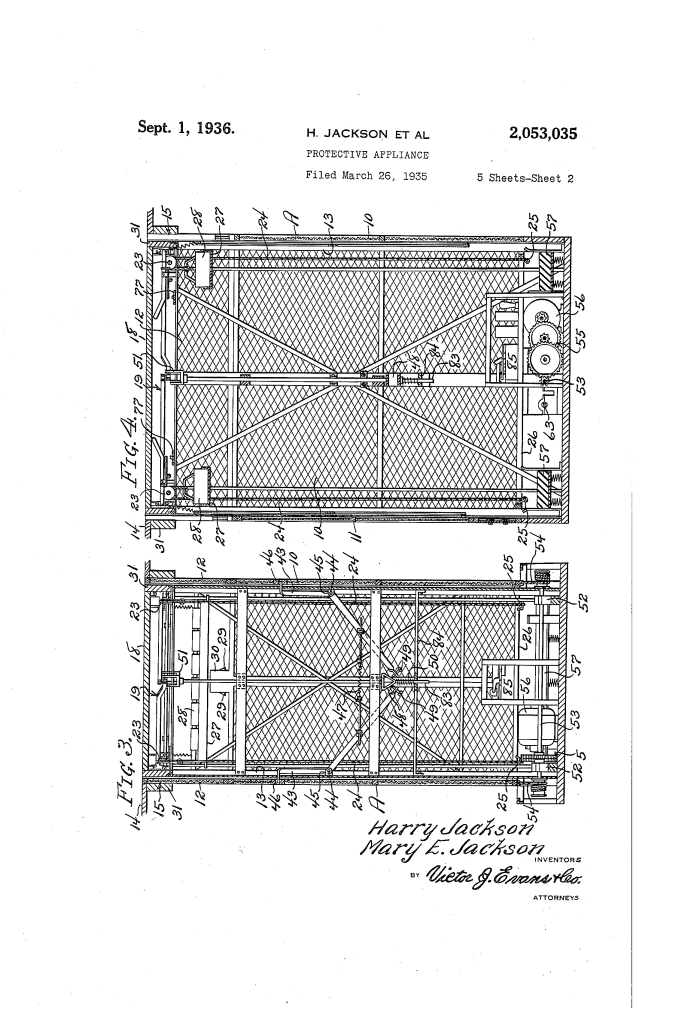
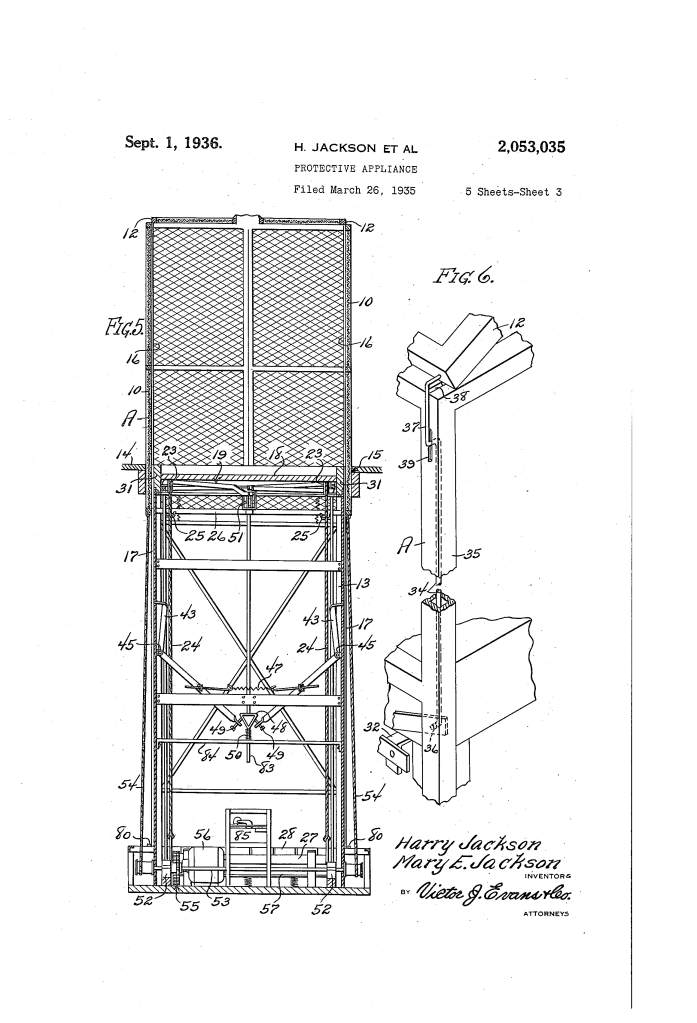
The primary ascent of the cage does not rely on a motor, which could be slow or cut by a thief. Instead, it uses a counterweight rack system.
- Mechanical Principle: Heavy weights (W) are suspended via cables over pulleys. When the locking members are released, potential energy is instantly converted to kinetic energy, snapping the cage upward faster than a human can react.
- Shock Absorption: Resilient “bumpers” are placed at the bottom of the housing to decelerate the weight racks at the end of their travel, preventing structural damage.
2. Depressible Platform Trigger (Differential Leverage)
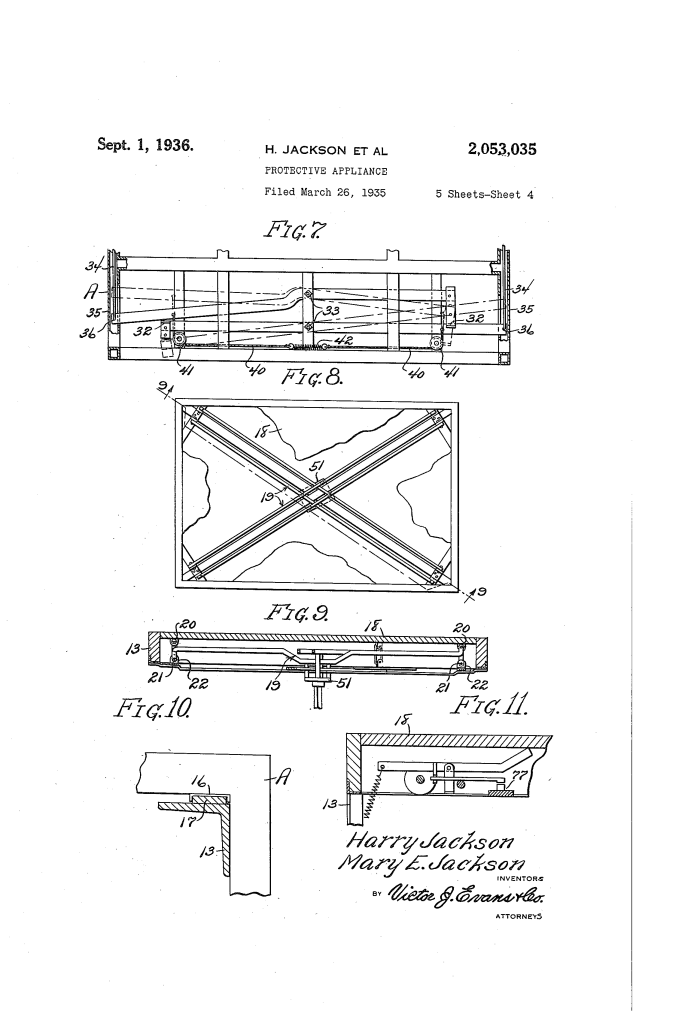
The “floor” in front of the vault is actually a floating tread platform mounted on a complex set of rocking X-levers.
- Function: This acts as a mechanical “and-gate.” The cage only releases if the platform is depressed and a secondary switch (operated by a teller) is closed, ensuring no accidental trappings of legitimate customers.
- Modern Term: This is a precursor to modern pressure-sensitive floor mats used in industrial safety zones.
3. Automatic Top-Closure Plungers
A major refinement in this patent is the mechanism that seals the “ceiling” of the cage as it rises.
- The Mechanism: As the cage reaches its maximum height, “trips” (mechanical strikers) hit fixed “abutments” on the floor frame. This force drives internal plungers upward, which flip the hinged trap doors closed.
- Locking: Once closed, spring-loaded latches engage, making it impossible to push the doors open from the inside.
“
4. Electro-Mechanical Integration
The system integrates a windlass shaft driven by an electric motor to reset the trap.
- Function: While gravity pulls the cage up, the motor is used to pull the cage back down into its concealed position after an arrest.
- Signal Circuitry: The system includes a “talking machine” (phonograph) interface designed to play a recorded alarm message to the police station.
Comparison Table: 1930s Security vs. The Jackson Trap
| Feature | Standard 1930s Methods | The Jackson Innovation |
| Response Time | Dependent on police arrival. | Instantaneous physical detention. |
| Visibility | Obvious bars or armed guards. | Total concealment beneath floor level. |
| Power Source | Manual or basic electric bells. | Hybrid: Gravity for speed, Electric for reset. |
| Containment | Open floor space; pursuit required. | 360° Enclosure including automated ceiling. |
| Alarm Type | Simple bell or siren. | Integrated Phonograph/Visual signal array. |
Significance
The Jackson Protective Appliance was a visionary step toward modern automated security. Its influence can be seen in:
- Modern “Man-Traps”: The precursor to the interlocking dual-door security portals used in modern data centers and high-security government wings.
- Automated Perimeter Defense: Early use of “if-then” logic where a physical trigger (pressure) initiates a sequence of mechanical events (containment + notification).
- Kinetic Energy Deployment: The use of counterweights for rapid deployment is a principle still used in emergency fire shutters and “drop-down” safety barriers.
