
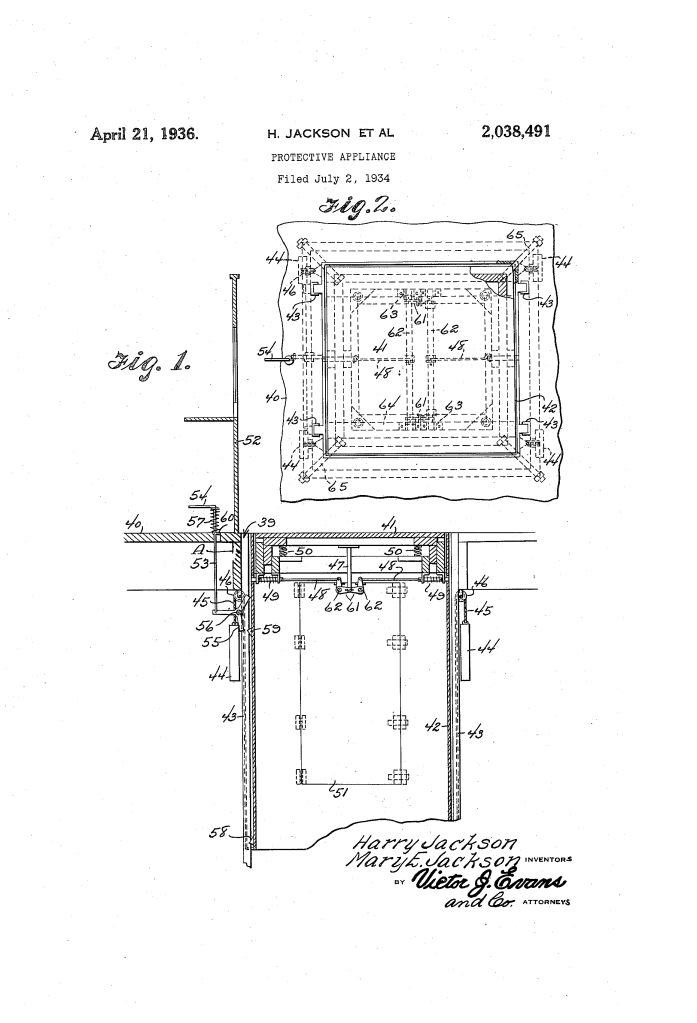
Protective Appliance | Harry & Mary E. Jackson | Patent No. 2,036,822
The patent by Harry Jackson and Mary E. Jackson of Harrisburg, Pennsylvania, describes a Protective Appliance (Patent No. 2,036,822), issued on April 21, 1936. This invention is a concealed, pressure-activated mechanical trap and signaling system integrated into the floor of a bank or similar institution, designed to physically capture or signal the presence of a person attempting a theft at an exchange window.
The “Why”
In the mid-1930s, bank robberies were a frequent and violent occurrence. Standard security measures were often visible, allowing “unscrupulous persons” to plan around them. The Jacksons identified the “pain point” of reactive security, seeking to create a device that was “concealed from view” and “automatic.” By removing the human element of hesitation and placing the trap beneath the floor line, the inventors aimed to neutralize a threat before a malicious person could “defeat the purpose” of the safety measure.
The Inventors: Harry & Mary E. Jackson
The Jacksons’ design reflects an engineering philosophy of Stealth Deterrence. Unlike the heavy, visible iron bars of the era, their work focused on the “novel construction” of hidden kinetic energy. Their patent demonstrates a deep understanding of mechanical linkage and counter-weight systems, prioritizing a “simple, strong, and durable” build that could be easily installed in existing floor structures. It stands as a unique example of civilian-led innovation in high-stakes security during the Great Depression.
Key Systems Section
Pressure-Triggered Release Mechanism
- Depressible Platform: The platform ($41$) is held flush with the floor by lifting springs ($50$). It remains “silent” and invisible until a threshold weight is applied.
- Mechanical Linkage: When stepped upon, a depending stem ($47$) activates a series of levers ($61$) on rock shafts ($62$). This action pulls back the spring-engaged latches ($49$) that hold the heavy trap casing in its “loaded” position.
Kinetic Vertical Capture
- Gravity-Drive Elevation: Once the latches are released, the trap casing ($42$) is rapidly pulled upward by heavy weights ($44$) connected via cables ($45$) and pulleys ($46$).
- Cage Confinement: The casing travels along vertical guides ($43$) until it completely surrounds the suspect on the platform, effectively caging them within a “trap casing” that stands above the floor plane.
The “Banker’s Governor” (Manual Override)
- Double-Jaw Dog: Inside the teller’s cage ($52$), an employee has a manual rod ($53$) with a grip ($54$). This controls a pivoting “dog” with double jaws ($55$).
- Two-Way Locking: The teller can use jaw $59$ to lock the trap down (to prevent accidentally trapping an innocent customer) or use jaw $58$ to lock the trap up once a suspect is caught, preventing them from forcing the casing back down to escape.
Comparison: Standard 1930s Bank Security vs. The Jackson Trap
| Feature | Standard “Bandit Barriers” | Jackson’s Protective Appliance |
| Visibility | Visible bars, glass, or armed guards. | Completely hidden beneath the floor line. |
| Activation | Manual (requires teller to hit a button). | Automatic (triggered by suspect’s weight). |
| Constraint | Passive (attempts to block access). | Active (physically traps the suspect). |
| Safety | High risk of “accidental” trigger. | Manual override “dog” prevents false arrests. |
Significance
- Precursor to Modern Sensors: The use of a “depressible platform” as a trigger is the mechanical ancestor to modern pressure-sensitive alarm mats.
- Integrated Architectural Security: The invention pioneered the idea of the building itself—specifically the flooring—acting as an active security component.
- Kinetic Counter-Measure: The use of gravity-fed weights ensured the trap functioned even during a power outage, a common occurrence and tactic during 1930s robberies.
