
Propelling Means for Aeroplanes (James Sloan Adams, No. 1,356,329)
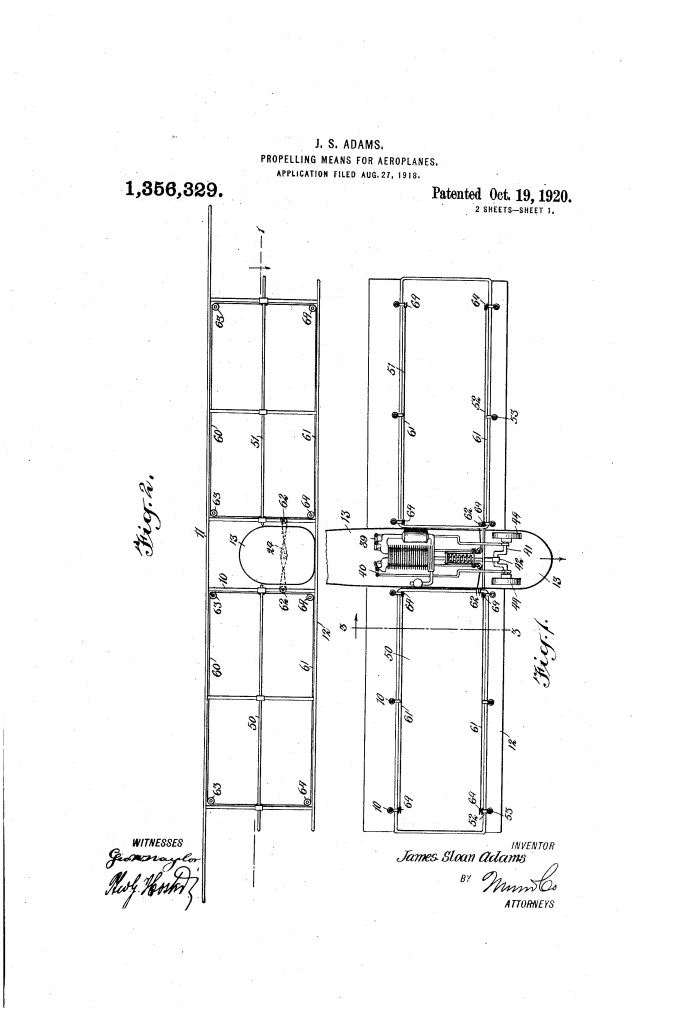
The patent by James Sloan Adams of New York, N. Y., describes a novel Propelling Means for Aeroplanes (Patent No. 1,356,329, 1920). This invention represents a radical departure from the standard propeller-driven aviation technology of the early 20th century. Adams’s design sought to eliminate the traditional “propelling wheel” (propeller) entirely, replacing it with a system that utilized the stored energy of a powerful coil spring and a pair of resistance planes to impart forward momentum through a series of rapid, pulsating impulses.
Inventor Background: James Sloan Adams
James Sloan Adams was an African American inventor based in Manhattan during the “Golden Age” of aviation. His 1920 patent reflects a period of intense experimentation in aerodynamics following World War I. While the aviation industry eventually standardized the internal combustion engine and propeller, Adams’s work focused on mechanical energy storage and reciprocating propulsion. His design demonstrates an advanced understanding of how to harness the “exhaust stroke” of an engine—usually considered wasted energy—to trigger a secondary propulsion event via a spring.
Key Mechanical Components & Functions
The propulsion system is built around a centrally mounted engine that compresses a spring rather than spinning a shaft.
1. The Internal Combustion Engine (20, 21)
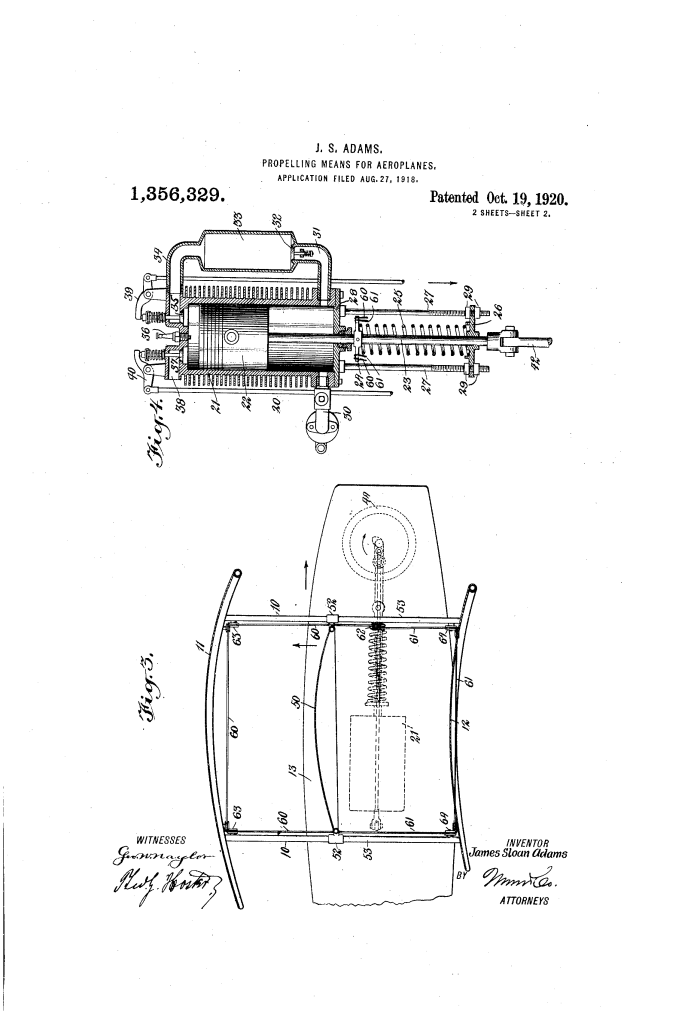
- Two-Cycle Motor: A motor (20) is mounted in the carriage with its cylinder (21) aligned lengthwise with the aircraft.
- Reciprocating Piston: As the piston (22) moves forward during its power stroke, it drives a piston rod (23) and a crosshead (24).
2. The Powerful Coil Spring (25) (Key Innovation)
- Energy Storage: A large coil spring (25) is positioned in front of the engine.
- The Power Stroke (Compression): During the engine’s power stroke, the forward-moving crosshead (24) crushes the spring against a fixed stop-plate (26).
- The Exhaust Stroke (Release): When the engine’s exhaust valve (37) opens, the pressure holding the piston forward is released. The compressed spring then suddenly expands, driving the entire mechanism backward relative to the aircraft’s frame.
3. The Resistance Planes (50, 51)
- Vertical Movement: Mounted on opposite sides of the carriage are two resistance planes (50, 51). They are designed to slide up and down on vertical posts (53).
- Flexible Connections (60): These planes are linked to the engine crosshead by cables and guide pulleys (62, 63).
- Flapping Action:
- Slow Upward Stroke: As the engine compresses the spring, the resistance planes are pulled slowly upward.
- Fast Downward Stroke: When the spring is released, it snaps the resistance planes downward at high velocity.
4. The Impulse Propulsion Effect
- Forward Thrust: Adams’s theory was based on the resistance of the air against these planes. Because the downward stroke (powered by the spring) is much faster and more forceful than the upward stroke, the net force—combined with the spring’s reaction against the fixed plate (26)—drives the aeroplane forward.
- Equilibrium: The resistance planes are parallel to the main sustaining planes (11, 12) to ensure the craft remains stable during these rapid mechanical pulses.
Comparison of Propulsion Technologies
| Feature | Standard Propeller Propulsion | Adams’s Spring Propulsion |
| Mechanical Action | Continuous rotation. | Intermittent pulsating impulses. |
| Primary Driver | Direct engine torque to blades. | Engine energy stored in a spring. |
| Air Interaction | Constant “screw” through air. | Oscillating resistance against vertical planes. |
| Energy Efficiency | High at constant speeds. | Seeks to utilize the “exhaust” cycle for thrust. |
Significance to Aerospace Engineering
James Sloan Adams’s propelling means influenced the concepts of impulse drive and unconventional aerodynamics.
- Energy Buffering: The use of a spring to “buffer” the explosive power of an engine and release it as a controlled mechanical event is a principle seen today in vibration dampening and certain types of pulsed propulsion.
- Ornithopter Logic: By using reciprocating vertical planes for thrust, Adams explored the physics of ornithopters (bird-like flapping flight), which remains a field of study for micro-air vehicles (MAVs).
- Part Consolidation: Adams attempted to make the engine’s piston serve as both a power source and a mechanical linkage for the thrust surfaces, an early attempt at reducing the number of rotating parts in an aircraft.
- Recoil Management: The idea of driving a machine forward by reacting against a fixed internal plate (the rebound of the spring) is a fundamental study in action-reaction physics (Newton’s Third Law) as applied to vehicle dynamics.
