
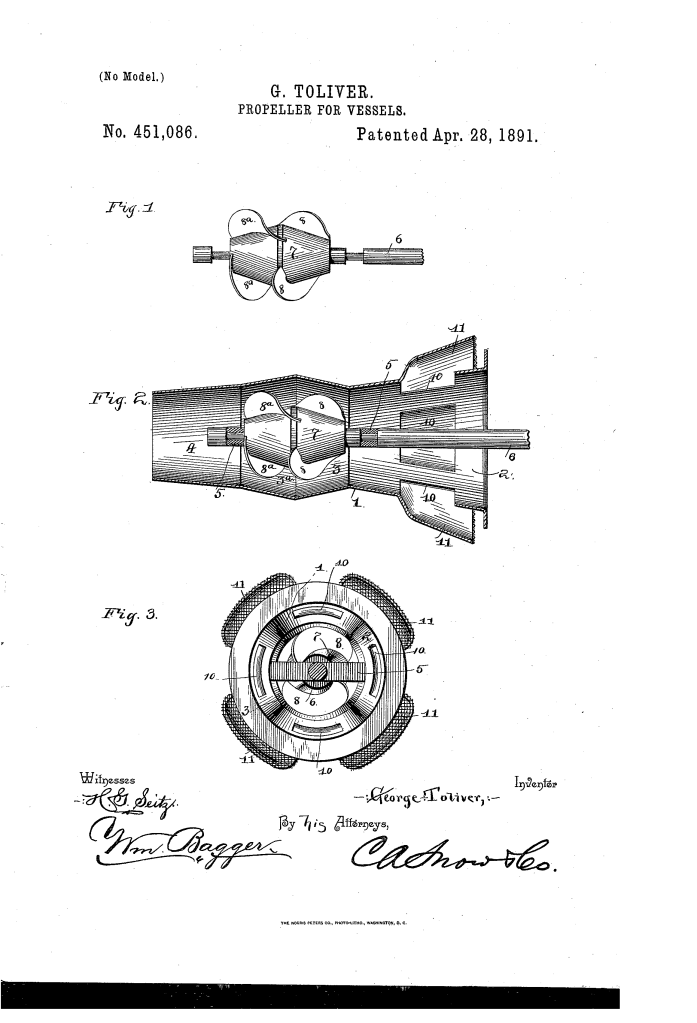
George Toliver’s patent for a “Propeller for Vessels,” No. 451,086, describes an innovative screw propeller designed to maximize efficiency and speed. Patented on April 28, 1891, the invention’s key features were a double-frustum-shaped hub with two sets of spiral propeller blades.
- Two-Stage Propulsion: The front set of blades was designed to force water backward and upward. The rear set of blades, positioned to break joints with the front set, would then intercept this water and propel it forcibly in a downward and backward direction. This two-stage action applied force to the water twice, which Toliver claimed would increase propulsion and efficiency.
- Enclosed Casing: The entire propeller was housed within a casing that had a flared, funnel-shaped front to scoop water in and a tapering rear to force it out. Side chutes with wire guards were also included to prevent debris from entering the propeller’s path.
Societal Impact
Toliver’s invention, while not as widely adopted as the standard screw propeller, represents an important piece of the history of naval engineering and the quest for efficiency in transportation.
- Improving on Existing Technology: The late 19th century was a period of intense innovation in marine technology, as engineers sought to improve steamships and other vessels. Toliver’s design was an attempt to improve upon the well-established screw propeller by addressing the problem of wasted energy and creating a more powerful, fuel-efficient system.
- A Focus on Efficiency: The patent highlights the growing importance of efficiency in an industrial economy where the cost of coal and other fuels was a major factor for shipping companies. Inventors like Toliver were keenly focused on designing machinery that could get the most out of every ounce of fuel.
- The Inventor’s Legacy: The provided information does not contain details about George Toliver’s life beyond his residence in Philadelphia. However, his work is an excellent example of the ingenuity that was applied to even the most complex engineering problems of the day.
