
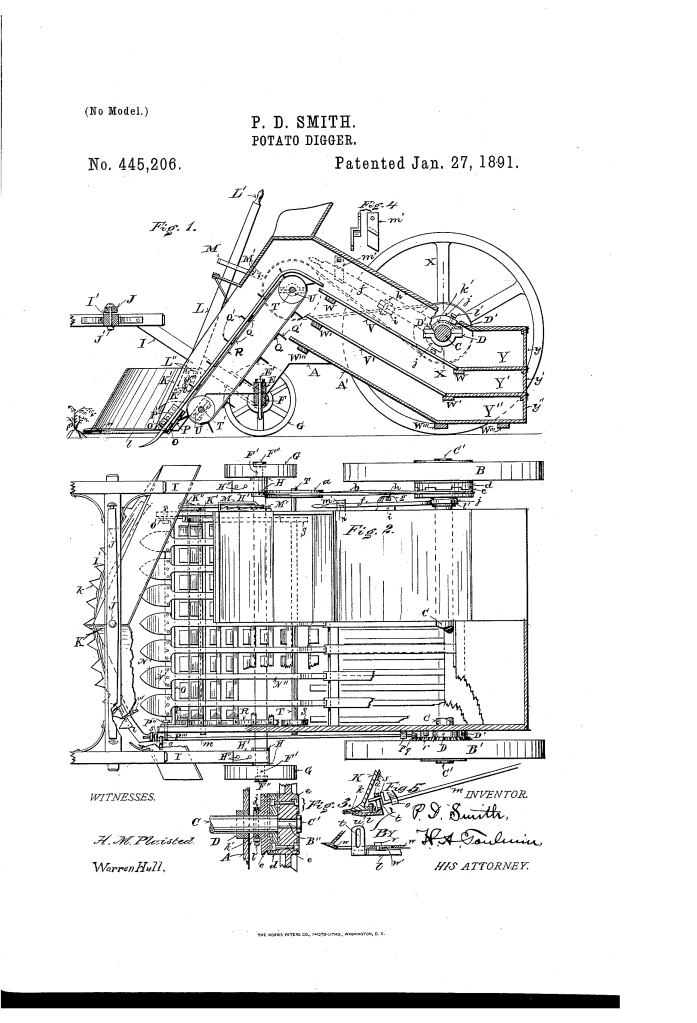
Potato-Digger (1891)
U.S. Patent No. 445,206, granted on January 27, 1891, to Peter D. Smith, introduces an advanced mechanical harvester designed to automate the labor-intensive process of digging, cleaning, and sorting potatoes. Smith, a resident of Springfield, Ohio, sought to move beyond the simple “plow-style” diggers of the era by creating a machine that not only extracted potatoes from the earth but graded them by size directly in the field.
The invention addressed the inefficiency of traditional harvesting, where potatoes were often left unharvested or damaged by hand tools. By integrating a multi-stage screening and compartment system, Smith’s machine allowed farmers to ascertain the value of their crop immediately and reduce waste.
The Core Innovation: Integrated Grading and Sorting
Unlike contemporary diggers that simply deposited potatoes back onto the dirt for manual pickup, Smith’s machine utilized a complex conveyor and gravity-fed screening system. This allowed the machine to perform three tasks in a single pass: clearing debris, elevating the crop, and sorting it into three distinct commercial grades.
1. The Pre-Clearing Scraper and Cutter
To prevent the machine from clogging, Smith designed an inclined scraper (K) at the very front. It featured a reciprocating cutter-bar (Z) driven by a crank-rod connected to the rear wheels. This mechanism acted like a miniature mower, slicing through potato vines and stalks before the digging shovels reached the hill.
2. The Shovel-Screener and Elevator
The potatoes are lifted by a series of inclined curved shovels (N). These shovels transition into long shanks that serve as a “dirt-screener,” allowing loose soil to fall through.
- The “Floats” (Q): A series of horizontal strips with projections (floats) move underneath these shanks via an endless belt.
- The Action: These floats reach up between the shanks to push the potatoes upward and backward, ensuring they reach the sorting screens without getting stuck.
The Sorting Process: Increasing Fineness
Once the potatoes are elevated to the top of the machine, they are discharged over the ends of the shanks onto a series of inclined parallel bars (screens).
| Stage | Mechanism | Result |
| Top Screen (V) | Wide-spaced bars | Large potatoes stay on top and slide into Compartment Y. |
| Second Screen (V’) | Narrower-spaced bars | Medium potatoes pass through the first screen but stay on this one, sliding into Compartment Y’. |
| Bottom Floor (A’) | Solid surface | Small “seed” potatoes fall through both screens and collect in Compartment Y”. |
Each compartment is equipped with a rear door (y), allowing the farmer to unload pre-sorted bags or crates directly from the machine.
Technical Components
- Adjustable Shovel-Bar (O): The depth of the cut can be adjusted by moving pins in the angle-plates (P), allowing the farmer to set the machine for different soil depths or to clear the ground entirely for transport.
- Clutch Mechanism (c, d): The driver can engage or disengage the entire elevating and sorting mechanism using a lever (f), which connects the motion of the rear wheel to the internal belts.
- Double Bolster Frame: The forward axle is pivoted to allow for easy turning at the end of crop rows, essential for a machine of this weight and complexity.
Historical and Agricultural Impact
Peter D. Smith’s invention was a precursor to the modern combine harvester. By the late 19th century, the industrialization of farming in the Midwest required machines that could handle higher volumes with less manual labor.
- Market Readiness: By sorting potatoes into grades (Large, Medium, and Small) instantly, farmers could command better prices and sell to different markets (e.g., premium table potatoes vs. livestock feed) without a secondary sorting process.
- Precision Engineering: The use of a reciprocating cutter-bar synchronized with the wheel rotation demonstrated a high level of mechanical sophistication for the 1890s.
About the Inventor: Peter D. Smith
Peter D. Smith was part of the vibrant community of inventors in Springfield, Ohio, which was a major hub for agricultural implement manufacturing in the late 1800s (home to companies like International Harvester’s predecessors). His focus on “rapid and profitable” harvesting reflected the era’s shift toward scientific farming and mechanical efficiency.
Summary of Claims
The patent explicitly claims:
- The combination of a vine-scraper, a series of inclined shovel-blades with dirt-screening shanks, and a traveling elevator with floats.
- The use of multiple inclined screens of increasing fineness positioned one below the other to sort potatoes by size.
- A compartment-box with separate doors for each grade of potato, integrated directly into the rear of the machine.
