
Potato Digger (1895)
U.S. Patent No. 537,953, granted on April 23, 1895, to Francis J. Wood, describes a mechanical horse-drawn harvesting implement designed to automate the labor-intensive process of harvesting potatoes. Wood, an inventor based in Greenville, Michigan, focused on optimizing how root crops were lifted from the soil and separated from dirt and debris.
This specific invention solved a persistent bottleneck in late 19th-century agriculture: how to efficiently dig up potatoes and completely separate them from clods of earth, heavy sod, and wet soil without clogging the machinery or damaging the crop.
The Innovation: The “Triple-Action” Independent Grate
Traditional potato diggers often dragged a static screen behind a plow share, which frequently clogged in heavy or damp soil. Wood’s breakthrough was an oscillating, multi-motion separator grate that acted completely independent of the main digging shovel.
By utilizing a clever system of mechanical linkages driven by the main wheels, the grate was engineered to move simultaneously in three distinct directions: forward, backward, and upward. This combined action actively kept the harvest moving along the line while clearing away clogs.
Why the Dynamic Grate Worked:
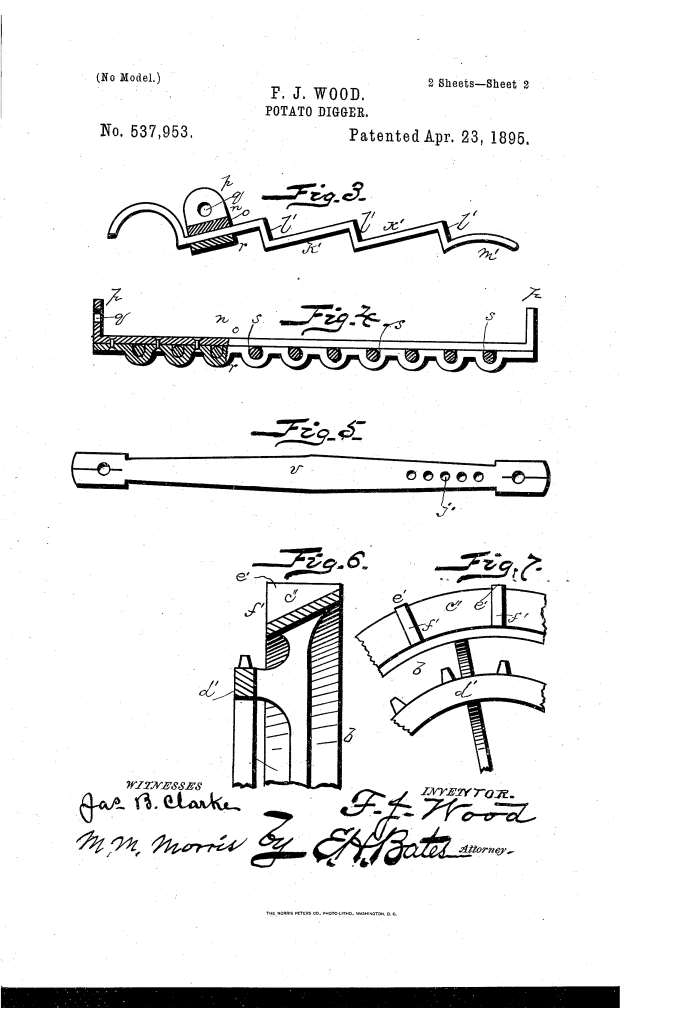
- The Offset Shoulders: The individual grate bars were not smooth; they featured built-in steps or “offsets” that created jagged shoulders. As the grate shook, these shoulders caught the potatoes and forced them backward, preventing them from sliding back toward the shovel.
- Adjustable Intensity: Wood included a series of adjustment holes in the rear linkage. By moving a single pivot pin, a farmer could change the motion from a gentle horizontal slide (for dry, loose soil) to a violent up-and-down shaking motion (designed to smash stubborn sod and break apart wet clay).
- Curved Discharge: The rear tips of the bars curved gently downward, allowing clean potatoes to roll smoothly off the machine and drop cleanly onto the soil surface for easy gathering.
Key Mechanical Components
The apparatus relies on a rugged, interconnected gear and lever system to turn forward momentum into a powerful cleaning action:
| Component | Function |
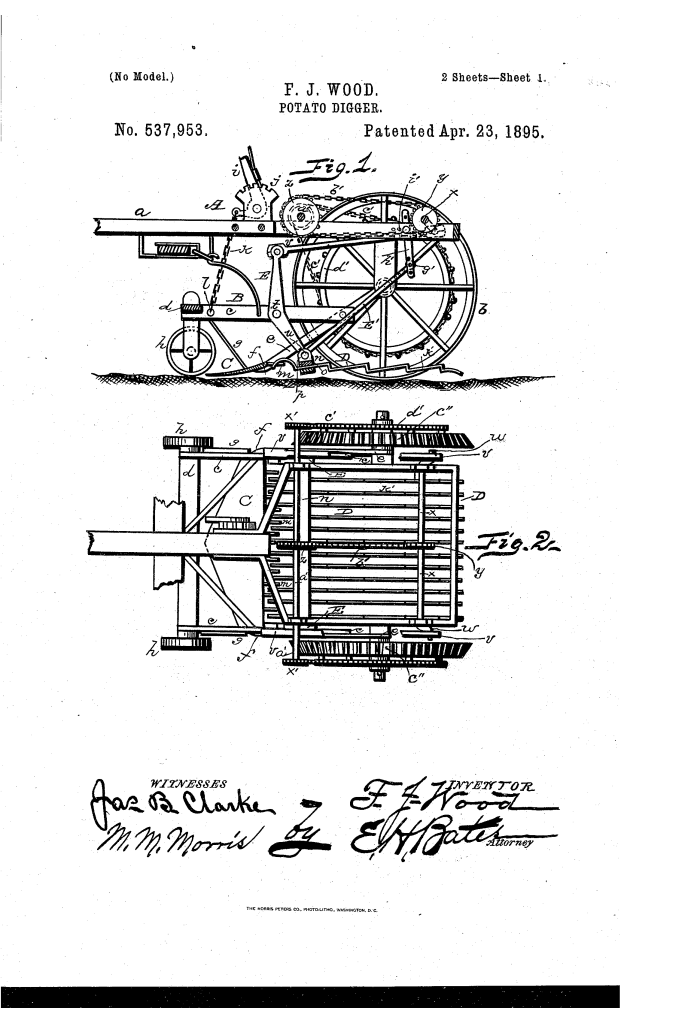
| The Shovel (C) | The leading plow share that passes deep beneath the potato hills, scooping up the crop along with a mass of earth. |
| Short Fingers (m) | Small stationary prongs on the rear of the shovel that guide the soil mass cleanly onto the moving shaker. |
| Angular Pivoted Bar (E) | A central bell-crank lever that translates the back-and-forth push of the drive system into the unique multi-axis movement of the grate. |
| The Pitman (v) | The drive rod connected to a transverse cranked shaft that pumps the entire shaker mechanism. |
| High-Grip Transporting Wheels (b) | Uniquely engineered drive wheels with outwardly inclined rims and custom cross-lugs. They are designed to ride high on dry soil but bite deeper into the ground to provide extra mechanical torque if the machine begins to slip. |
How the Apparatus Functions
The entire mechanical sequence is completely automated by the forward motion of the team pulling the machine:
- Depth Adjustment: The operator uses a hand lever, a toothed rack, and a heavy chain to raise or lower the front caster wheels, perfectly gaging how deep the shovel cuts into the potato bed.
- The Scoop: As the machine moves forward, the shovel cuts under the potatoes, forcing the dirt and crop upward and backward over the short guide fingers.
- Power Transfer: The rotating main wheels turn a dual-chain drive system, passing mechanical power through a front transverse shaft back to a rear cranked shaft.
- The Separation: The cranked shaft drives the pitman arms and angular levers, violently oscillating the grated frame. Dirt falls through the gaps between the bars, while the unique offsets step the potatoes upward and backward.
- The Deposit: Cleaned potatoes slide off the downward-curved ends of the grate bars, resting neatly on top of the turned earth for quick hand-picking.
About the Inventor: Francis J. Wood
Francis J. Wood was a practical mechanic and inventor from Montcalm County, Michigan. Operating during the height of the American industrial revolution’s agricultural boom, his work contributed directly to the rapid mechanization of midwestern farming. By focusing on adjustable machinery, Wood ensured that a single piece of equipment could successfully operate across the unpredictable and diverse soil profiles of the American heartland.
Summary of Claims
The patent explicitly claims:
- The combination of a digging shovel with a trailing separator grate operated dynamically by a central pivoted angular bar and driving pitman.
- An adjustable rear linkage featuring an inclined bar and an adjustable short arm to alter the trajectory and intensity of the shaking motion.
- A dual-chain drive mechanism running off both main transporting wheels to deliver balanced, double-sided mechanical power to the internal shafts.
- A specialized traction wheel design featuring an outwardly inclined rim face and horizontal biting lugs to maximize torque in adverse field conditions.
