
Postmarking and Canceling Machine (1897)
U.S. Patent No. 585,075, granted on June 22, 1897, to William Barry, describes a high-speed, automated postmarking and stamp-canceling machine engineered to handle mail matter of diverse sizes and thicknesses. William Barry designed this mechanical system to solve high-volume mail bottlenecks in post offices during the late 19th-century boom in postal communication.
This invention resolved several persistent mechanical failures in early automated mail processors: envelope jams caused by feeding multiple letters at once, smearing or tearing of envelopes of varying thicknesses, and the slow, labor-intensive manual sorting and facing of incoming mail.
The Innovation: The Synchronized Feeder, Separator, and Printing Couple
Barry’s machine introduced a continuous automated workflow that combined a dedicated sorting-table facing device, an aggressive needle-point separator, and a dynamic impression roller that adjusted pressure on the fly.
Why These Innovations Mattered:
- Positive Separation: A friction-feed finger system wrapped in replaceable emery cloth, paired with hooked supplemental fingers, prevented multiple letters from feeding simultaneously without tearing thin paper.
- Needle-Point Grasping: An independently segmented biting feeder gripped letters by their front leading edge rather than pushing them from the center, eliminating crumpled or doubled-up envelopes.
- Smear Prevention and Dynamic Pressure: The impression roll maintained a tiny clearance to prevent ink transfer when running empty, while a cam-operated mechanism surged pressure only at the exact instant the printing characters contacted the envelope.
Key Mechanical Components
The machine integrates multiple coordinated assemblies to move, cancel, and restack mail smoothly:
| Component | Function |
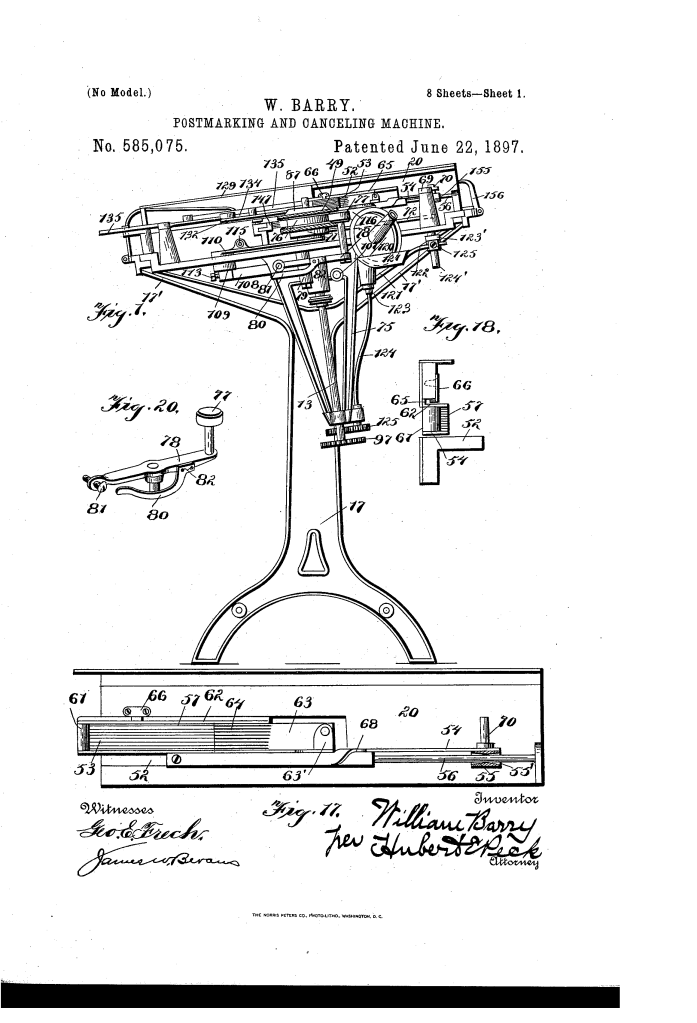
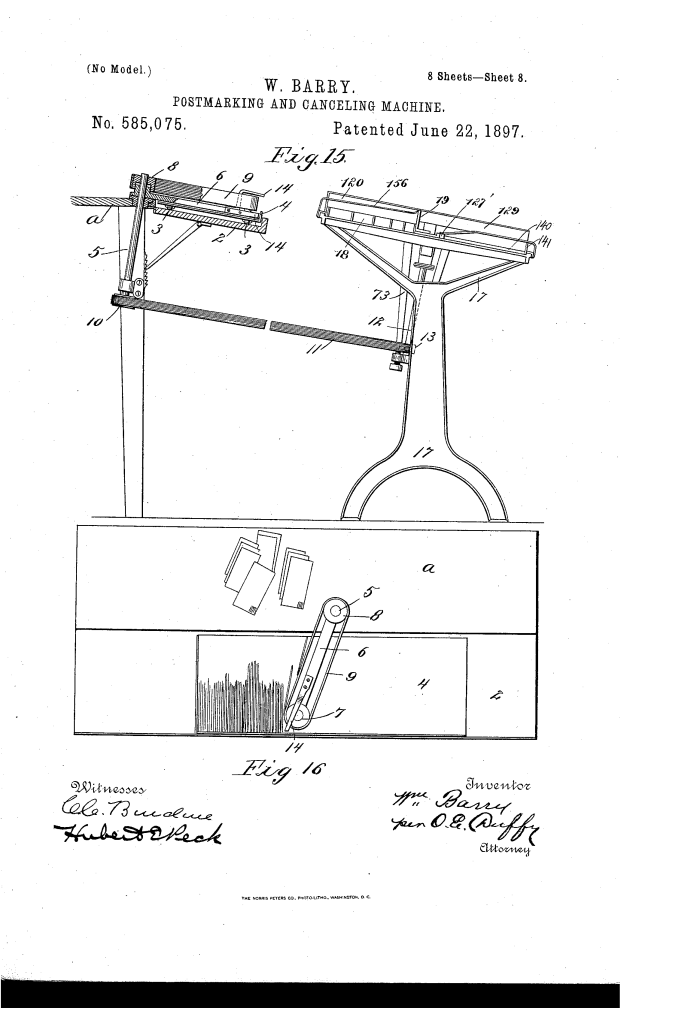
| Facing and Stacking Belt (9) | An inclined traveling belt on the sorting table that automatically aligns and packs faced letters into a removable tray. |
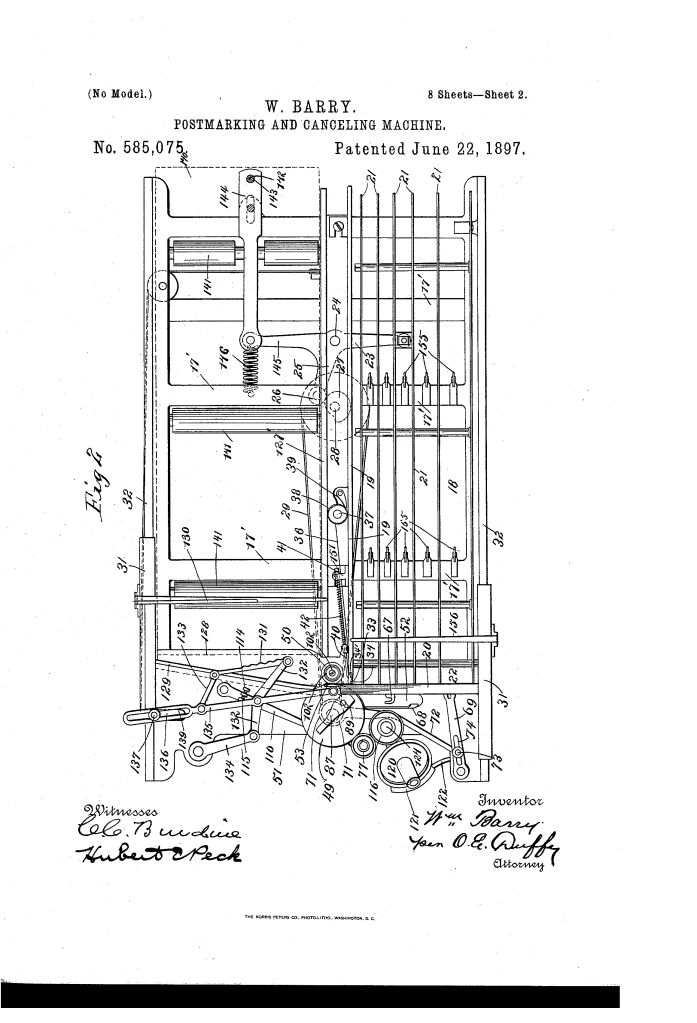
| Reciprocating Floor Rods (21) | Cam-driven longitudinal floor rods that step forward slowly to advance the mail stack and slip back quickly without dragging letters in reverse. |
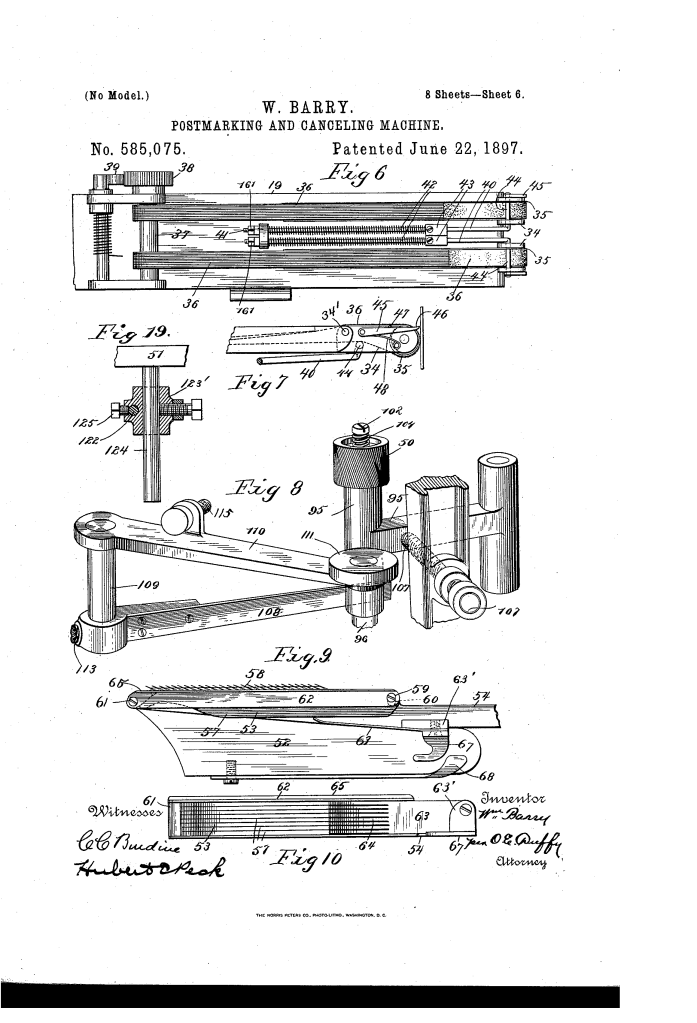
| Needle-Point Feeder Plates (57) | A series of independent spring-loaded plates tipped with fine needle points (58) that conform to uneven envelope surfaces. |
| Emery Separating Fingers (34, 35) | Spring-tensioned friction blocks surfaced with spool-fed emery cloth (36) to hold back downstream letters. |
| Hooked Auxiliary Finger (45, 46) | A pivoted, spring-loaded hooked finger that catches the leading edge of trailing letters to ensure single-item feeding. |
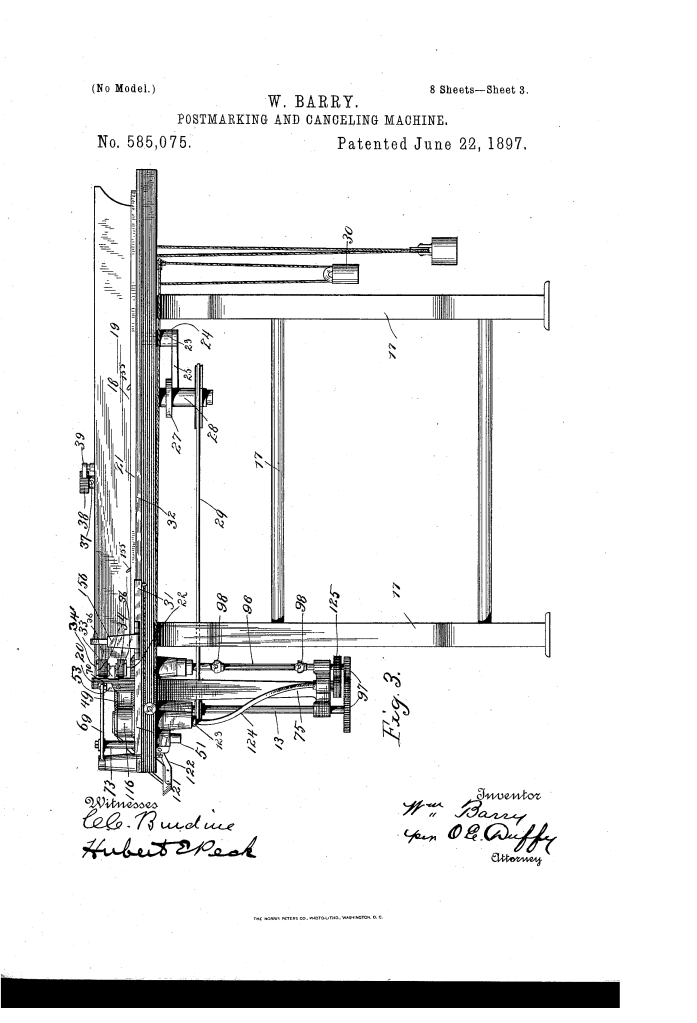
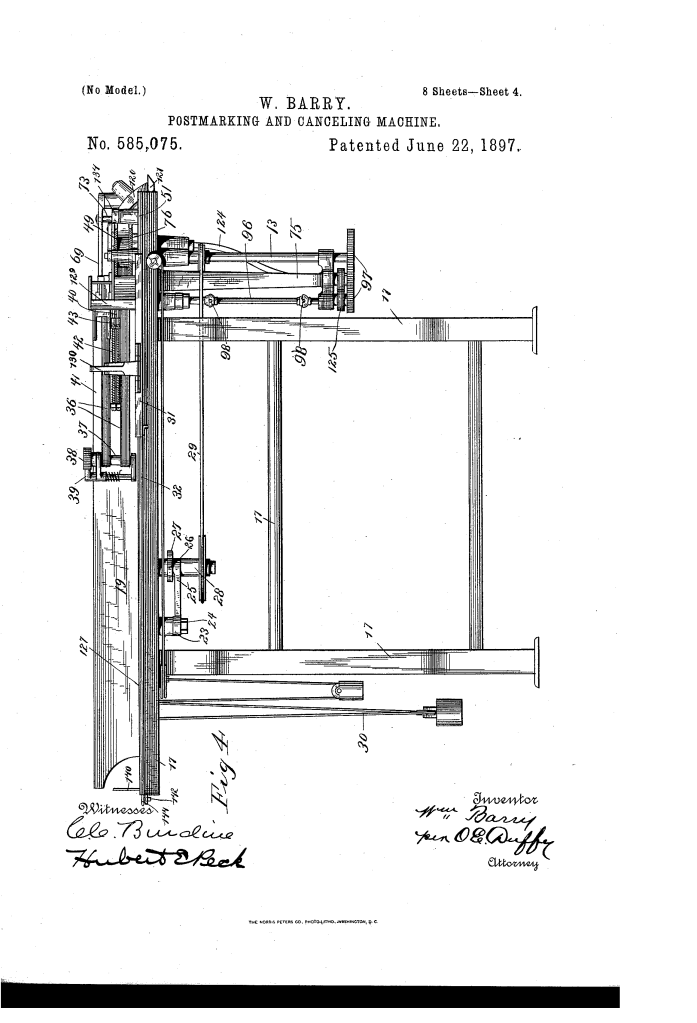
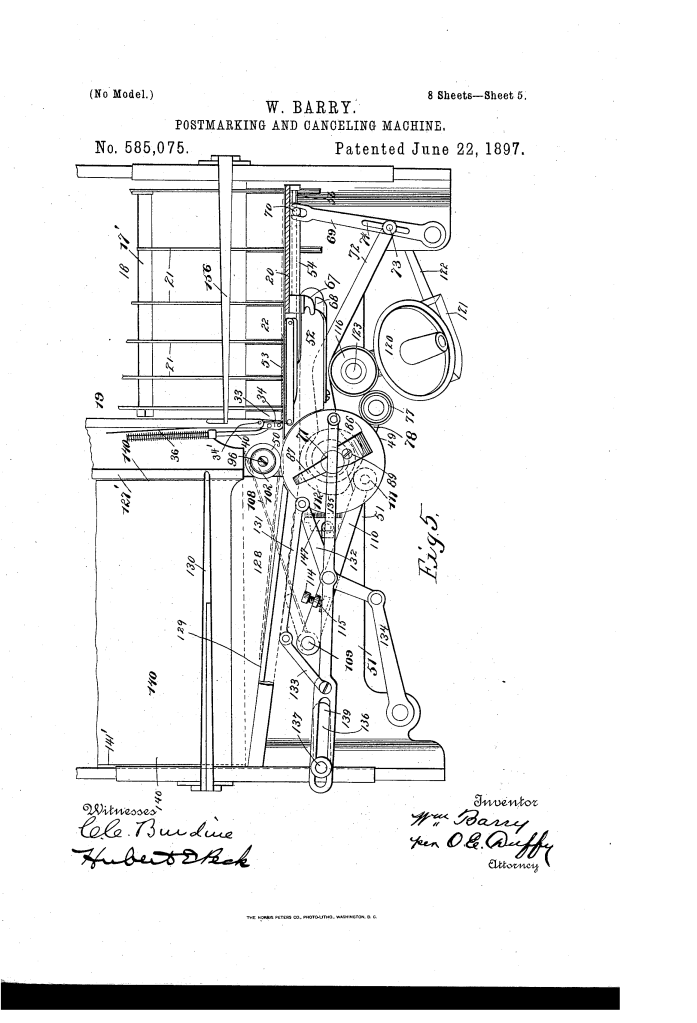
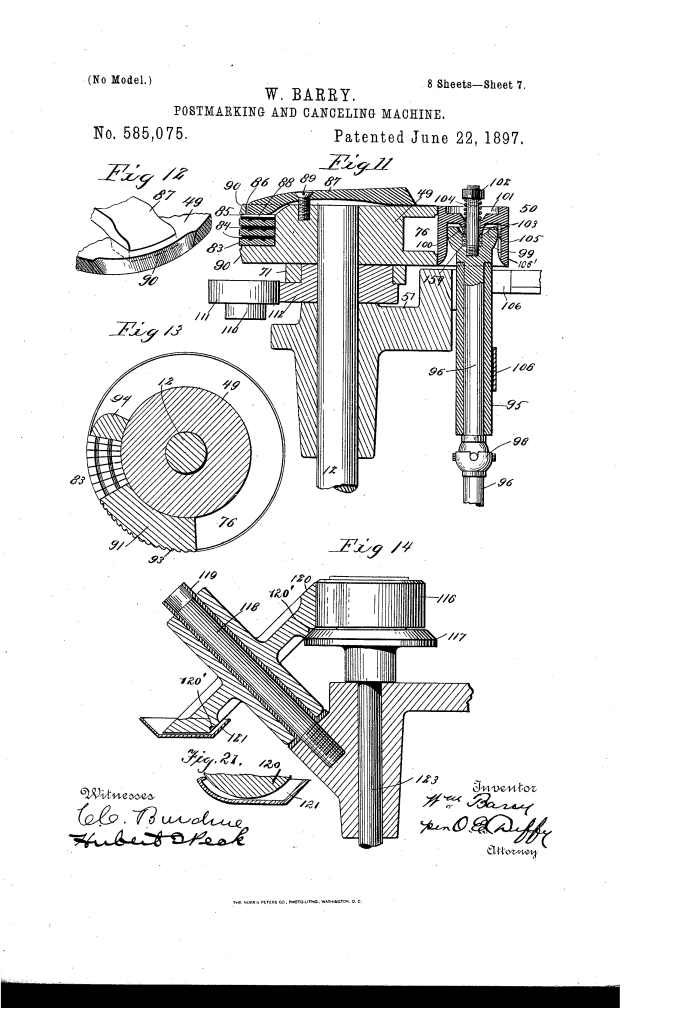
| Printing Roll (49) & Impression Roll (50) | The printing couple; roll 49 carries removable type (83) and killer ribs (93), while hollow roll 50 rocks on a ball-jointed shaft (96) to match uneven letter faces. |
| Ink Elevator Wheel (120) & Distributing Roll (116) | An inclined rotary disk that lifts ink from an adjustable reservoir pan (121) directly to the inking roller train without spillage. |
| Elliptical Pusher-Bar Stacker (131) | A multi-link lever assembly (132, 134, 135) that sweeps behind discharged letters to stack and align them neatly into the receiving tray (140). |
How the Machine Functions
The processing stream operates in a continuous mechanical loop powered directly from the primary drive shaft:
| Stage | Action | Operational Purpose |
| 1. Facing & Traying | Mail is sorted against the inclined traveling belt (9) on table shelf 2 into tray 1. | Packs and aligns letters facing the same direction for rapid tray transfer. |
| 2. Feedway Advancement | Reciprocating rods (21) advance the stack toward end wall 20; follower 150 maintains upright support. | Keeps the leading envelope positioned against the lateral discharge throat 33. |
| 3. Singular Separation | Feeder 53 thrusts inward via spring 68 to grip the leading letter; emery fingers 34 hold back the rest. | Pulls a single envelope through the discharge opening without tearing paper. |
| 4. Dynamic Printing & Canceling | Letter passes between rolls 49 and 50; cam 112 surges impression tension via bow spring 108. | Imprints the postmark and cancels the stamp cleanly across variable mail thicknesses. |
| 5. Elliptical Stacking | Pusher-bar 131 executes an elliptical stroke into receiving way 129, sweeping the letter into tray 140. | Keeps the discharge path clear and neatly stacks processed letters against guide 141. |
Historical and Technical Impact
William Barry’s machine contributed substantially to the modernization of the United States Postal Service and postal systems worldwide at the turn of the century:
- High-Volume Throughput: Relieved postal clerks from manual hand-stamping, allowing high volumes of commercial and personal correspondence to be faced, canceled, and sorted rapidly.
- Versatile Mail Handling: By utilizing rocking impression rollers and multi-point spring feeders, the machine accommodated stiff parcels, thick envelopes, and fragile paper within the same run without manual reconfiguration.
- Continuous Operational Uptime: Replaceable wear surfaces—such as spool-wound emery cloth for friction control and removable type blocks with independent killer dies—allowed fast maintenance directly on the workroom floor.
Summary of Claims
The patent explicitly claims:
- A sorting-table assembly featuring an inclined support shelf and an automated packing belt to face and load letters into a removable tray.
- A mail-marking feedway and receiving mechanism operating with reciprocating stepped floors driven by a multi-armed lever and cam arrangement.
- A transverse feeding mechanism featuring independently movable plates with inclined biting needle points and lateral play guides.
- A friction separator utilizing pivoted fingers wrapped with spool-wound, renewable emery cloth strips and auxiliary hooked catch fingers.
- A printing couple comprising a type roll with an independent stamp-canceling block and a rockable, spring-balanced impression roll controlled by an intermittent pressure-relief cam.
- An automatic inking apparatus combining an adjustable pan reservoir, an inclined rotary elevator wheel, and an ink-distributing roll.
