
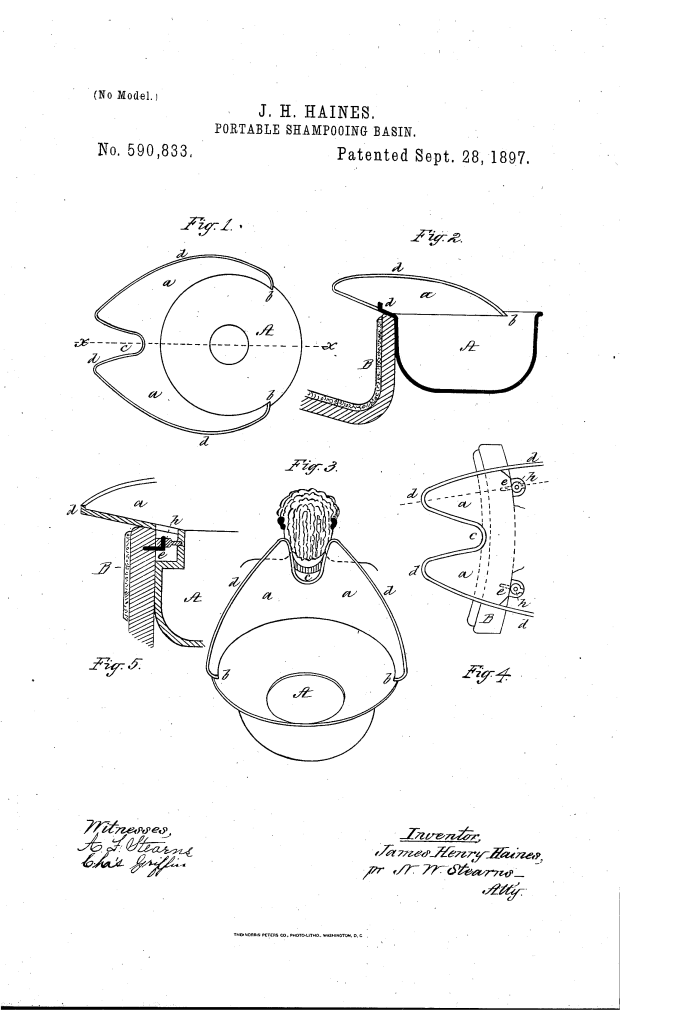
Portable Shampooing Basin (1897)
U.S. Patent No. 590,883, granted on September 28, 1897, to James Henry Haines, introduces an ergonomic and portable apparatus designed to streamline hair washing in barbershops and salons. Haines, an inventor based in Tampa, Florida, developed the device to modernize late-19th-century personal grooming.
The invention solved a common operational frustration in barbershops: requiring patrons to get out of their chairs after a haircut and walk over to a stationary sink fixture, where they had to hold a tiresome, bent-forward posture over the bowl while being scrubbed and rinsed. Haines created a lightweight, detachable basin that brought the washing station directly to the seated patron.
The Innovation: Contoured Drainage and Modular Support
Haines designed the basin to integrate smoothly with standard barber chairs while safeguarding the client’s comfort and clothing from spills.
Ergonomic Neck Recess (c): The front portion of the bowl is sculpted into an anatomical cutout tailored to rest snugly against the back and sides of the patron’s neck.
Inclined Guide-Wings (a a) and Containment Flanges (d d): Two symmetrical, downward-sloping guide wings extend forward over the client’s shoulders. Along their outer edges run upright protective flanges (d d) that channel water run-off directly back into the primary basin (A), keeping suds and moisture completely off the customer’s garments.
Chair-Mounting Interface: To allow barbers to work using both hands, the basin features an underside flat bearing surface and mounting screw-eyes (h h) that drop onto matching upright pintles (e e) fixed to the upper rim of the barber chair (B).
Key Technical Components
| Component | Patent Callout | Functional Role |
| Basin Body | A | Receptacle that collects and holds water used during shampooing. |
| Inclined Guides | a a | Symmetrical forward wings that route drainage backward into the basin. |
| Neck Recess | c | Curved ergonomic interface fitting snugly around the client’s neck. |
| Outer Flanges | d d | Upright raised lips preventing water from escaping over the sides. |
| Guide Terminals | b b | Inward-directing discharge points projecting over the bowl’s interior edge. |
| Mounting Rings / Eyes | h h | Underside rings that lock onto chair fixtures for hands-free stability. |
| Chair Pintles | e e | Upright pins installed on the chair back to seat and anchor the basin. |
How the Apparatus Functions
The operation follows a simple, repeatable sequence that eliminates the need for fixed plumbing stands:
- Preparation: The barber removes the chair’s standard sliding headrest to expose the upper back support.
- Mounting: The basin’s underside eyes (h h) are aligned with and dropped onto the chair’s upright pintles (e e). The flat lower face of the basin abuts flush against the chair frame for steady leverage.
- Positioning: The client leans back slightly, seating the curved recess (c) directly against the neck while the inclined wings (a a) extend forward over the shoulders.
- Shampooing: The barber uses both hands freely to shower, sponge, and cleanse the hair. All water rolls down the channeled guides (a a), retained by the flanges (d d), and discharges past terminals (b b) back into the main bowl (A).
- Removal: Once finished, the operator lifts the entire assembly off the pintles without needing tools or unfastening mechanical screws.
Manufacturing and Materials
Haines recognized the need for durability, sanitation, and portability. The patent specifies construction using non-frangible, lightweight materials:
- Material Options: Molded paper-pulp, stamped sheet iron, or alternative sheet metals.
- Finishing: Capable of being nickel- or silver-plated to provide corrosion resistance, ease of cleaning between clients, and an ornamental appearance suitable for upscale shops.
- Alternative Support: The specification also accounts for mobile use without chair pintles, offering alternative retention through body straps worn around the operator’s neck, clamping-screws, or simple one-handed manual support.
About the Inventor: James Henry Haines
James Henry Haines was an inventor active in Tampa (Hillsborough County), Florida, during the late 19th century. His focus on mechanical utility addressed the rapidly expanding service and personal-care industries of the era. By patenting an adaptable, low-cost alternative to expensive, plumbed wash fixtures, Haines contributed practical engineering solutions aimed at small business operators and service-sector craftspeople.
Summary of Claims
The patent explicitly claims:
- A portable shampooing-basin comprising a bowl (A) equipped with inclined guide-wings (a a) and upturned flanges (d d), terminating at points (b b) within the bowl’s upper edge perimeter.
- A front-recessed bowl configuration fitted with screw-eyes (h h) and a flat forward bearing surface.
- The mechanical combination of the portable basin with a chair back provided with pintles (e e) arranged to register with the screw-eyes for instant attachment, firm support, and easy removal.
