
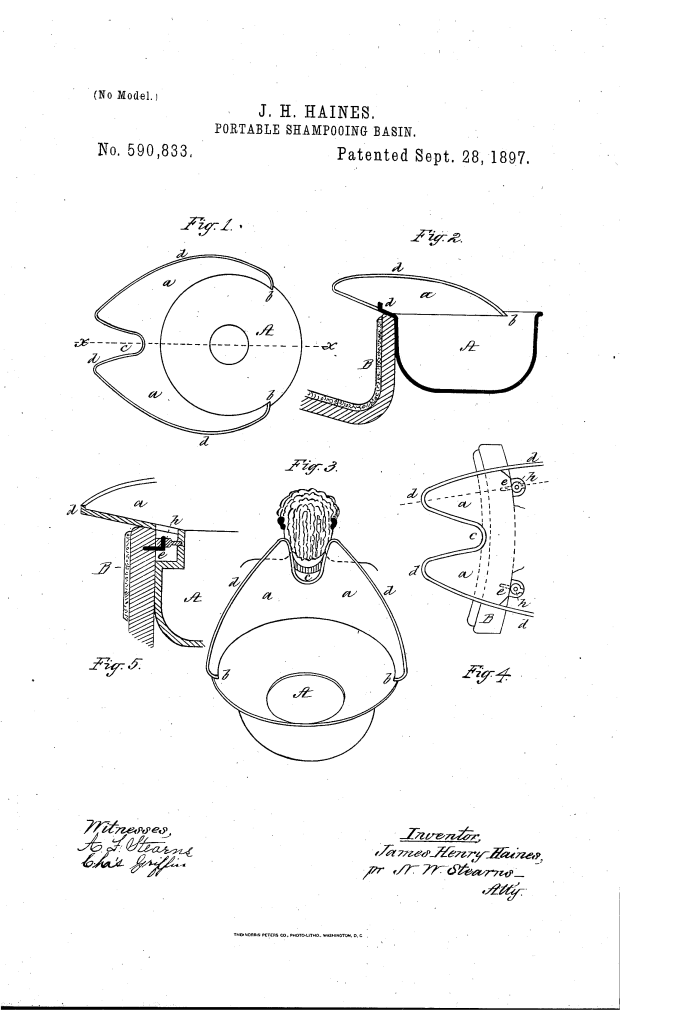
Portable Shampooing-Basin (James Henry Haines, No. 590,883)
The patent by James Henry Haines of Tampa, Florida, describes a Portable Shampooing-Basin (Patent No. 590,883, 1897). The primary purpose is to simplify and obviate the inconvenience of the traditional shampooing process in a hair-dresser’s shop by avoiding the fixed basin and allowing the shampooing to be done while the customer remains seated in the chair.
Inventor Background: James Henry Haines
James Henry Haines was an inventor focused on improving service industry efficiency and customer convenience. His invention addressed a common point of inconvenience and interruption in the barbering process, providing a specialized tool for the growing commercial hair-dressing market. The assignment of interest to Charles Griffin and Jerry M. Certain suggests a commercial partnership to manufacture or market the basin.
Invention and Mechanism
The device is a contoured basin designed to fit around the neck and shoulders, incorporating features for splash prevention and quick attachment to a chair.
1. Basin and Contouring
- Basin (A): The receptacle for holding the water. The inventor prefers light, non-frangible material like molded paper-pulp or sheet metal.
- Inclined Guides (): Two guides project above the upper rim of the basin, extending from the front toward the rear periphery.
- Curved Recess (c): A curved recess formed between the front of the guides (
), carefully adapted to snugly fit around the neck of the person being shampooed.
- Upturned Flange (): A low flange extends around the outer rim of each guide (
).
- Function: When the guides are located over the shoulders and the recess (
) fitted to the neck, the flange (
) precludes the escape of water, reliably insuring its return to the basin and preventing the customer’s clothes from getting wet.
- Function: When the guides are located over the shoulders and the recess (
2. Chair Attachment (The Portability Solution)
- Eyes (): A pair of eyes or rings projecting from the front of the under side of the basin.
- Pintles (): A corresponding pair of pintles (pins) projecting up from the back of the chair (B) near its top.
- Bearing Surface: The front of the under side of the basin is formed as an extended flat surface conforming to the back of the chair.
- Function: To support the basin, the operator aligns the eyes (
) with the pintles (
) on the chair back. The flat bearing surface snugly abuts the chair back, providing firm support while the operator uses both hands for the shampooing operation. The device is designed to be instantly located and readily removed.
- Function: To support the basin, the operator aligns the eyes (
Concepts Influenced by This Invention
Haines’s portable basin influenced subsequent service industry tools by establishing standards for portable, ergonomic utility and integrated equipment accessories.
- Portable Contoured Basins: The design of a contoured, portable basin that fits snugly against the neck/shoulders to contain fluid influenced the design of modern portable hair-washing trays, medical basins, and specialized barbering sinks used for in-bed or at-chair washing.
- Toolless Accessory Attachment: The use of simple, corresponding hardware (eyes and pintles ) for quick, toolless attachment and removal of an accessory to a piece of furniture (the barber chair) influenced the design of numerous add-on utility trays, tool holders, and brackets in service industries, where speed and minimal installation effort are critical.
- Ergonomics in Service: The goal of allowing the client to remain in a comfortable, seated position and allowing the operator to use both hands simultaneously influenced ergonomic design in service industries, prioritizing client comfort and operator efficiency by eliminating inconvenient bending and movement.
