
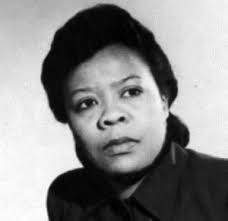
Portable Receptacle Support, Bessie Virginia Griffin (1951)
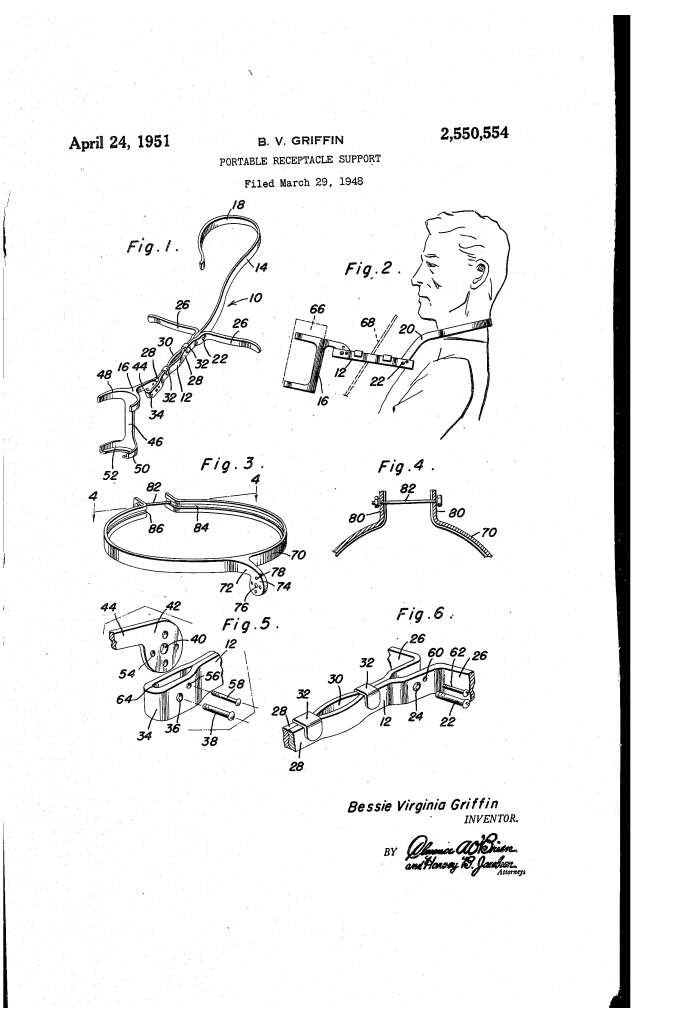
Patented on April 24, 1951 (U.S. Patent No. 2,550,554), this invention by Bessie Virginia Griffin was designed as an assistive technology for individuals with limited use of their hands and arms. Whether due to permanent disability, temporary injury, or post-surgical recovery, the device allowed users to drink or eat independently by supporting a cup, glass, or bowl directly from their body.
The invention is a “hands-free” support system that rests on the user’s chest and hangs from their neck, positioning a beverage or food container at the perfect angle for use with a straw or tube.
The “Why”
- Independence for Invalids: It provides dignity and autonomy to convalescents and paralyzed individuals who would otherwise require constant assistance to stay hydrated.
- Ergonomic Stability: Unlike a simple tray, this device uses the geometry of the human chest and neck to create a stable, non-tipping platform.
- Versatility: The support is fully adjustable, meaning it can be used while the patient is sitting upright in a chair or reclining in a bed.
- Dual Function: The base can be detached from the neck strap and used as a standalone tripod support on a bedside table.
Key Systems Section
1. The Body-Anchored Frame
The device is constructed primarily from flat metal strips, which provide rigidity while remaining lightweight.
- Hanger Bar (14): Features a hook portion (18) that fits comfortably around the neck.
- Chest Contour: The bar has a specific curve (20) designed to follow the anatomy of the sternum and chest.
- Base Member (12): This part connects to the hanger bar and extends outward. It features lateral legs (26) that rest against the user’s chest to prevent the holder from swinging side-to-side.
2. The Multi-Axis Adjustment
To accommodate different heights and postures, Griffin engineered two separate pivot points.
- Primary Pivot (22): Connects the hanger bar to the base member.
- Secondary Pivot (38): Connects the base member to the actual receptacle holder.
- Locking Mechanism: Both pivots use a system of locking apertures (54) and a lock pin (58). By aligning different holes, the user (or a caregiver) can lock the cup at a specific tilt, ensuring the contents don’t spill while remaining reachable.
3. The Receptacle Holders
The device was designed with interchangeable “heads” depending on what the user needed to consume.
- Cup Holder (16): Features two arcuate bands (48/50) and a bottom flange (52) to securely cradle a standard glass or mug.
- Bowl/Dish Attachment (70): An alternative attachment (shown in Fig. 3) uses a split ring and a clamp bolt (82). This allows the device to grip the rim of a soup bowl or a small plate.
4. Integrated Straw Support
Griffin recognized that many users would lack the neck mobility to reach a cup directly.
- Straw Passage (30): The base member plates are bowed outward to create a dedicated hole for a drinking straw or tube (68).
- Friction Clips (32): These clips can be tightened to “pinch” the straw, holding it exactly where the user needs it so they don’t have to chase the straw with their mouth.
Component & Operation Table
| Component | Part # | Function |
| Hanger Bar | 14 | Transfers the weight of the liquid to the user’s neck. |
| Base Member | 12 | The “bridge” that holds the straw and extends the cup away from the body. |
| Lateral Legs | 26 | Stabilizers that press against the chest to eliminate wobbling. |
| Lock Pin | 58 | Secures the receptacle at the desired “drinking angle.” |
| Tripod Mode | N/A | When detached from the neck bar, legs (26) and holder (16) form a 3-point stand. |
Significance
Bessie Virginia Griffin’s patent is a significant early example of assistive device design:
- Human-Centric Engineering: It acknowledges that “one size does not fit all” by allowing for granular angular adjustments.
- Multipurpose Design: By allowing the device to work as both a wearable support and a table-top stand, it maximized the value for the patient.
- Simplicity: By using flat-strip construction and simple pins, the device was easy to manufacture and could be cleaned easily—a vital requirement for medical environments.
Final Insight: This support was more than just a holder; it was a tool for rehabilitation. By solving the “stability” and “straw placement” issues simultaneously, Griffin ensured that a patient could drink a full glass of water without a single hand being used.
