
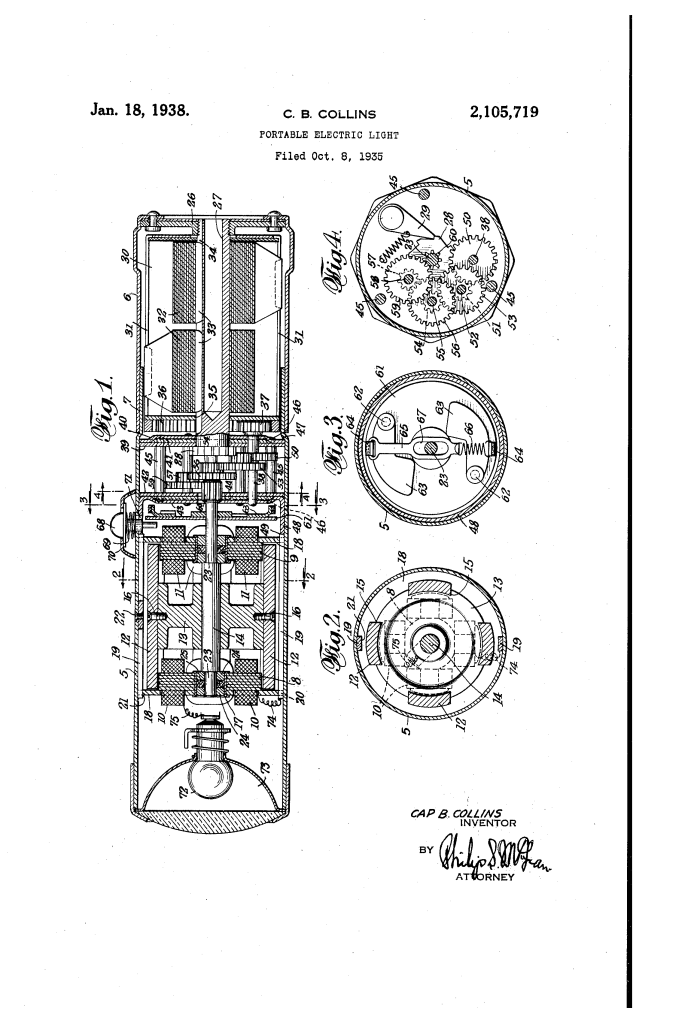
Portable Electric Light: Cap B. Collins (Patent No. 2,105,735)
The patent by Cap B. Collins of Washington, D.C., describes a Portable Electric Light (Patent No. 2,105,735), granted on January 18, 1938. This invention is a self-powering flashlight that operates without chemical batteries, instead utilizing a mechanical spring motor and a compact internal generator. By winding the handle section of the casing, the user stores energy in spiral springs which, when released, drive a high-speed gear train to spin magnets and generate a continuous electric current for the lamp.
The “Why”
In the mid-1930s, portable lighting was almost entirely dependent on dry-cell batteries, which were notoriously unreliable, expensive, and prone to leaking or losing their charge over time. The primary “pain point” Collins addressed was the lack of energy independence. He sought to create a “pocket flashlight” that was always ready for use, regardless of the age of its components, by harnessing basic mechanical physics—converting manual torque into stored elastic potential energy and then into electrical energy.
Inventor Section: Cap B. Collins
Cap B. Collins was an inventor dedicated to miniaturized electromechanical systems. His engineering philosophy centered on modular durability. Recognizing that precision instruments often failed due to lack of maintenance, he designed this flashlight with “unit assemblies” (generator unit, gear unit, spring unit) that could be manufactured separately and swapped easily. His focus on long-lasting lubrication via felt oil pads (41, 44) demonstrates a commitment to creating “lifetime” tools rather than disposable consumer goods.
Key Systems Section
1. The Telescopic Winding Mechanism
The casing consists of two cylindrical sections (5 and 6). The rear handle section (6) acts as a large winding key.
- Modern Term: Rotary Manual Actuator.
- Turning the handle rotates the internal winding shaft (27), which is held in place by a ratchet and pawl (28) to prevent the springs from unwinding backward.
2. Spiral Spring Power Reservoir
The energy is stored in a spring barrel (30) containing one or more spiral springs (32).
- Modern Term: Torsion Spring Energy Storage.
- As the springs relax, they turn a ring gear (36) that initiates the power transfer to the generator.
3. Compact Bar-Magnet Generator
The generator is specifically designed for a small-diameter casing. It uses a spider (13) mounted on a shaft (14) carrying permanent bar magnets (12).
- Modern Term: Axial Flux Micro-Generator.
- These magnets rotate between current-generating windings (10, 11) mounted on radially extending pole pieces. This “cage assembly” maximizes magnetic flux in a very narrow space.
4. Centrifugal Leaf Governor
To prevent the springs from dumping all their energy at once (which would blow the bulb), Collins included a governor (61).
- Modern Term: Centrifugal Brake / Speed Regulator.
- Weight leaves (63) swing outward as the speed increases, pressing brake pads (64) against the casing to maintain a constant RPM and a steady light output.
Comparison Table
| Feature | Standard 1930s Flashlight | Collins’ Spring-Powered Light |
| Power Source | Chemical Battery (Disposable). | Mechanical Spring (Renewable). |
| Shelf Life | Months (Degrades over time). | Years (Indefinite readiness). |
| Reliability | Prone to leakage and corrosion. | Fully enclosed, oil-pad lubricated gears. |
| User Input | None (Switch only). | Manual winding for “On-Demand” power. |
Significance
- Precursor to Emergency Cranking Lights: The fundamental logic of this patent—replacing batteries with a mechanical generator—is the direct ancestor of modern “crank” emergency radios and flashlights.
- Modular Engineering: By separating the generator and gear train into distinct units, Collins anticipated modern DFA (Design for Assembly) principles.
- Precision Miniaturization: The use of arcuate (curved) bar magnets to fit the cylindrical casing was a sophisticated move in magnetic circuit design, allowing for high efficiency in a “pocket” form factor.
- Sustainability: This device was an early, unintended champion of sustainability, removing the need for the heavy metals and chemicals found in 1930s battery production.
