
🖼️ Curtain-Pole Tip (Samuel R. Scottron, No. 349,525)
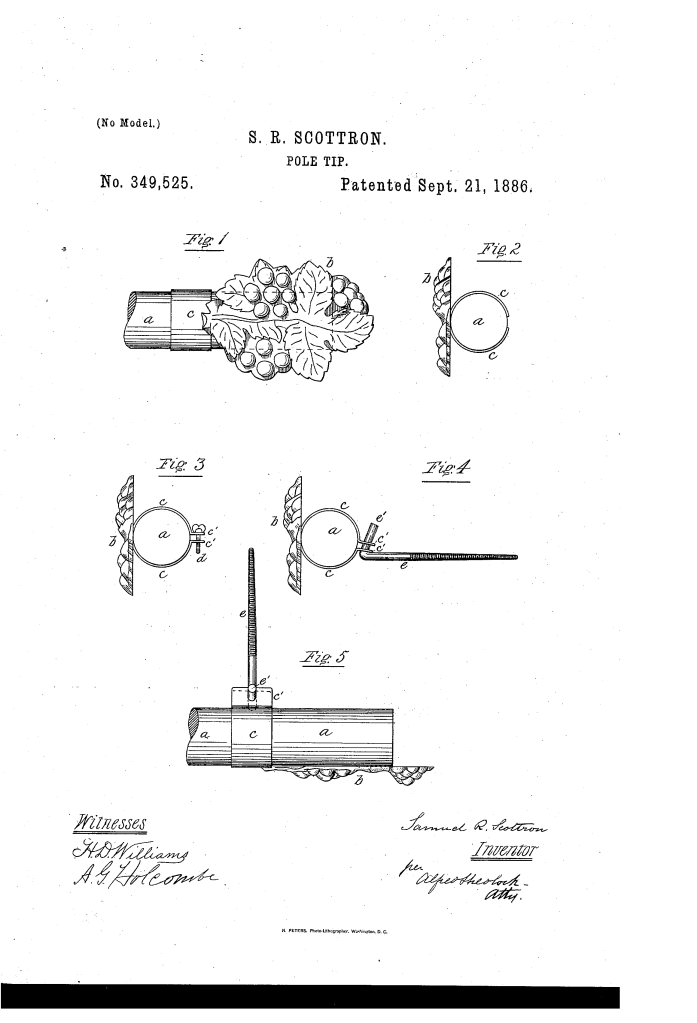
The patent by Samuel R. Scottron of Brooklyn, New York, describes an improvement in Pole-Tips (Patent No. 349,525, 1886). The invention is an ornamental end-cap for curtain poles designed to hide the ends of the pole while providing a high degree of adjustability. Unlike traditional tips that had to be fitted to specific pole lengths, Scottron’s design allowed a single ornament to work on poles of varying diameters and lengths.
Inventor Background: Samuel R. Scottron
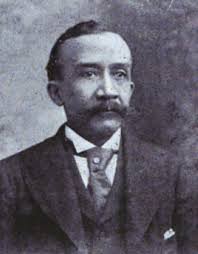
Samuel Raymond Scottron (1841–1908) was a prominent African-American inventor, businessman, and civic leader. Based in Brooklyn, he was well-known for his “Scottron Adjustable” products, which revolutionized the interior design and hardware industries. Scottron was a master of identifying “universal” solutions—creating hardware that could adapt to the various sizes of furniture and windows found in Victorian homes. Beyond his inventions, he was a scholar and a frequent contributor to national magazines, writing on racial heritage and social progress.
Invention and Mechanism (Simplified)
The device consists of an ornamental faceplate attached to an adjustable clamping ring that grips the side of the curtain pole.
1. The Clamping Ring (c)
- Elastic Resilience: The primary feature is a clamping-ring (c) that embraces the pole ($a$). In its simplest form, it is an open elastic ring that uses its own spring tension to grip the pole.
- Screw Adjustment: For heavier ornaments, Scottron added bent ends ($c’$) and a tightening screw ($d$).
- Function: This allowed the tip to “firmly clasp poles of different diameters,” making it a universal fit for different hardware sets.
2. Longitudinal Adjustment (Key Innovation)
- Variable Length: Because the ornament ($b$) is held at the side of the pole rather than being plugged into the end, the pole can sit anywhere behind the faceplate.
- Benefit: This “obviates the necessity of making the poles of exact lengths.” If a pole was slightly too short or too long for a window, the adjustable tip could be slid along the end to compensate, hiding the gap or the excess wood.
3. Integrated Supporting Bracket
- Dual-Purpose Hardware: Scottron’s design also utilized the clamping ring as a structural support for the entire pole.
- Perforated Ends: The bent ends of the ring were provided with holes.
- Function: These holes were placed over a cornice-hook (e) or upwardly-projecting pin attached to the wall. Scottron cleverly designed the hook to be slightly inclined.
- Result: The greater the weight of the curtains, the more securely the ring was held onto the hook, preventing the pole from falling.
Concepts Influenced by This Invention
Scottron’s pole-tip influenced the development of modular home hardware and the “one-size-fits-all” design philosophy.
- Universal Fit Engineering: The core concept of using an adjustable clamp to make a product compatible with various third-party dimensions (pole diameters) is a fundamental principle in modern consumer hardware and mounting brackets.
- Non-Destructive Fastening: By using resilient friction and clamping rather than nails or screws driven into the wood, Scottron pioneered hardware that allowed for infinite adjustment without damaging the pole.
- Gravity-Locked Supports: The use of an inclined pin where the load increases the security of the joint is a principle still widely used in industrial racking and heavy-duty shelving.
- Modular Aesthetics: Scottron’s approach—separating the structural mounting (the ring) from the aesthetic faceplate (the tip)—allowed for mass production of a single mechanical unit that could be decorated with various ornate styles.
