
🔥 Pole, Post, and Tree Protector (Ned E. Barnes, No. 1,673,358)
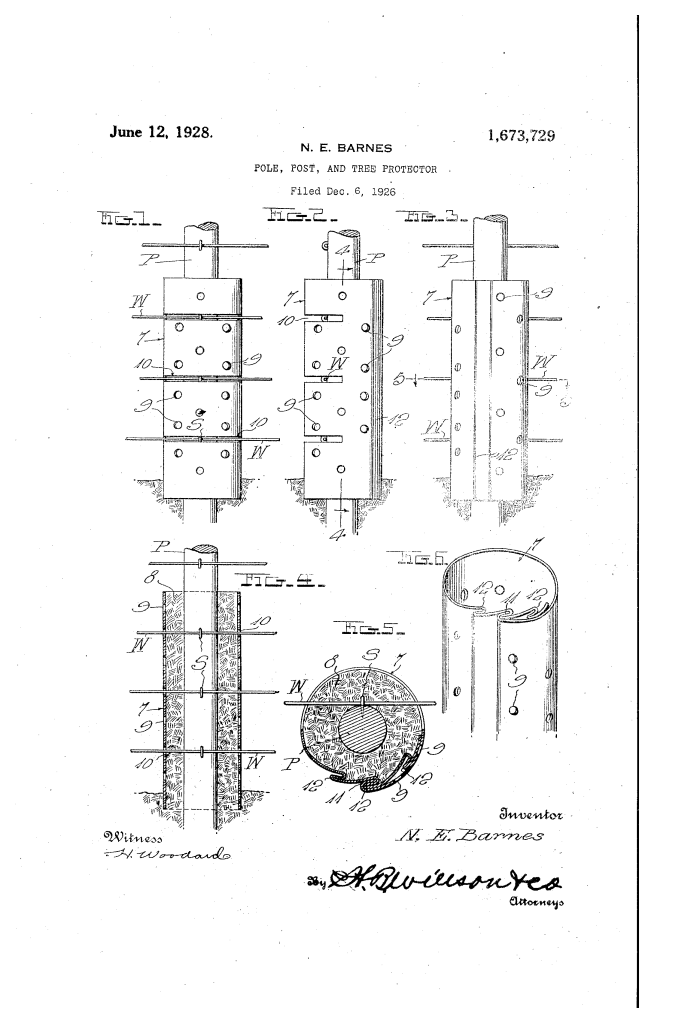
The patent by Ned E. Barnes of Willis, Texas, describes a Pole, Post, and Tree Protector (Patent No. 1,673,358, 1928). This invention is a specialized metal sleeve designed to shield telephone poles, fence posts, and trees from damage caused by grass fires and wildfires. Barnes’s primary objective was to create an inexpensive, adjustable, and easily installed barrier that prevents fire from reaching the combustible wood at the base of these structures. His innovation features a flexible interlocking seam and a packing system that accommodates expansion while providing a fireproof seal.
Inventor Background: Ned E. Barnes
Ned E. Barnes was an African American inventor from Texas, active during the early 20th century. Living in a region where wildfires were a frequent threat to agricultural and utility infrastructure, Barnes developed practical mechanical solutions to protect essential property. This 1928 patent follows his work on railway safety (the Tie Plate and Joint Brace), demonstrating his versatility in industrial and civil engineering. Barnes’s designs consistently prioritize durability and cost-effectiveness, reflecting the needs of rural communities during the transition into a more electrified and interconnected America.
Key Mechanical & Protective Systems
The protector is a metal “armor” that utilizes the surrounding earth and internal insulation to create a thermal barrier.
1. The Split-Sleeve with Adjustable Seam (7, 11, 12)
- Single-Sheet Construction: The sleeve (7) is bent from a single sheet of metal.
- The Hook Flange (11): One edge of the sheet is bent inward to form a longitudinal hook.
- S-Shaped Formations (12): The opposite edge features a series of S-shaped folds spaced apart.
- Function: This allows the protector to be adjustable. The hook flange can be tucked into any of the S-shaped folds to fit the specific diameter of a pole or tree. The S-folds also act as an expansion joint, allowing the sleeve to expand slightly without breaking if the internal packing freezes.
2. Fireproof Packing and Insulation (8)
- The Seal: Once the sleeve is wrapped around the post, the space between the metal and the wood is filled with packing (8), such as sand, gravel, or non-combustible earth.
- Mechanical Stability: The packing serves a dual purpose: it acts as a thermal insulator against the heat of the fire and provides internal pressure that keeps the hook flange (11) securely locked into its selected fold.
3. Ground Integration and Drainage (9)
- Fire Barrier: The lower end of the sleeve is forced a short distance into the ground.
- Drainage Perforations (9): Small holes are drilled into the lower portion of the sleeve.
- Function: Burying the edge prevents fire from “creeping” under the metal to reach the post. The perforations allow moisture to escape, preventing the wooden post from rotting due to trapped water inside the packing.
4. The Wire-Lock System (10)
- Transverse Slots (10): For fence posts or telegraph poles, the sleeve includes horizontal slots.
- Anchoring: Fence wires (W) or telegraph wires are passed through these slots and stapled to the post.
- Function: By running the wires through the slots, the wires themselves act as an anchor, preventing the sleeve from being pulled upward out of the ground or displaced by animals or wind.
Improvements Over Standard Post Protection
| Feature | Unprotected Wood / Simple Wraps | Barnes’s Adjustable Protector |
| Fire Resistance | High risk of ignition at the base. | Sleeve + Packing creates a full thermal shield. |
| Fit | Required custom sizes for every tree/pole. | Interlocking S-folds provide universal adjustment. |
| Durability | Rigid wraps often cracked in winter. | Expansion formations (12) prevent freezing damage. |
| Root/Wood Health | Trapped moisture caused rot. | Drainage perforations (9) allow the post to breathe. |
Significance to Civil and Utility Engineering
Ned E. Barnes’s protector influenced the development of utility pole armor and wildfire mitigation hardware.
- Adjustable Diameter Logic: The “hook and fold” adjustment system is a precursor to the adjustable pipe clamps and tension bands used in modern plumbing and construction.
- Thermal Expansion Management: By incorporating S-shaped “relief” folds, Barnes anticipated the thermal expansion joints now standard in bridges, pipelines, and metallic siding.
- Infrastructure Longevity: This invention was a critical early contribution to asset protection, focusing on the “Total Cost of Ownership” for railroads and telegraph companies by extending the life of wooden infrastructure.
- Integrated Security: Using existing utility wires to “lock” a protective sleeve in place is a brilliant example of resource-efficient design, solving two problems (security and protection) with a single component.
