
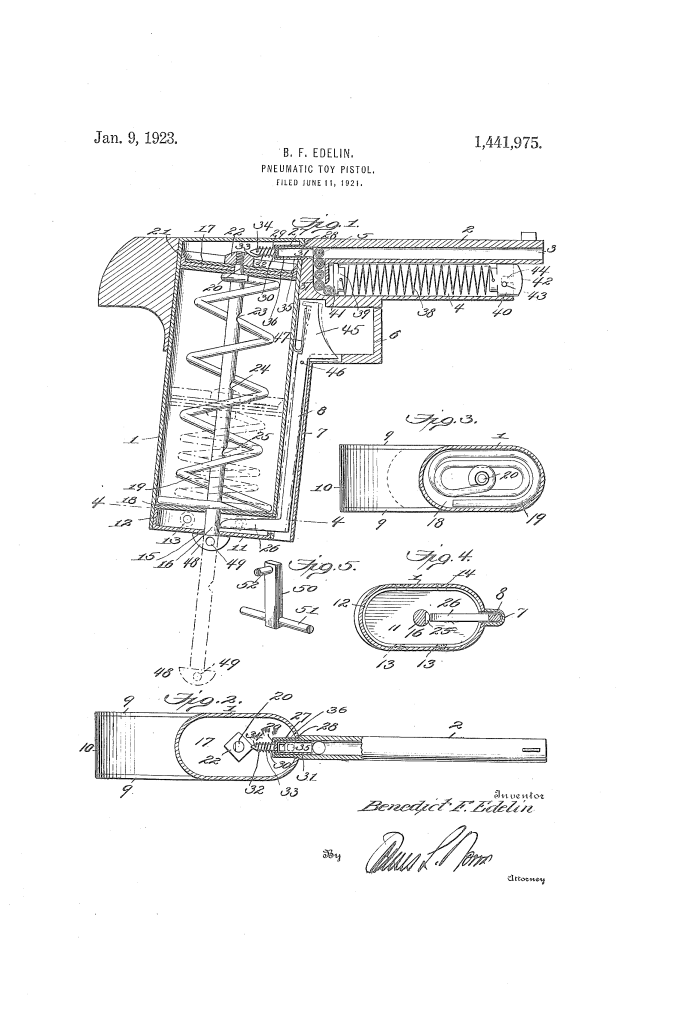
The patent by Benedict F. Edelin of Washington, D.C., describes a Pneumatic Toy Pistol (Patent No. 1,441,976, 1923). The invention’s primary objects are to provide a toy pistol that: simulates a real automatic pistol in form and action, offers a selective range of power, and ensures the air release controls the feed from the magazine.
Inventor Background: Benedict F. Edelin
Benedict F. Edelin was an inventor who patented this device in 1923. His focus was on applying mechanical ingenuity to create realistic and functional toys, capitalizing on the popularity of automatic pistols in the early 20th century. The complex, integrated mechanism shows a dedication to solving engineering problems within the constraints of a consumer product.
Invention and Mechanism
The pistol uses a manually compressed, spring-driven piston and a sophisticated cam-and-valve system to time the air release and the shot feed.
1. Frame and Form
- Air Cylinder (1) and Grip: A hollow, often oval-shaped member forming the air compression cylinder, inclined slightly to form a convenient grip, simulating the slide and grip of an automatic pistol.
- Barrel Block (2): Attached to the side of the cylinder, containing the barrel (3) and the magazine bore (4).
- Trigger (45): A finger piece exposed within the trigger loop (6), pivotally secured to the guard (7), enhancing the realistic look.
2. Power and Selective Range
- Piston (17) and Rod (16): The piston is mounted on a rod that extends out the bottom of the cylinder. A large helical spring (19) maintains the rod in tension (compressed state).
- Power Adjustment (Notches 23, 24, 25): The piston rod (16) has multiple notches along its side.
- Function: The user withdraws the rod using a key/tool (50) until the trigger piece (26) engages one of the notches. Selecting a deeper notch compresses the spring more, providing a selective range of power for the shot.
3. Integrated Firing and Feeding (Key Innovation)
- Valve Block (31): A cylindrical block slidably arranged in the barrel bore (3). It is normally held closed by a spring (33).
- Valve Stem (32): A non-circular stem projecting rearward from the valve block.
- Cam Member (Nut 22): A sloping nut secured to the inner end of the piston rod (16) serves as the cam member.
- Firing Sequence (Simultaneous Action):
- Pre-Fire: The trigger is released, propelling the piston (17) forcibly inward.
- Compression: The piston rapidly compresses air in the cylinder.
- Valve Actuation: At the peak of the compression stroke, the sloping surface of the cam nut (22) strikes the valve stem (32). This opens the valve block (31) against the spring tension (33).
- Air Release: The valve port (36) is put into registry with the air chamber port (35), allowing a sudden release of compressed air behind the shot.
- Feed Control: The forward motion of the valve block (31) simultaneously overruns and closes the feed tube (37) from the magazine, preventing a second shot from entering the barrel until the firing cycle is complete and the valve retracts.
Core Concepts Utilized Today
Edelin’s pneumatic pistol influenced subsequent toy and miniature mechanisms by demonstrating precise cam-based timing for sequential, high-speed actions.
- Ram/Hammer Valve Actuation: The concept of using the forward motion of the air-compressing element (piston/nut 22) to deliver a hammer blow to and open the discharge valve (31) at the peak of compression is the foundation of many high-efficiency pneumatic and airsoft gun valve systems . This timing maximizes shot velocity.
- Integrated Feed Control: The design where the valve’s motion simultaneously opens the power port and closes the feed port is a key feature in modern airsoft and paintball gun loaders. This mechanism prevents “double feeds” and ensures only one projectile is loaded per shot cycle.
- Selective Spring Pre-Compression: The use of multiple engagement points (notches 23, 24, 25) on the cocking rod to allow the user to select the spring’s compression level influenced the design of various consumer products requiring adjustable force or power settings, such as adjustable torque tools, variable-rate sprinklers, and consumer spring-piston mechanisms.
- Aesthetic and Functional Simulation: The commitment to making the toy simulate the form and action of a real automatic pistol (including a slide-like cocking action via the rod 16 and a realistic trigger mechanism) influenced the design philosophy of toys focused on mechanical realism.
