
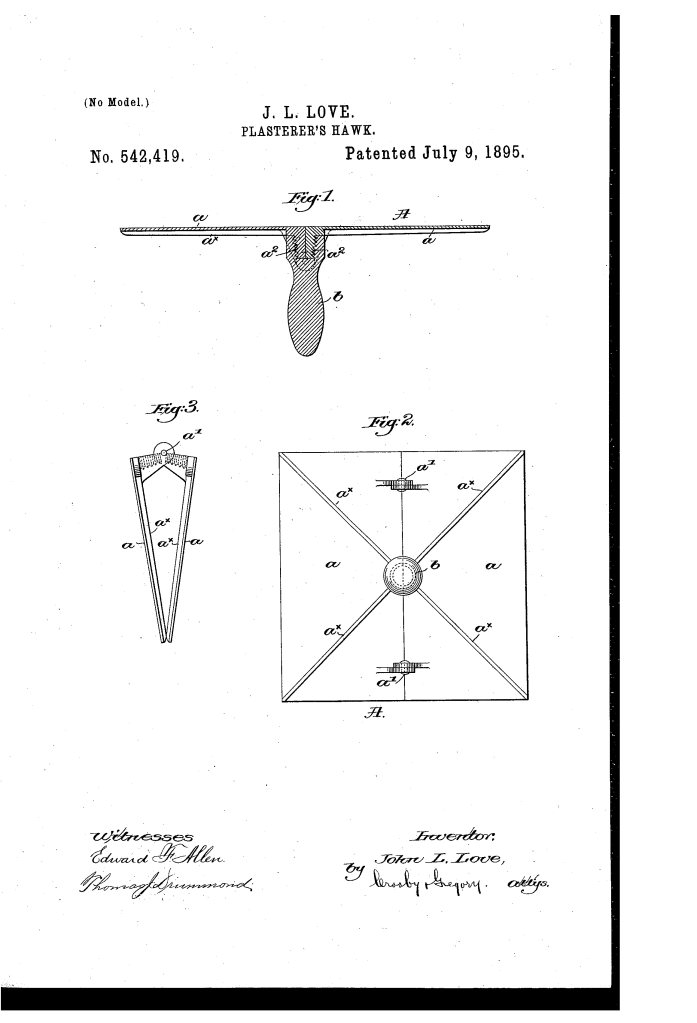
Plasterers Hawk (1895)
U.S. Patent No. 542,419, granted on July 9, 1895, to John L. Love of Medford, Massachusetts, introduces a highly portable, durable, and warp-resistant upgrade to a foundational tool used by masons and plasterers.
This practical invention solved a multi-layered problem for 19th-century tradesmen: traditional wooden plastering hawks were bulky to transport, deteriorated quickly from the moisture of wet plaster, and utilized top-down screws that eventually loosened and ruined the smooth finish of a plaster wall.
The Innovation: The Hinged “Split-Shank” Design
Traditional hawks consisted of a flat square board permanently fixed to a central wooden handle by a screw driven straight through the face of the tool. Love completely reimagined this architecture by dividing the main plate into two equal halves connected by an underlying hinge system and a interlocking, detachable handle.
Why the Mechanical Redesign?
- Portability: By folding the tool completely in half and removing the handle, a plasterer could easily pack the hawk into a standard tool bag alongside other implements when traveling.
- Warp Resistance: Switching the construction material from wood to a lightweight metal (aluminum) ensured the tool would never warp, twist, or degrade due to continuous exposure to wet mortar or plaster.
- Flawless Working Surface: Because the handle attaches entirely from underneath, the top face of the hawk remains completely smooth and free of protruding nails or screws that could catch a plasterer’s trowel.
Key Structural Components
Love’s design utilizes a clever combination of lightweight materials and interlocking geometry where the handle itself serves as the ultimate structural lock:
| Component | Function |
| Holding-Plate (A) | The thin, flat aluminum surface that holds the wet plaster; divided into two identical members (a, a). |
| Under-side Hinge (a2) | Connects the two halves of the plate, with the axis set below the plate level to allow a clean, face-to-face fold. |
| Semicylindrical Shank Members (a3) | Twin threaded half-cones attached to each plate member that abut to form a single, conically-threaded nipple when unfolded. |
| Removable Handle (h) | Features a matching conical threaded socket (D) that screws onto the split-shank, clamping the entire tool together. |
| Reinforcing Ribs (a5) | Structural supports placed on the underside of the thin metal plates to provide maximum rigidity without adding heavy bulk. |
How the Apparatus Functions
To transform the tool from a compact travel configuration to a rock-solid masonry device, the operator uses a simple, toolless assembly sequence:
- Unfolding: The two plate halves (a, a) are rotated flat about the underlying hinges until the flat interior faces of the split-shank meet.
- Threading: The internally threaded socket of the handle (h) is placed over the combined conical shank.
- Locking: As the handle is screwed tighter, its internal tapered cone design acts as a wedge, forcibly drawing both halves of the plate tightly together into a seamless, completely rigid working plane.
- Breakdown: After use, the handle is unscrewed, allowing the plates to collapse backward for easy cleaning and transport.
About the Inventor: John L. Love
John Albert Love was an innovative African American inventor active during the late 19th century, whose creations focused on optimizing everyday utility tools for working professionals.
- Patents: While famously known for his subsequent 1897 patent for an improved, enclosed mechanical pencil sharpener (U.S. Patent No. 594,114), his plasterer’s hawk highlights his deep mechanical understanding of structural engineering and metallurgical benefits.
- Early Adoption of Aluminum: Love was remarkably forward-thinking in specifying aluminum for his hawk in 1895. At the time, aluminum was a relatively new commercial metal, but Love recognized its unique combination of extreme lightness, strength, and immunity to water damage as the perfect solution for physical tradesmen.
Summary of Claims
The patent explicitly claims:
- A plasterer’s hawk featuring a plate composed of multiple hinged members designed to fold together, alongside a detachable handle oriented perpendicular to the plate plane for easy transportation.
- A interlocking system where each hinged plate segment contains a threaded shank member that abuts to form a singular threaded stem when opened into working position.
- A tapered socket handle that, when screwed down upon the combined shank, uses its internal taper to pull the separate plate members tightly into a uniform, operational tool.
