
Planter (1894)
U.S. Patent No. 520,887, granted on June 5, 1894, to George W. Murray, describes an innovative agricultural planter designed to streamline the planting process by automatically dropping seeds at precise intervals, covering them with soil, and shaping the resulting protective ridge—all in a single, continuous operation.
George W. Murray, an inventor residing in Sumter, South Carolina, developed this machine to solve a common inefficiency in late 19th-century farming: the labor-intensive, multi-step process of manually furrowing, seeding, burying, and packing fields.
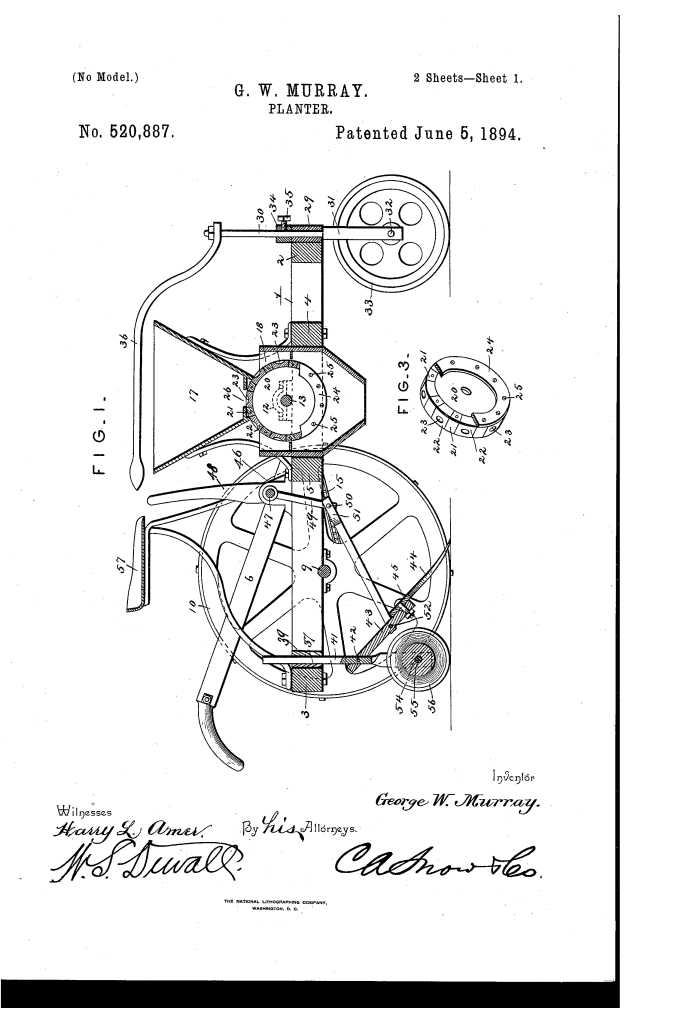
The Innovation: The Adjustable “Dovetail” Seed-Wheel
Traditional mechanical planters often struggled with versatility; changing the distance between planted seeds usually required dismantling the entire driving mechanism. Murray’s breakthrough was an adaptable, modular seed-wheel that allowed farmers to easily customize planting distances based on the crop.
Why the Dovetail Design?
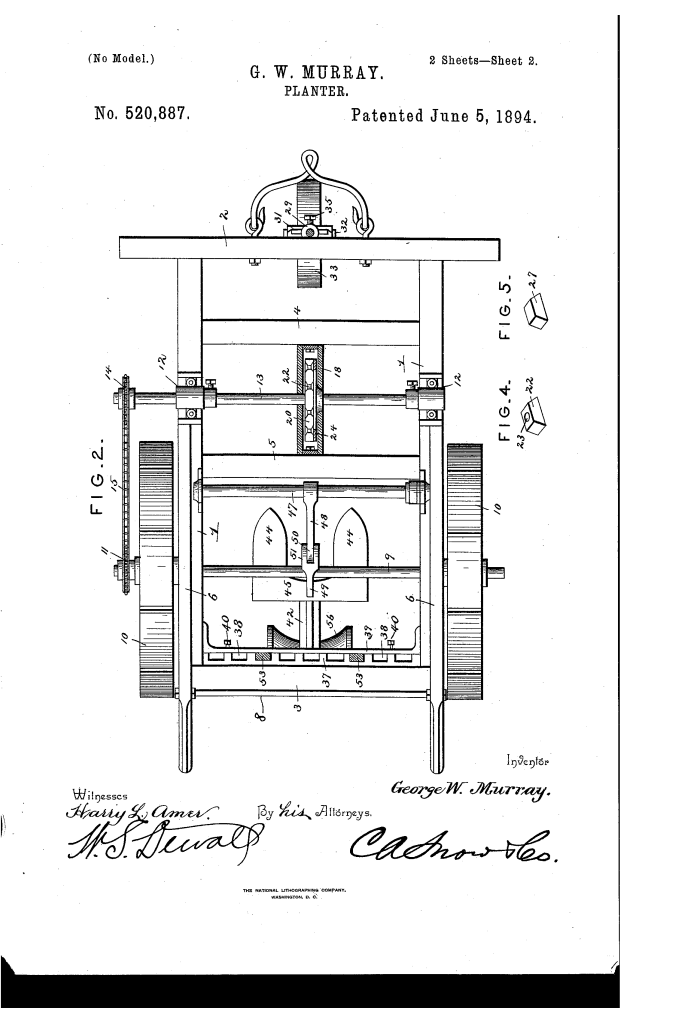
- Adjustable Spacing: The wheel features integrally cast, wedge-shaped dovetail blocks (21) around its edge. Reversely beveled seed-cups (22) slide into these spaces.
- Customization: If a farmer wants to plant seeds farther apart, they can simply slide out a seed-cup and replace it with a flat blank-cup (27), preventing seed release on that rotation.
- Secure Locking: A cast-metal clamping ring (24) bolts directly to the face of the blocks, locking the cups firmly in place so they don’t slip under the heavy weight of the seed hopper.
Key Mechanical Components
The planter utilizes a robust, synchronized mechanical framework where every part coordinates with the rotation of the ground wheels:
| Component | Function |
| Ground Wheels & Axle (10, 9) | Drive the vehicle and transfer rotational energy to the planting mechanism via a sprocket-and-chain system. |
| Seed-Wheel (20) | Revolves directly beneath the slotted hopper bottom to accurately scoop and drop a consistent quota of seed. |
| Caster-Wheel & Handle (33, 36) | Located at the front to allow the operator to smoothly steer and maneuver the heavy frame. |
| Double-Bladed Shovels (44) | Straddle the path of the dropped seed, pulling loose dirt over the furrow to bury it. |
| Concaved Blocking-Roller (56) | Follows behind the shovels to pack down the dirt and shape the soil into a perfect, protective ridge. |
How the Apparatus Functions
The planter is designed for efficiency, allowing a single operator to sit on the integrated driver’s seat and manage the entire sequence using convenient hand levers:
- Seeding: As the team pulls the planter forward, the sprocket chain spins the seed-wheel. Each open seed-cup passes under the bottom slot of the hopper (17), catches the designated amount of seed (such as corn or peas), and drops it through the discharge spout into the ground.
- Covering: Immediately following the discharge spout, the twin-pattern shovels (43) carve through the soil. Positioned on opposite sides of the seed path, they cast loose dirt inward to cover the newly dropped seed.
- Molding: Finally, the heavy blocking-wheel (56) rolls over the loose dirt. Because its outer rim is explicitly concaved, it packs the soil tightly and shapes the continuous drill into a uniform, raised ridge.
- Depth Control: If the operator encounters a rock or needs to transport the unit across a road, they pull the rock-shaft lever (48), which uses a mechanical link to lift the heavy shovels completely out of the dirt.
George W. Murray had an incredibly historic day on June 5, 1894, when he was granted a total of six patents at once (spanning numbers 520,887 through 520,892). These were all designed to be part of his grand mechanical vision: an all-in-one agricultural framework equipped with interchangeable attachments that could turn a single machine base into a planter, a chopper, a distributor, or a reaper.
While both No. 520,887 and No. 520,890 are titled “Planter” on paper, they represent different modular tool configurations within his interchangeable system:
- No. 520,887 (Smooth Seed Planter): This is the core machine described above. It is specifically designed for smooth, heavy, free-flowing grains like corn and peas. It relies on the distinct, gravity-fed dovetail pocket seed-wheel to scoop clean amounts of uniform seed and drop them directly into the furrow.
- No. 520,890 (Cotton-Seed Planter Variant): This module was specifically engineered to handle the unique agricultural nightmare of planting cotton seeds. Raw cotton seeds are covered in sticky, fibrous lint, meaning they clump together and completely jam regular gravity-fed seed cups. Murray’s 520,890 variant replaced the smooth cup wheel with an aggressive, mechanical agitation and force-feed picker mechanism inside the hopper to tear the clinging cotton seeds apart and mechanically force them down the spout at regular intervals.
About the Inventor: George W. Murray
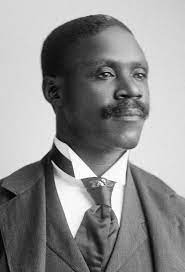
George Washington Murray was an extraordinary figure of the Reconstruction and post-Reconstruction eras, breaking massive barriers in both technology and American politics.
- Patents: Born into slavery in South Carolina, Murray was a brilliant visualizer of mechanical systems. He secured eight patents in the mid-1890s for a suite of agricultural achievements, including a soil chopper, a fertilizer distributor, and a cotton-picker enhancement.
- Political Legacy: Beyond his engineering feats, Murray was a prominent educator and politician. He was elected to the U.S. House of Representatives, serving from 1893 to 1897, where he was a fierce advocate for the protection of Black voting rights and frequently highlighted the technological achievements of Black inventors to combat the era’s systemic prejudices.
- Impact: Murray’s inventions focused heavily on reducing physical drudgery for Southern tenant farmers and sharecroppers, proving that small-scale agricultural operations could be significantly optimized through accessible mechanical automation.
Summary of Claims
The patent explicitly claims:
- A planter combining a framework and hopper with a transverse driving shaft, featuring a specialized wheel with integrally formed peripheral dovetail blocks, removable seed-cups, and a secure clamping ring.
- A rear mounting plate featuring vertical adjustment recesses that hold adjustable standards, allowing the depth and pressure of the concaved blocking-roller to be precisely clamped into position.
