
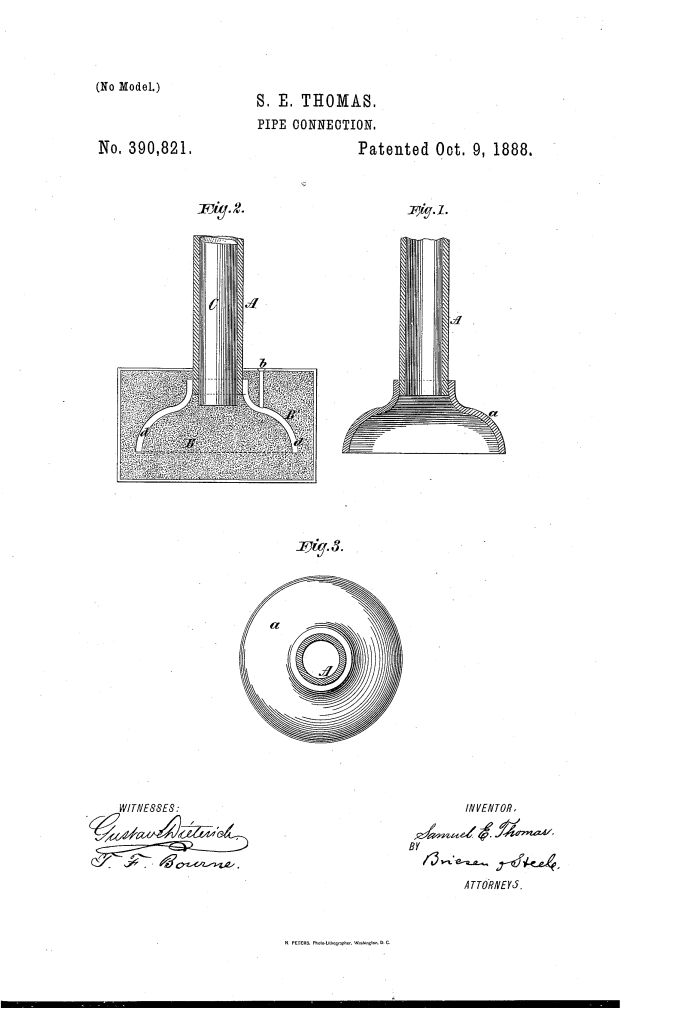
Pipe Connection (Samuel E. Thomas, No. 390,821)
The patent by Samuel E. Thomas of Brooklyn, New York, describes an improved Pipe Connection (Patent No. 390,821, 1888). This invention is a specialized method and resulting product for uniting wrought-lead pipes with cast-metal flanges or plates.
The “Why”: The Pain Point
Thomas’s primary objective was to create a leak-proof, permanent junction that could withstand weather, rust, and physical wear better than traditional soldered joints. His innovation features a molecular bonding process involving a tin intermediary and a rigid core to maintain the pipe’s structural integrity during the casting process. In the late 19th century, plumbic (lead) systems were the standard for sanitation; however, the point where a flexible wrought pipe met a rigid cast-iron or lead fixture was a notorious failure point. Soldered “wiped joints” were labor-intensive and prone to cracking under thermal expansion or mechanical stress. Thomas sought a unified, monolithic structure that behaved as a single piece of metal.
The Inventor: Samuel E. Thomas
Samuel E. Thomas was a Brooklyn-based inventor whose work focused on the critical, though often invisible, infrastructure of the growing American city. Operating during the height of the Industrial Revolution, Thomas’s engineering philosophy centered on material synergy—the idea that different forms of metal (wrought vs. cast) could be fused into a superior composite. As a Black inventor in the 1880s, Thomas’s ability to secure patents and assign them to established firms like Fred Adee & Co. demonstrates a high level of technical authority and navigate-ability within a patent system that was often exclusionary. His work reflects a pragmatic brilliance: solving the “dirty” problems of urban sanitation to ensure public health and structural longevity.
Key Systems Section
Molecular Interfacial Bonding
- The Component: The “Film of Tin.”
- Technical Breakdown: Thomas utilized a tin intermediary layer as a fluxing agent. By dipping the wrought lead into molten tin, he created a surface with a lower melting point than the pipe itself. When the molten cast metal entered the mold, it fused with this tin layer, creating a metallurgical bond rather than a simple mechanical friction fit.
Thermal Integrity Core
- The Component: The “Rigid Core” (Iron or Stone).
- Technical Breakdown: To prevent the thin-walled wrought pipe from collapsing or “running” (melting) under the extreme heat of the incoming molten metal, Thomas inserted a removable internal mandrel. This acted as a heat sink and a structural brace, ensuring the internal diameter (ID) of the pipe remained true during the transition from liquid to solid state.
Integrated Casting Mold
- The Component: The “Mold-Cavity.”
- Technical Breakdown: The pipe itself serves as a fixed insert within the casting mold. This transformed the pipe from a separate component into a “wall of the mold-cavity,” allowing the flange to be cast onto the pipe rather than joined to it post-production.
Comparison Table
| Standard Methods of the Time | The New Innovation (Thomas Method) |
| Wiped Soldered Joints: Required a manual application of molten solder around a seam; prone to “pinhole” leaks. | Direct Fusion: Creates a monolithic bond where the cast and wrought parts become a single unit. |
| Mechanical Deformation: Flaring or threading pipes often weakened the lead wall, leading to stress fractures. | Structural Reinforcement: The casting process adds mass and strength to the connection point without thinning the pipe. |
| High Maintenance: Solder and lead have different expansion rates, causing joints to fail over seasonal cycles. | Thermal Uniformity: By using similar metals (Lead-on-Lead), the expansion rates are matched, preventing separation. |
Significance Section
- Precursor to Modern Die-Casting: The method of using an insert within a mold to create a composite part is a foundational principle in modern automotive and aerospace manufacturing.
- Sanitation Revolution: By reducing leaks in water-closet (toilet) discharge pipes, this invention directly contributed to the hygiene standards of high-density tenement housing in the late 19th century.
- Metallurgical Fluxing: The use of a tin film to facilitate the bonding of disparate metal states (wrought vs. cast) prefigured modern industrial brazing and soldering techniques.
