
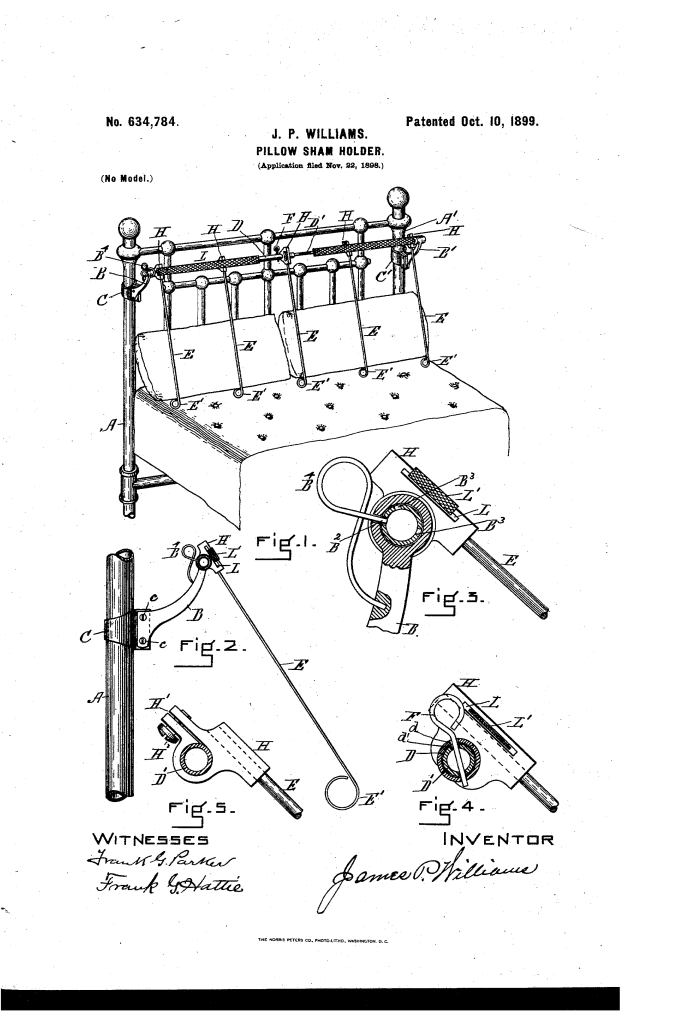
Pillow-Sham Holder (1899)
U.S. Patent No. 634,784, granted on October 10, 1899, to James P. Williams, describes an adjustable mechanical frame designed to support and display decorative pillow shams on domestic bedsteads. Williams, an inventor based in Boston, Massachusetts, engineered a system that could easily rotate out of the way when the bed was in use while adapting seamlessly to mattresses and bed frames of varying dimensions.
In late 19th-century domestic life, decorative pillow shams were popular bedroom fixtures, yet they routinely required cumbersome manual positioning or fixed frames that fit only one specific size of bed. Williams solved this issue by introducing a telescoping, multi-position rocker-shaft assembly that simplified both the installation and daily operation of bed drapery.
The Innovation: The Telescoping Rocker-Shaft Assembly
The foundation of Williams’s design is an extensible central rocker-shaft mounted horizontally between the bedposts. Rather than relying on a rigid, single-length bar, the device utilizes an interlocking dual-tube mechanism that accommodates different bed widths without requiring specialized tools.
- Telescoping Tubing (D, D’)The main support consists of two metal tubes, with inner tube D’ sliding smoothly inside outer tube D.Both tubes feature a series of aligned adjustment holes (d, d’).A locking pin (E or F) passes through the overlapping holes, securing the assembly at the exact width required for standard twin, full, or custom frames.
- Spring-Pin Angle Regulation (B’, B”)The ends of the rocker-shaft rest within supporting head brackets (B) secured to the posts.A spring-loaded pin (B’) mounted on the bracket head engages with circumferential positioning holes (B”) on tube D.This enables the user to rotate the entire frame to multiple angled display positions during the day or pivot it back when retiring for the night.
Technical Components
The assembly integrates several interlocking elements to hold decorative linens taut and secure:
| Component | Function |
| Telescoping Tubes (D, D’) | Provide the main structural rocker-shaft while enabling variable-width adjustments across bed posts. |
| Mounting Brackets (B) & Clamps (C) | Wrap around the bedposts and anchor the shaft using clamping screws (c) that tighten the bracket and clamp simultaneously. |
| Spring-Pin Lock (B’, B”) | Fixes the rotational angle of the rocker-shaft to position the pillow shams upright or swung back. |
| Socket-Pieces (H) | Fixed and adjustable collars mounted on the shaft to receive and secure the sham support frame. |
| Slotted Kerf & Clamping Screw (H’, H”) | Features on adjustable socket-pieces that allow them to slide freely along tube D’ during telescoping and lock into place. |
| Rib-Wires & Support Arms (E) | Extend outward from socket-pieces to create the structural backing for the pillow shams. |
| Attachment Tape/Ribbon (L) | Threaded through slots in the support arms to provide a clean sewing or fastening surface for the fabric sham. |
Key Operational Features
Reversible Mounting: The rib-wires (E) can be inserted into the socket-pieces (H) from either side, allowing the entire rocker-shaft assembly to be reversed end-for-end to accommodate diverse bedpost configurations.
Single-Operation Fastening: The post clamp (C) is engineered so that drawing the ends together with screw c simultaneously locks the bracket to the clamp and the clamp to the bedpost, cutting installation time in half.
Fabric Protection: By securing shams via dedicated slotted ribbons (L) rather than direct mechanical grips or sharp fasteners, the device prevents tearing or creasing delicate linen work.
About the Inventor: James P. Williams
James P. Williams was an inventor active in Boston, Suffolk County, Massachusetts, at the close of the 19th century. His work on domestic furnishings reflected the late Victorian era’s growing demand for household convenience, modular consumer goods, and functional mechanical adaptations for interior living spaces.
Summary of Claims
The patent explicitly claims:
- A pillow-sham holder featuring brackets attached to bedposts to carry an adjustable rocker-shaft.
- Spring pins in the bracket heads that engage and hold the rocker-shaft at selected rotational angles.
- A rocker-shaft formed of two concentric sliding tubes adjustably locked together via a pin passing through matching adjustment holes.
- Supporting bracket-pieces (H) attached to the shaft, complete with extension arms and slots to receive tape for securing the pillow sham.
