
Picture-Projection Theater (Arthur L. Macbeth, No. 1,419,870)
The patent by Arthur L. Macbeth of Baltimore, Maryland, describes a Picture-Projection Theater (Patent No. 1,419,870, 1922). This invention is a specialized architectural structure designed for the “daylight” display of motion pictures or slides. Macbeth’s primary objective was to enable large audiences to assemble in the open air and view projected media clearly, even during the day, by utilizing a unique three-compartment system that shields the screen from ambient light while maintaining wide viewing angles.
Inventor Background: Arthur L. Macbeth
Arthur L. Macbeth was an accomplished African American photographer and inventor based in Baltimore. His 1922 patent (a continuation of his 1920 application) addresses a significant technical hurdle of the early silent film era: the requirement for near-total darkness to view projections. By applying his expertise in optics and light behavior, Macbeth designed a “portable” yet sturdy theater that brought the cinema experience outdoors, prioritizing public health (fresh air) and commercial accessibility.
Key Structural & Optical Systems
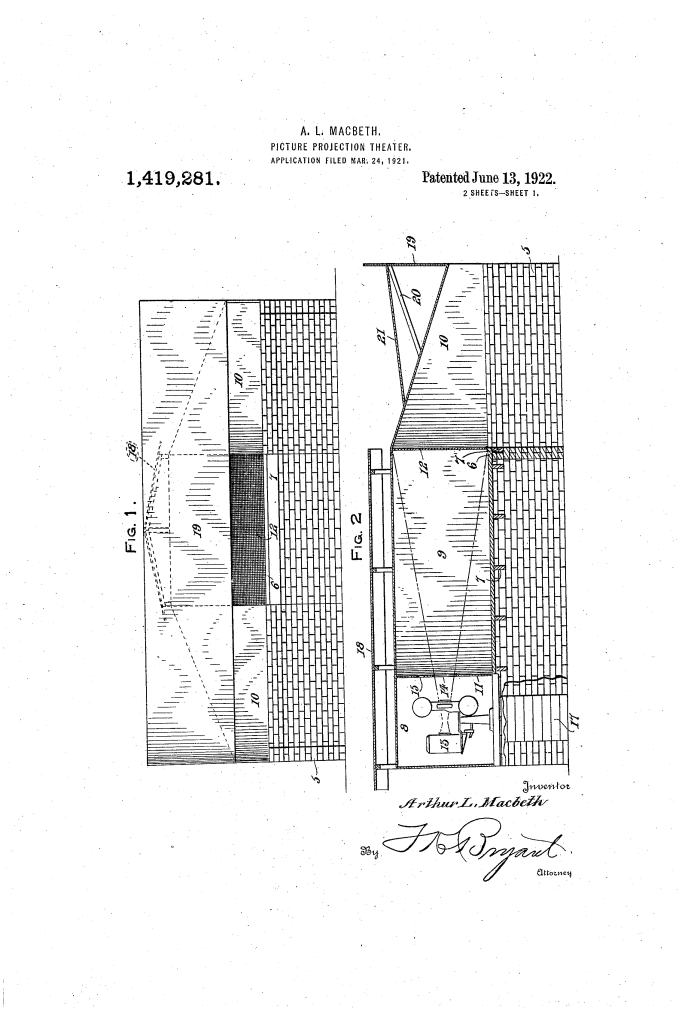
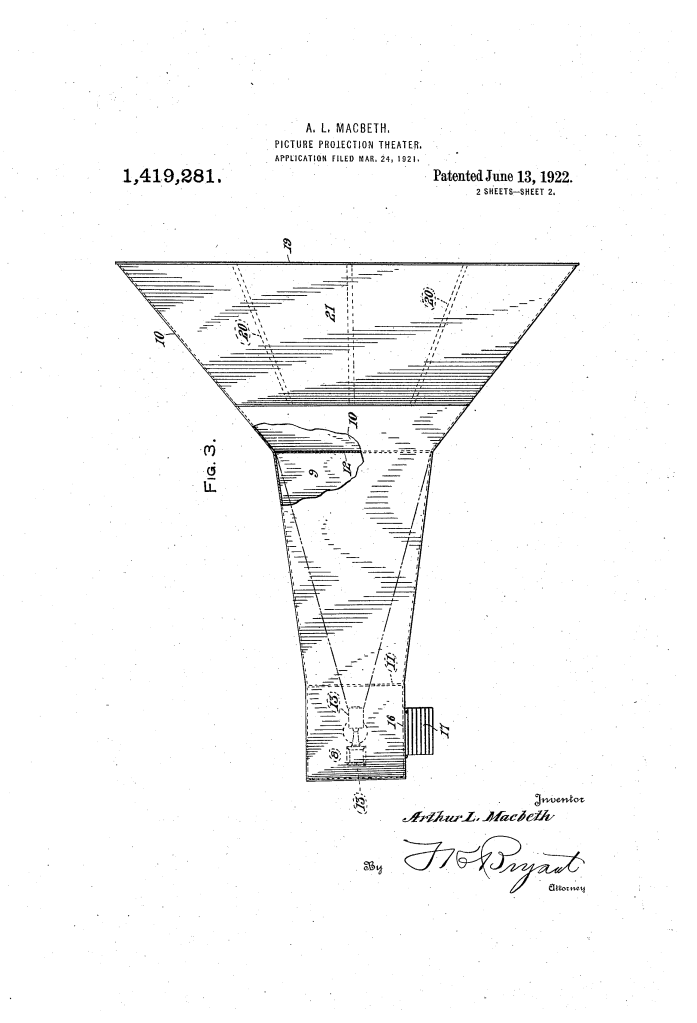
The theater is a “house-like” structure built upon a raised foundation (5) and floor (6), organized into three distinct functional zones.
1. The Operators Booth (8)
- Location: The rear-most rectangular compartment.
- Function: Houses the projection and enlarging machine (13).
- Access: Features a side door (16) and steps (17) for the operator, ensuring the technical workspace is isolated from the audience and the elements.
2. The Middle Projection Room (9)
- Separation: Divided from the booth by an opaque partition (11).
- The Apertures: The partition contains two vital openings:
- Projection Opening (14): Where the light rays pass through.
- Sight Opening (15): Allows the operator to monitor the screen (12) from within the booth to ensure focus and alignment.
- Geometry: The side walls of this room diverge slightly forward to accommodate the expanding cone of the projection light.
3. The Front Alcove and Translucent Screen (10, 12)
- The Screen (12): A translucent or opalescent screen acts as the barrier between the middle and front rooms. Unlike standard screens, images are projected onto the back and viewed from the front.
- Flaring Alcove (10): The side walls diverge sharply to provide a wide horizontal field of vision for a large outdoor audience.
- Light Control: The top wall (ceiling) of the alcove slants forward and downward. This “restricted opening” prevents sunlight or overhead light from hitting the screen surface, preserving image contrast during the day.
Mechanical Features and Navigation
| Feature | Engineering Solution | Function |
| Translucent Screen (12) | Rear-projection material. | Allows images to be viewed from the opposite side of the projector. |
| Slanting Roof (21) | Forward-downward pitch. | Excludes external light from the alcove to permit “daylight” viewing. |
| Sign Plate (19) | Vertically mounted above the entrance. | Provides a space for advertising and theater branding. |
| Fireproof Walls | Sheet metal construction. | Ensures safety and makes the structure potentially portable. |
Significance to Cinematic Engineering
Arthur L. Macbeth’s design provided a blueprint for solving the “ambient light” problem in early cinematography.
- The Rear-Projection Model: By placing the mechanics behind the screen and the audience in front of it, Macbeth minimized shadows and interference, a precursor to modern rear-projection systems used in television and events.
- Environmental Integration: His focus on the “open air” reflects a historical period where indoor ventilation was poor; his theater offered a “beneficial to health” alternative to cramped, dark nickelodeons.
- Optical Geometry: The use of diverging walls and slanted ceilings demonstrates an advanced understanding of light exclusion and sightlines, principles that remain core to modern cinema and stadium design.
