
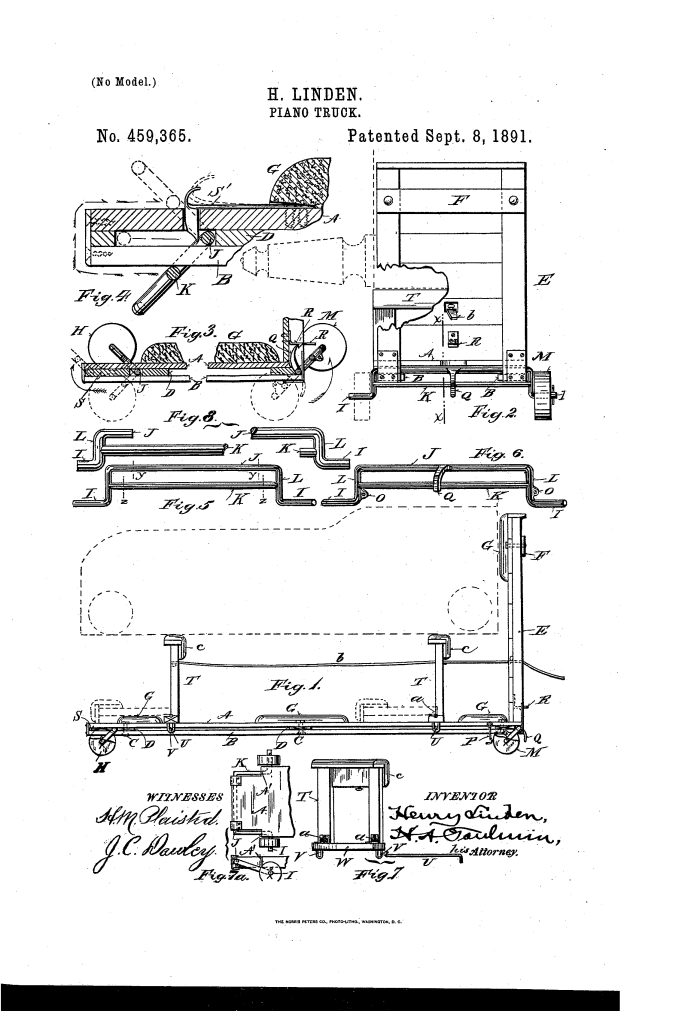
Piano Truck (1891)
U.S. Patent No. 459,365, granted on September 8, 1891, to Henry Linden, introduces a versatile, heavy-duty transport system designed to handle the unique challenges of moving both square and upright pianos. Linden, a resident of Springfield, Ohio, sought to solve a common 19th-century logistical nightmare: transitioning a massive, fragile instrument from a rolling transport to a sliding surface without requiring a large crew of movers.
The invention’s primary breakthrough was a reversible wheel system that allowed a single operator to retract the wheels with their foot, converting the truck into a set of skids for sliding over curbs, stairs, or into wagons.
The Innovation: The Reversible Wheel-Frame
Traditionally, moving a piano required lifting the entire weight to remove or add wheels. Linden’s design utilized a “cranked” axle system that allowed the wheels to swing 180 degrees from a functional lower position to a stored upper position.
- The Hybrid Body: The truck consists of a solid bottom (A) and side strips or “skids” (B). When the wheels are retracted, these skids provide a smooth sliding surface.
- The “Foot-Action” Reverse: The rear wheel frame includes a specific hook (Q). A mover can maintain their grip on the truck’s handle and use their toe to kick the hook, engaging a spring-catch (R) that locks the wheels in the “up” position.
- Self-Locking Stability: When in use, a cross-piece (K) acts as a stop against the frame, preventing the axles from spreading under the immense weight of the piano.
Key Mechanical Components
The truck is a study in Victorian mechanical efficiency, using leverage and gravity to manage heavy loads:
| Component | Function |
| Crank Portions (L) | Connects the upper and lower axles, allowing the wheels to pivot in an arc around the frame. |
| Stop-Piece (K) | A reinforcement bar that rests against the skids to bear the weight when wheels are down. |
| Detachable Trestles (T) | Padded supports that hold a square piano on its side so the legs can be removed for transport. |
| Spring-Catch (R) | Automatically secures the rear wheels in the reversed position when triggered by the foot. |
| Cushioned Points (G) | Protective padding at contact zones to prevent scratching the piano’s polished wood finish. |
Versatility: Square vs. Upright Pianos
Linden’s truck was essentially a two-in-one tool, adapting to the two most common piano styles of the era:
- For Square Pianos: The operator uses the detachable trestles. The piano is tilted onto these supports, which are at the exact height needed to keep the legs horizontal. This allowed movers to unscrew the legs easily before lowering the piano body onto the truck.
- For Upright Pianos: The trestles can be completely removed by withdrawing a cross-rod (U). This lightens the truck and allows the upright piano to sit flush against the cushioned frame.
Operational Workflow
The patent describes a specific sequence that allowed just two men—one at each end—to manage the move:
- Lifting & Locking: While the man at the rear lifts the handle (F), he uses his foot to flip the wheel frame.
- The Transition: To go from a rolling sidewalk to a sliding doorstep, the wheels are “broken” from their engagement and flipped upward, letting the truck land on its wooden skids.
- The Safety Strap: A connecting strap (b) ensures the trestles don’t accidentally collapse while the piano is being tilted.
About the Inventor: Henry Linden
Henry Linden was an innovator based in Springfield, Ohio, a hub of manufacturing in the late 1800s. By assigning half of the patent rights to Thomas Vall, Linden secured the backing necessary to market the device to professional piano movers and music houses. His work reflected the era’s obsession with “labor-saving” machinery—mechanizing the brute force previously required for piano logistics.
Summary of Claims
The patent explicitly protects:
- A truck-body frame consisting of a bottom and skids with separating pieces.
- Reversible wheel-frames that use an upper sliding axle and a lower wheel axle connected by cranks.
- The foot-operated hook and spring-catch system for “hands-free” wheel adjustment.
- Adjustable, hinged trestles specifically designed for the removal of piano legs during transport.
