
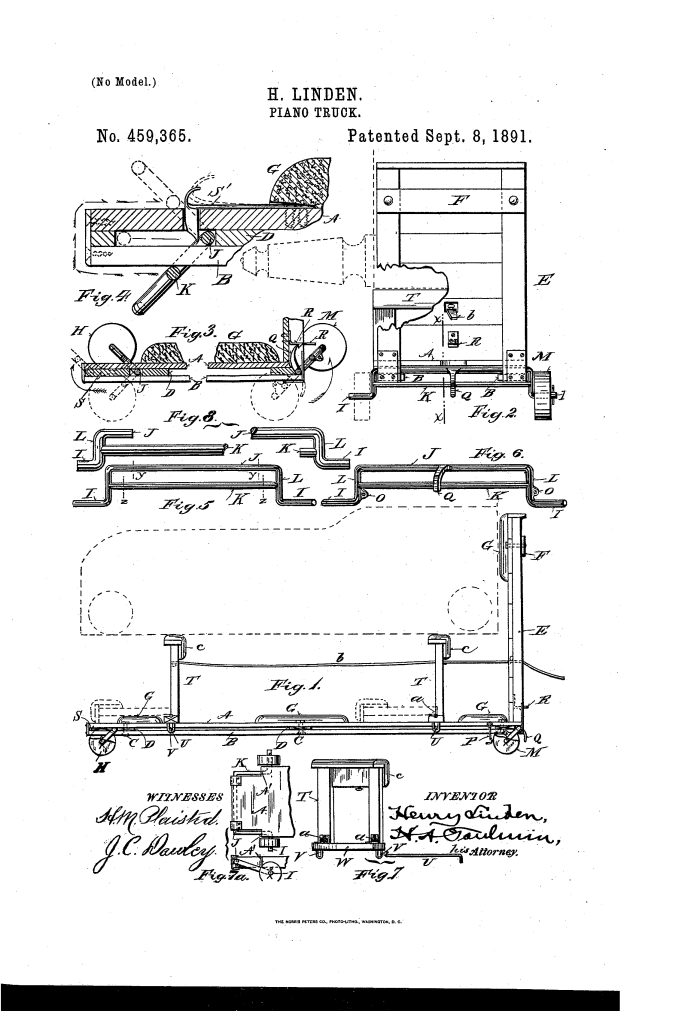
Piano Truck – Patent No. 459,365
Inventor: Henry Linden, of Springfield, Ohio.
Patent Number: 459,365
Date of Patent: September 8, 1891
Description: Henry Linden’s patent for a “Piano-Truck” was an innovative device designed for moving heavy pianos more safely and efficiently. The invention included a wheeled dolly with several key features:
- Reversible Wheel Frames: The truck had two sets of wheel frames, one at the front and one at the rear. These frames could be reversed, either positioning the wheels for rolling or tucking them away to allow the truck to slide on its runners (skids).
- Foot-Operated Mechanism: The rear wheels had a hook-and-spring mechanism that a person could operate with their foot. This allowed a single person to quickly flip the wheels up or down without having to let go of the piano.
- Convertible Trestles: The truck also included foldable trestles that could be detached. When a square piano needed to be moved, the trestles could be raised to support the piano on its side, making it easier to remove its legs for transportation. When not needed, they could be folded down or removed entirely for moving an upright piano.
Societal Impact
Linden’s piano truck was a practical invention that addressed a significant physical challenge in the late 19th century: moving large, fragile objects.
- Increased Efficiency and Safety: Moving a piano was a difficult and often dangerous task that required significant physical labor. Linden’s invention made the process much safer and more efficient. The ability to switch between wheels and skids meant the truck could handle both smooth surfaces and rough floors, while the adjustable trestles made it easier to handle pianos of different shapes and sizes. This reduced the risk of injury to the movers and damage to the valuable instrument.
- Professionalization of a Service: Inventions like this contributed to the professionalization of moving and transportation services. By providing specialized, purpose-built equipment, it allowed companies to offer a more reliable and less destructive service.
- The Inventor’s Legacy: The patent record for Henry Linden does not contain details about his life beyond his residence in Ohio. His invention, however, stands as an example of the kind of pragmatic ingenuity that was applied to solving everyday problems in a rapidly industrializing society.
