
Photographic Processes (1965)
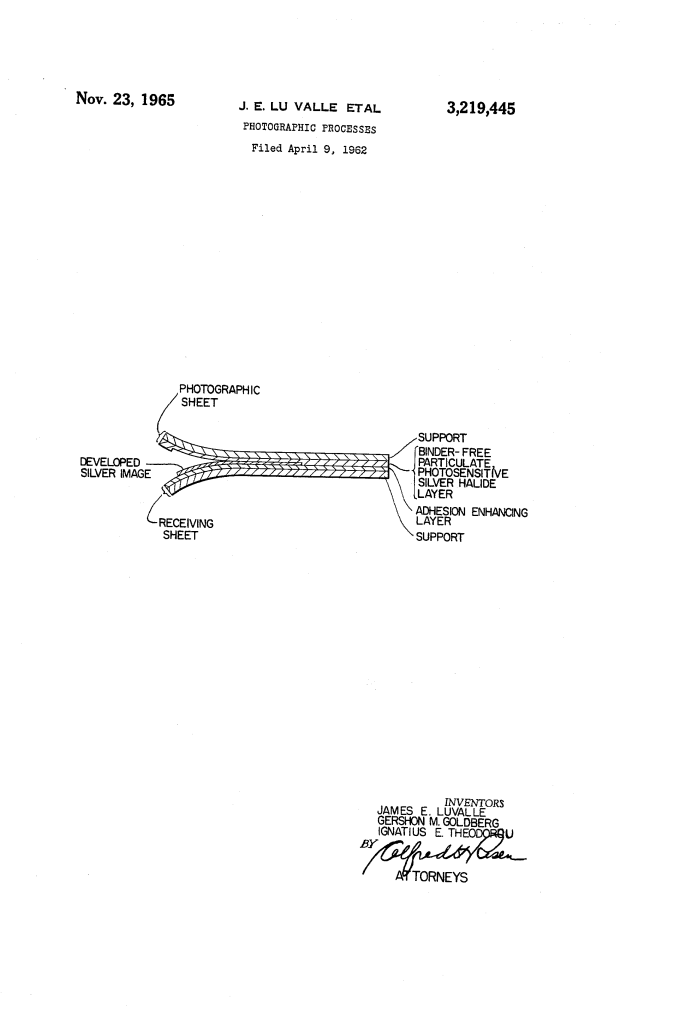
U.S. Patent No. 3,219,445, granted on November 23, 1965, to James E. LuValle, Gershon M. Goldberg, and Ignatius E. Theodorou (assigned to Technical Operations, Incorporated), describes a novel photographic transfer method that mechanically lifts a developed silver image directly off a photosensitive substrate using preferential adhesion.
Traditional diffusion transfer processes—such as early Polaroid systems—relied on complex wet chemistry, processing pods, and solvent diffusion to dissolve undeveloped silver salts and precipitate them onto a secondary receiving sheet. LuValle and his team bypassed chemical diffusion entirely by eliminating the standard gelatin binder, allowing pure metallic silver to be physically stripped away from the unexposed silver halide base.
The Innovation: Binder-Free Mechanical Transfer
In conventional photography, light-sensitive silver halide crystals are suspended inside a thick gelatin matrix. While functional, this emulsion slows development down, requires extensive chemical fixation baths, and causes light scatter that limits image resolution and sharpness (acutance).
LuValle replaced the conventional emulsion with a binder-free, particulate layer of silver halide (such as silver bromide or silver iodobromide) deposited via vacuum evaporation directly onto a base support in an ultra-thin stratum (often 0.1 to 1.0 micron thick). Because there is no gelatin encapsulating the grains:
- Rapid Surface Development: Chemical developers react instantly at the surface without needing to permeate a binder.
- Direct Mechanical Peeling: The metallic silver grains formed during development cohere to each other rather than being locked inside an organic web, allowing them to be cleanly pulled away by an adhesive receiving sheet.
Why Preferential Adhesion?
The physical separation depends on carefully calibrating surface energy and adhesive forces:
- Selective Affinity: The receiving material must exert a stronger adhesive pull on the reduced metallic silver image than the silver holds to the underlying halide base.
- Substrate Retention: At the same time, the receiving sheet must show far less adhesion toward the unreduced silver halide, leaving the unexposed substrate intact on its original base.
- Multiple Reproductions: Because only the top surface layer of developed silver is peeled away, a single latent image in a 1-micron-thick layer can be redeveloped and stripped repeatedly—yielding as many as seven sharp copies from a single exposure.
Key Technical Components
| Component | Function |
| Binder-Free Halide Stratum | An evaporated, vacuum-deposited layer of silver halide microcrystals (0.1 to 1.0 micron) free of gelatin. |
| Base Support | Transparent or opaque substrates (e.g., Mylar polyester, baryta paper, glass, or cellulose esters) that hold the halide layer. |
| Surface Developer | Fast-acting alkaline developer (such as diluted D-19 or Elon-hydroquinone) applied via spray, bath, or absorbent pad without dissolving the base. |
| Adhesive Receiving Sheet | Transfer element—ranging from pressure-sensitive tape to heat-softened gelatin-urea or silicate-coated glass—that strips the silver image. |
| Protective Polymer Overcoat | Terpolymer varnishes (e.g., vinyl acetate-vinyl chloride-maleic acetate) applied to shield the final transferred silver image from abrasion and oxidation. |
How the Transfer Process Works
| Step | Action | Mechanical & Chemical Purpose |
| 1. Exposure | The binder-free halide sheet is exposed to actinic light. | Forms a latent image across the surface microcrystals without binder diffusion drag. |
| 2. Surface Development | An alkaline developing agent is sprayed or applied to the surface. | Rapidly reduces exposed halide crystals into a coherent layer of metallic silver. |
| 3. Superposition | A receiving sheet (e.g., adhesive tape or softenable silicate/gelatin) is pressed against the surface. | Establishes intimate molecular contact and high adhesive affinity for the silver grains. |
| 4. Mechanical Stripping | The receiving sheet is peeled away from the base substrate. | Lifts the coherent negative silver image off cleanly, leaving residual halide behind. |
| 5. Reversal / Processing | The remaining unexposed halide on the base is fogged or flooded with developer. | Converts residual halide into a permanent positive silver image, generating two distinct records. |
Performance and Advantages
- Ultra-High Acutance and Resolution: Eliminating the gelatin matrix prevents light dispersion and developer oxidation trapping, producing microscopically sharp lines.
- Dual Image Generation: A single exposure produces both a transferred image on the receiving sheet and a reversed image on the original base.
- Dry and Rapid Handling: By utilizing pressure-sensitive adhesives or pressure-polymerizable coatings (such as cyanoacrylates or acrylate monomers), development and permanent transfer can occur in seconds without liquid wash tanks.
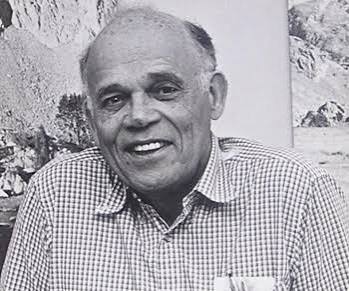
About the Lead Inventor: James E. LuValle
James Ellis LuValle was an Olympic medalist, physical chemist, and pioneering research scientist.
- Early Achievements: Before his scientific career took center stage, LuValle won the bronze medal in the 400-meter run at the 1936 Berlin Olympic Games.
- Academic Excellence: He earned his Ph.D. in chemistry and mathematics from the California Institute of Technology (Caltech) under the mentorship of Nobel laureate Linus Pauling, focusing on electron diffraction and molecular structure.
- Industrial Impact: LuValle served as the Director of Basic Research at Technical Operations, Inc., and later held senior research positions at Fairchild Camera and Instrument. He became a preeminent authority on the photochemistry of silver halides, high-resolution aerial reconnaissance imaging, and advanced optical systems.
- Legacy: Overcoming intense mid-century racial barriers in corporate and academic laboratories, LuValle published dozens of technical papers, secured numerous patents in photographic chemistry, and later served as the director of undergraduate chemistry laboratories at Stanford University, where the student center at UCLA (LuValle Commons) was also named in his honor.
Summary of Claims
The patent explicitly claims:
- A photographic transfer method utilizing an exposed, binder-free particulate silver halide stratum on a support base.
- Forming a surface silver image and placing it in intimate contact with a receiving element to achieve preferential mechanical adhesion.
- Stripping the receiving sheet to remove substantially all the silver image in a silver halide-free form.
- Reducing the residual, unexposed silver halide stratum on the original base to form a second, reversed record image.
- The utilization of ultra-thin, vapor-deposited microcrystalline layers having a thickness of approximately 0.1 to 1.0 micron.
