
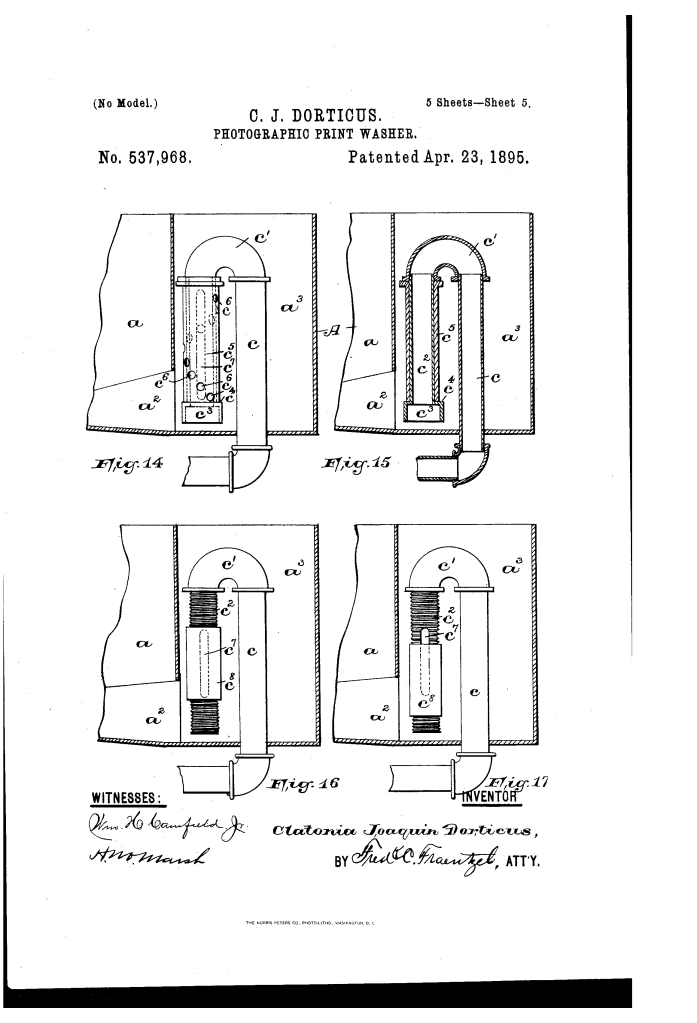
Photographic Print Washer (1895)
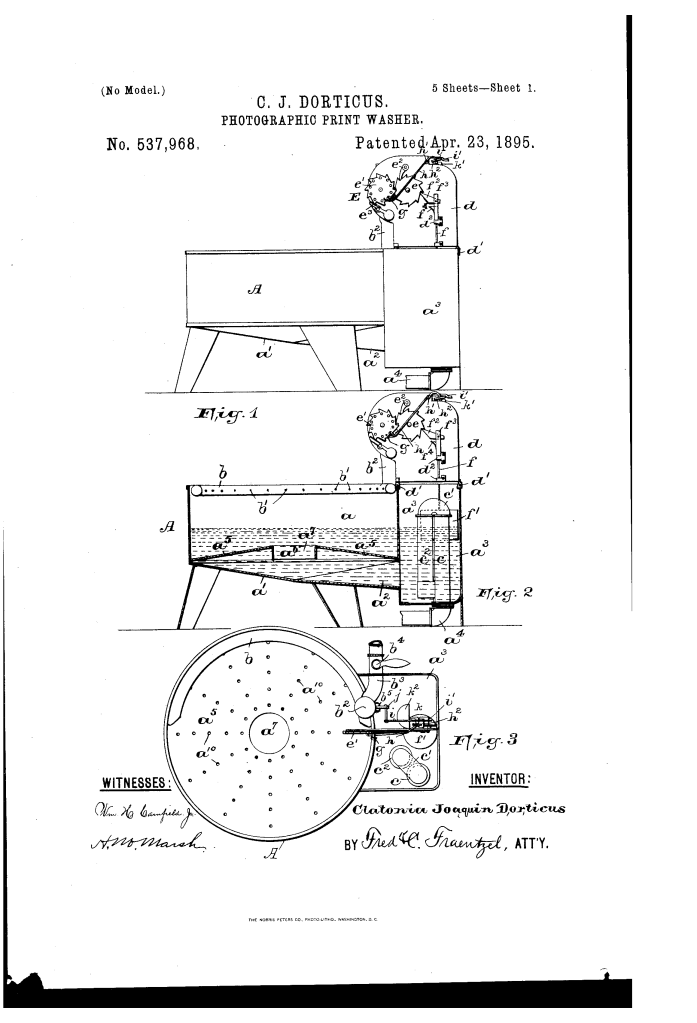
U.S. Patent No. 537,968, granted on April 23, 1895, to Clatonia Joaquin Dorticus, details an advanced automatic apparatus designed to thoroughly wash photographic prints and gelatin negatives. Operating out of Newton, New Jersey, Dorticus—a prolific late-19th-century inventor—engineered a mechanical solution to a delicate chemical problem: rapidly eliminating destructive residual chemistry from photography paper without destroying the image surface.
This specific invention solved multiple persistent problems in early photography processing: how to prevent fragile prints from sticking to container walls, tearing, or congregating in a clump, while simultaneously automating the labor-intensive process of tracking and changing chemical-laden wash water.
The Innovation: The Cyclical Fluid Dynamics & Auto-Shutoff
Traditional print washing in the 1890s required manual water changes or left prints stagnant, causing the sodium hyposulfite (“hypo” fixing salts) to soften, dull, and permanently ruin the photographic emulsion. Dorticus’s breakthrough was a self-regulating, high-velocity system that utilized fluid dynamics to keep the prints constantly moving while automatically tracking the number of water cycles.
Why the Dual-System Mechanics?
- Anti-Adhesion Corrugation: The internal walls of the circular tank are entirely corrugated. This prevents the wet, sticky albumen or aristotype paper faces from sealing against the flat sides of the pan.
- Density-Driven Evacuation: Because heavy hypo salts naturally sink below lighter water, Dorticus positioned a false bottom over a sloped floor, pulling the contaminated fluids down into an isolated drainage well.
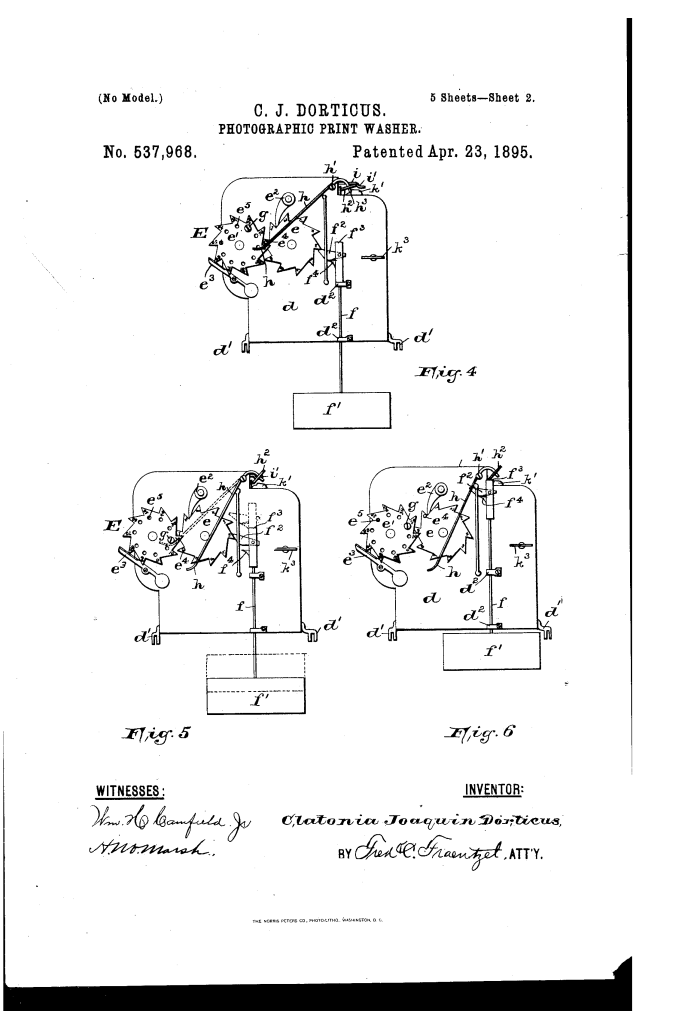
- Automated Cycle Counting: A mechanical float monitors the filling and emptying cycles, turning a series of ratchet dials to count up to 100 washes before automatically triggering a spring-loaded shutoff valve.
How the Apparatus Functions
The machine executes a hands-free, repetitive sequence to safely cycle fresh water through the tank:
| Step | Action | Mechanical Purpose |
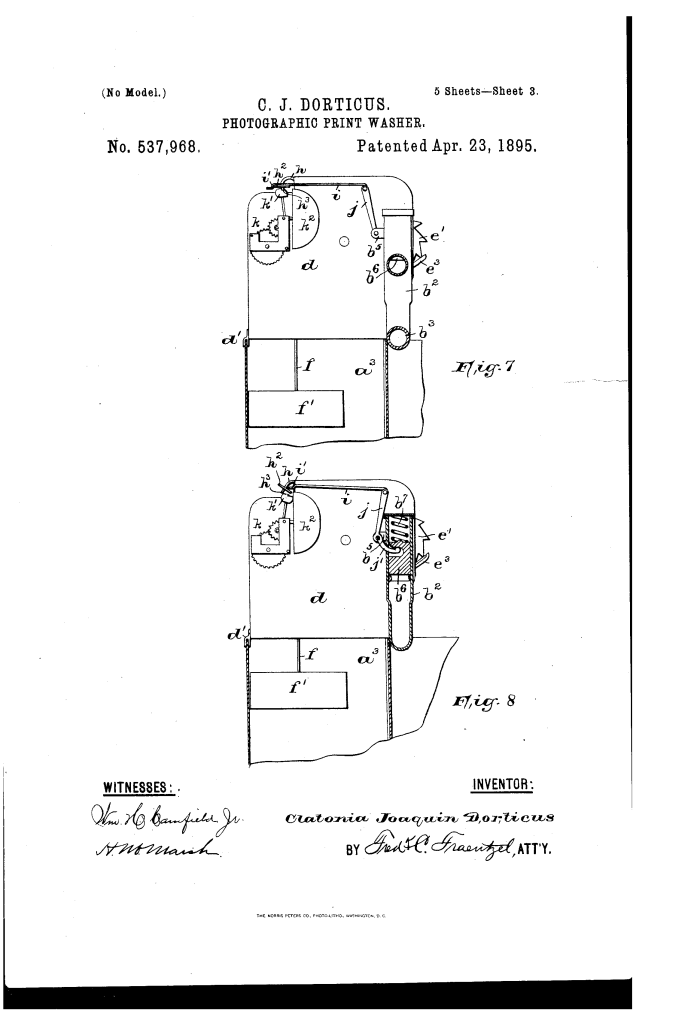
| 1. Spray Injection | Water enters a top-mounted perforated pipe (b) at an angle. | Generates a uniform circular current that keeps prints suspended and moving. |
| 2. Sedimentation | Heavy chemical runoff sinks through a perforated false bottom (a3). | Isolates prints from contaminated sediment to protect the image film. |
| 3. Siphoning | A dedicated drainage well (a1) utilizes an adjustable siphon (c) to purge water. | Draws heavily from the bottom at a volume exceeding the inflow rate. |
| 4. Registration | A rising float (f1) and rod (f) advance a ratchet disk (e) by one tooth per fill. | Keeps an exact physical count of total fluid changes. |
| 5. Deactivation | A preset pin (g) trips a lever (h), shutting the valve and striking a gong (k2). | Prevents over-washing, guards against overflow, and alerts the operator. |
Key Structural Components
The apparatus is built from zinc and engineered as a modular system depending on media size:
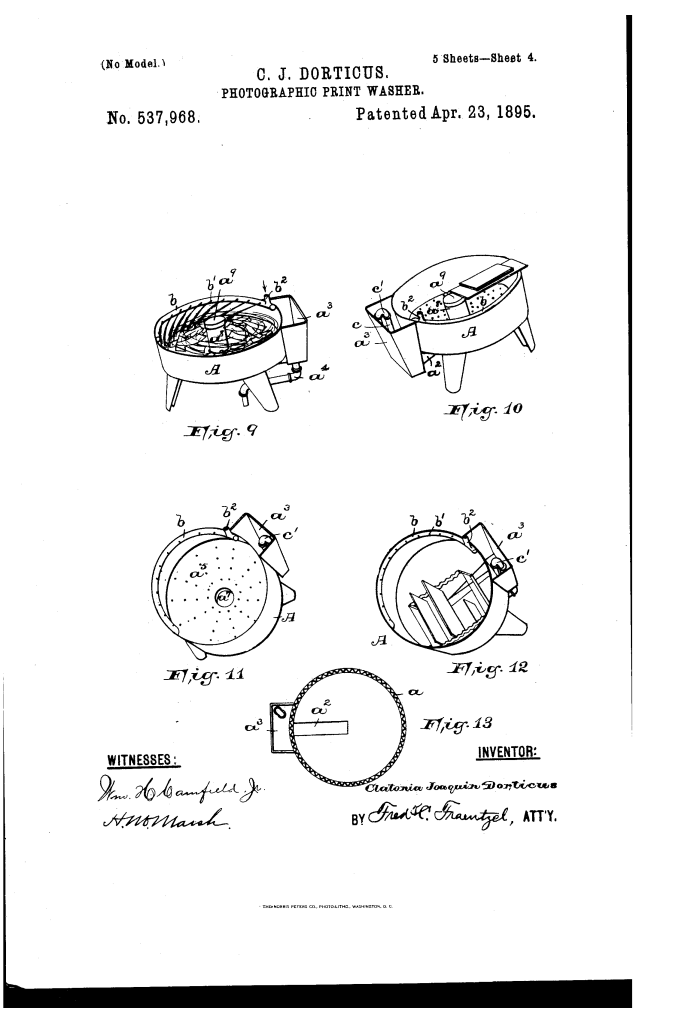
- Corrugated Tank (A): The primary circular vessel featuring uneven sides (a) and a conical base to prevent prints from gathering statically in the center.
- Removable False Bottom (a3): A perforated interior deck with flaring walls and a central opening (a4).
- Center Post & Cap (a,a6): A structural core used specifically for small prints to keep them traveling in an unbroken circular orbit. Removing the post adjusts the space for massive prints or standing negative frames.
- Adjustable Siphon (c1, c2): A specialized drainage assembly featuring a rotatable sleeve with spirally aligned apertures or threads. This allows the operator to set exactly how much minimum water remains in the tank post-cycle to keep prints from drying flat or curling.
Historical and Scientific Impact
Clatonia Joaquin Dorticus’s invention significantly advanced the efficiency of commercial photography labs at the close of the 19th century.
- Labor Minimization: Photographers no longer had to sit and manually count, drain, and refill trays to achieve permanent, stable images.
- Archival Permanency: By extracting heavy hyposulfite salts out from beneath the false bottom, the design eliminated chemical re-contamination, protecting historical photographs from fading or yellowing over time.
- Material Preservation: The controlled water current eliminated the tearing, bruising, and friction that typically ruined delicate photographic paper batches when processed in standard basins.
About the Inventor: Clatonia Joaquin Dorticus
Clatonia Joaquin Dorticus was a highly inventive African American inventor based in northern New Jersey. Active during a golden age of industrial innovation, Dorticus received several notable patents throughout the 1890s, particularly targeting photography and consumer goods. Beyond his sophisticated Photographic Print Washer, he successfully patented an advanced photographic print embossers and a machine for coloring photographs, cementing his legacy as a brilliant developer of technical mechanisms that refined the precision and scalability of early visual media.
Summary of Claims
The patent explicitly claims:
- A photographic wash tank featuring corrugated or uneven sides combined with a conical bottom to stop prints from sticking to walls or clustering in the center.
- A perforated, flare-sided false bottom with a modular central opening and removable post assembly to adapt the system for various print dimensions.
- An automatic mechanical register operated by a vertical float rod that records individual water cycles.
- A spring-actuated shutoff valve and audible alarm linkage triggered by the register disk to automatically close the water line and signal cycle completion.
