
Photographic Medium and Methods of Preparing Same (1965)
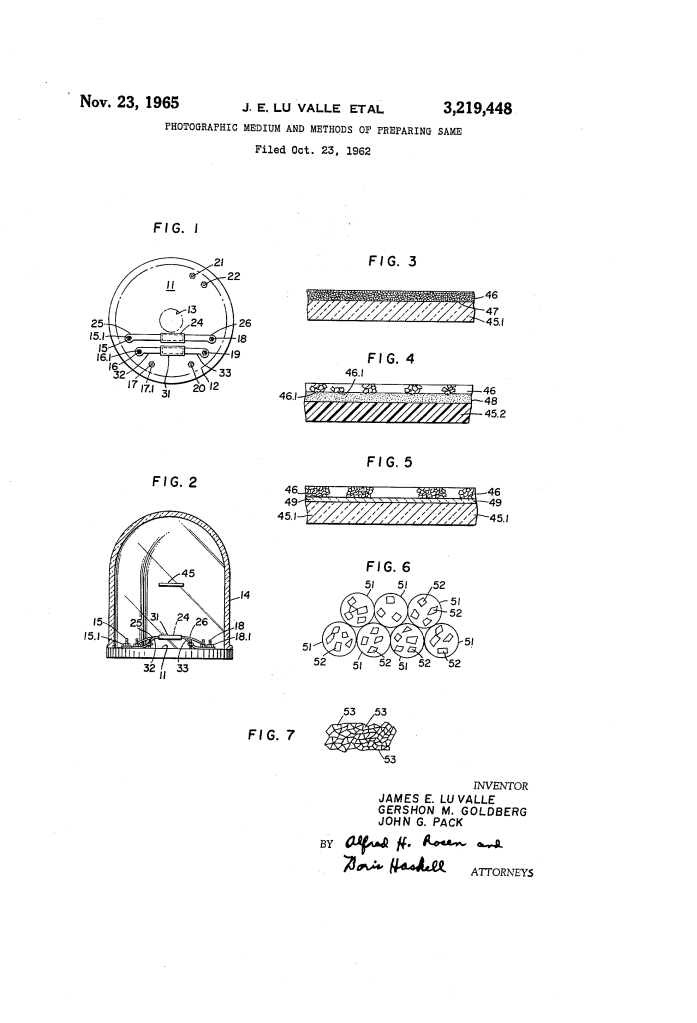
U.S. Patent No. 3,219,448, granted on November 23, 1965, to James E. Lu Valle, Gershon M. Goldberg, and John G. Pack (assigned to Technical Operations, Incorporated), describes a method for creating binder-free, ultra-thin silver halide photographic film via high-vacuum vapor deposition.
For decades, photographic film relied entirely on silver halide grains suspended in a thick gelatin emulsion. This conventional design suffered from inherent technical flaws: emulsion grains limited the maximum resolution, developers had to slowly diffuse through gelatin, radiation easily fogged the film, and the media could only be used once. Lu Valle and his team eliminated the gelatin binder entirely, creating a pure, microcrystalline photosensitive layer deposited directly onto supporting substrates.
The Innovation: Vacuum-Condensed, Binder-Free Thin Films
Rather than mixing silver salts into a gelatin matrix, the inventors melted pure silver halides in a high-vacuum chamber, allowing the vaporized molecules to condense directly onto a target substrate.
As the vapors strike the cool substrate, they condense into tightly packed microcrystals that adhere directly to each other and to the base material without any chemical binder.
Why Binder-Free Vapor Deposition?
- Superfine Resolution: Because there is no gelatin separating the grains, the film is essentially “grainless,” allowing an unprecedented density of fine photographic detail.
- Direct Development: Liquid or gaseous chemical developers do not need to penetrate a gelatinous layer; they react immediately with the surface crystals.
- Radiation Immunity: Gelatin acts as a halogen acceptor that permanently separates silver and halogen ions during radiation exposure, causing irreversible fogging. In Lu Valle’s pure crystalline layer, ionized silver and halogen atoms naturally recombine, making the film practically immune to gamma radiation fogging (tested up to 10,000 R).
- Image Transfer and Reusability: When developed only partially through its depth, the metallic silver image adheres poorly to the underlying silver halide crystals. A tacky sheet can lift off the developed silver image directly, leaving behind unexposed silver halide that can be reused for subsequent exposures.
Key System Components
The invention relies on precise physical parameters and vacuum hardware:
| Component | Function |
| Electrically Conductive Boats (24, 31) | Molybdenum, tantalum, or tungsten heating filaments holding pools of molten silver halide starting material. |
| Vacuum Chamber (Bell Jar 14) | Maintains an operating vacuum between 10^-4 and 10^-6 mm Hg to allow clean evaporation without thermal decomposition. |
| Supporting Substrate (45, 45.1, 45.2) | The receiving base, consisting of glass, photographic paper, or plastic film (such as Cronar polyester or cellulose acetate). |
| Subbing Stratum (48, 49) | Optional bonding layer (e.g., soft lacquer, silicon monoxide, or pressure-sensitive adhesive) that initial microcrystals penetrate (46.1) for increased mechanical anchoring. |
| Microcrystalline Stratum (46, 53) | The pure, continuous photosensitive layer, packed to roughly 95% of solid crystal density (6.16 g/cc for silver bromide). |
Performance: The 0.3-Micron Optimum
The patent demonstrates that photographic speed, gamma, and resolution are extraordinarily sensitive to the physical thickness of the deposited stratum:
- Sub-Optimum Thinness (0.1 micron / 15-second evaporation): Yields functional step wedges without fogging, but exhibits lower overall photographic density.
- The Sweet Spot (0.3 micron / ~1-minute evaporation): Delivers maximum photographic speed, maximum density, and optimal contrast (gamma). Light-struck areas can be developed completely down to the substrate, anchoring the final silver image securely during fixing baths without loss of sharpness.
- Excessive Thickness (up to 3.5 microns / 14-minute evaporation): Lateral spread of development between interconnected crystal grains degrades image sharpness and acutance, though it permits multiple cycles of peel-apart image transfer.
The Manufacturing Process
The production of binder-free film requires tight thermal and atmospheric control:
- Load Starting Halides: Place pure silver bromide, silver chloride, or silver iodide into the tungsten or molybdenum heating filaments (24, 31). Dual filaments are used to co-evaporate mixed halides, such as silver bromoiodide or chlorobromide.
- Evacuate the Chamber: Pump down the bell jar to a high vacuum between 10^-4 and 10^-6 mm Hg before applying heat to prevent premature decomposition.
- Establish Thermal Equilibrium: Heat the source material past its melting point (e.g., silver bromide melted and stabilized at approximately 515°C) behind a movable shutter.
- Expose and Condense: Open the shutter to let vaporized halides travel roughly 3.5 inches to the substrate target (45), which is maintained at a condensation temperature between 30°C and 50°C.
- Deposit Stratum: Condense the vapor for 15 seconds to several minutes until a continuous microcrystalline film of roughly 0.3 micron thickness is formed.
About the Inventor: James E. Lu Valle
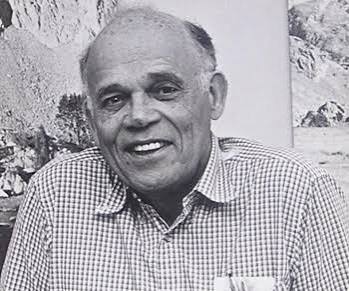
Dr. James Ellis Lu Valle was a pioneering American physical chemist and an Olympic athlete.
- Athletic Achievement: Before his major scientific career, Lu Valle won the bronze medal in the 400-meter run at the 1936 Summer Olympics in Berlin.
- Scientific Pedigree: He earned his Ph.D. in chemistry and mathematics at the California Institute of Technology under the mentorship of two-time Nobel laureate Linus Pauling.
- Photographic Chemistry: Lu Valle spent decades heading fundamental research laboratories—including positions at Eastman Kodak, Technical Operations, and Fairchild Camera and Instrument—specializing in photochemistry, electron diffraction, and the physics of the photographic latent image.
- High-Tech & Defense Applications: His binder-free thin films solved severe limitations in aerial surveillance, micro-reproduction, and high-radiation scientific recording during the Cold War space and defense era.
Summary of Claims
The patent explicitly claims:
- A photographic element comprising a substrate sheet covered by a substantially binder-free, continuous stratum of vapor-deposited silver halide microcrystals.
- A microcrystalline stratum thickness between 0.1 and 0.5 micron (optimally about 0.3 micron).
- A microcrystalline packing density of approximately 95% of the starting material’s solid crystalline density.
- A vacuum-evaporation method operating below material decomposition temperatures, between 10^-4 and 10^-6 mm Hg, condensing directly onto a base member.
- A method of photographic recording and development through the full thickness of a 0.3-micron binder-free stratum directly down to the supporting substrate.
