
Phonograph Expression Device (Joseph Hunter Dickinson, No. 1,261,502)
The patent by Joseph Hunter Dickinson of Cranford, New Jersey, describes an improved Phonograph (Patent No. 1,261,502, 1918). This invention is a specialized “expression device” designed to give the listener manual control over the volume and tone of the music. By using a unique telescoping valve system, Dickinson solved the problem of “abruptness” in sound graduation, allowing for a smooth transition from loud to soft—mimicking the expressive capabilities of a live musician.
Inventor Background: Joseph Hunter Dickinson
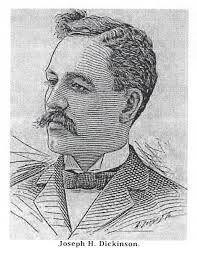
Joseph Hunter Dickinson (1855–1933) was a prolific African American inventor and a highly respected engineer in the musical instrument industry. Before joining the Aeolian Company, he was a veteran of the U.S. Navy and a pioneer in the design of player pianos and organs. His expertise was so renowned that he was tasked by Aeolian—one of the world’s largest manufacturers of musical instruments—to improve the acoustic quality of their phonographs. Dickinson’s work often focused on the “human touch,” creating mechanical systems that allowed for artistic expression in automated or recorded playback.
Key Mechanical Components & Functions
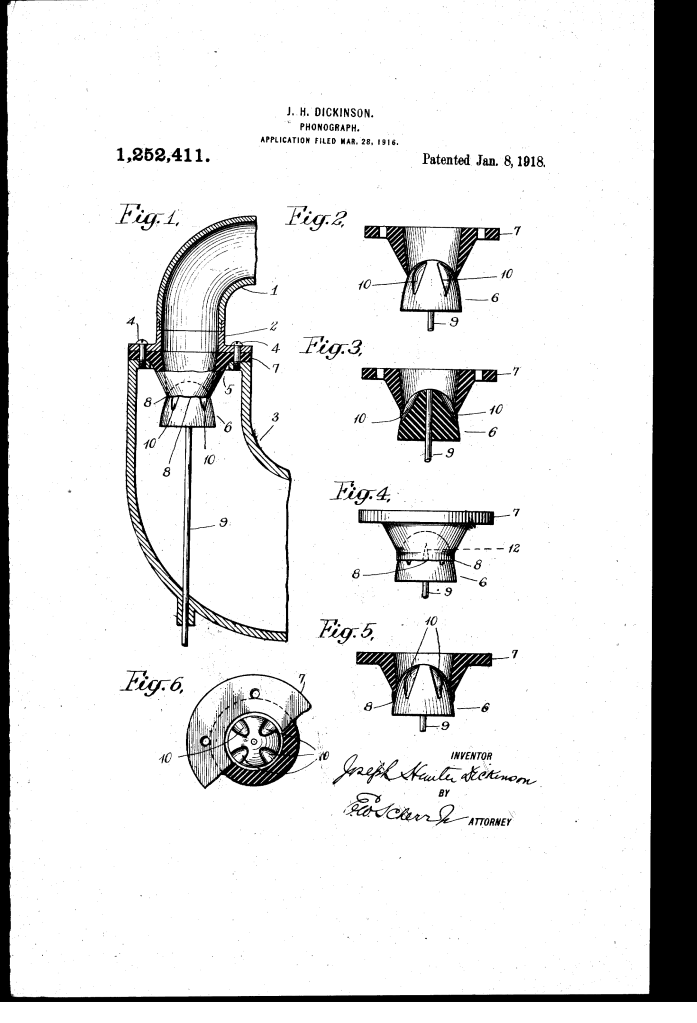
The expression device is situated at the junction where the tone arm meets the horn, acting as a sophisticated mechanical “dimmer switch” for sound.
1. The Elastic Throat (5)
- Material: The throat (5) is made of soft, elastic rubber.
- Tapered Wall: The wall of the throat tapers to a very thin lip (8) at the mouth.
- Function: Because it is made of soft rubber, the throat can expand and contract. As the valve is pushed into it, the rubber stretches and conforms to the valve’s shape, creating an airtight seal only when fully inserted.
2. The Irregular Lip (8) (Key Innovation)
- The Problem: In standard valves, as soon as the valve touches the throat, the sound is cut off abruptly.
- The Solution: Dickinson designed the lip of the throat with an irregular or notched edge (12).
- Function: When the valve first makes contact, it only touches the “high points” of the irregular edge. This leaves small spaces around the mouth where sound can still leak through, preventing a sudden drop in volume and allowing for a “gentle” fade-out.
3. The Recessed Plug Valve (6, 10)
- The Valve: A convex plug valve (6) mounted on a stem that the operator can slide back and forth.
- The Recesses (10): The surface of the valve features grooves or recesses (10).
- Function: These recesses act as secondary sound channels. Even when the valve is partially inserted, the sound travels through these grooves. As the valve is pushed deeper, the elastic walls of the throat gradually squeeze into the recesses, slowly pinching off the sound until it is completely silent.
4. The Graduated Taper
- Geometry: The recesses (10) become shallower and narrower as they reach toward the top of the valve.
- Function: This provides a mathematical graduation of sound. The further the valve is telescoped into the throat, the smaller the available space for sound waves to travel, resulting in a perfectly smooth “diminuendo” (fading of sound).
Comparison of Sound Control Methods
| Feature | Standard Phonograph Shutters | Dickinson’s Expression Device |
| Material | Usually rigid wood or metal slats. | Soft, elastic rubber throat and recessed plug. |
| Transition | “Steppy” or abrupt changes in volume. | Smooth, continuous graduation of tone. |
| Seal | Hard to achieve a total “silent” softest play. | Elastic throat conforms to valve for total occlusion. |
| User Experience | Mechanical and clunky. | Responsive and artistic; allows for delicate nuance. |
Significance to Acoustic Engineering
Joseph Hunter Dickinson’s expression device influenced the development of acoustic modulation and audio engineering.
- Nuanced Attenuation: The logic of using irregular edges and variable-depth recesses to avoid “clipping” or abrupt transitions is a fundamental principle in modern audio limiters and faders.
- Elastomeric Sealing: His use of soft rubber as a structural, variable-shape component was ahead of its time, anticipating the use of polymers in modern high-fidelity speaker surrounds and vibration dampening.
- Human-Centered Design: By focusing on the “expressive” quality of the machine, Dickinson helped move the phonograph from a mere novelty into a legitimate musical instrument capable of artistic interpretation.
