

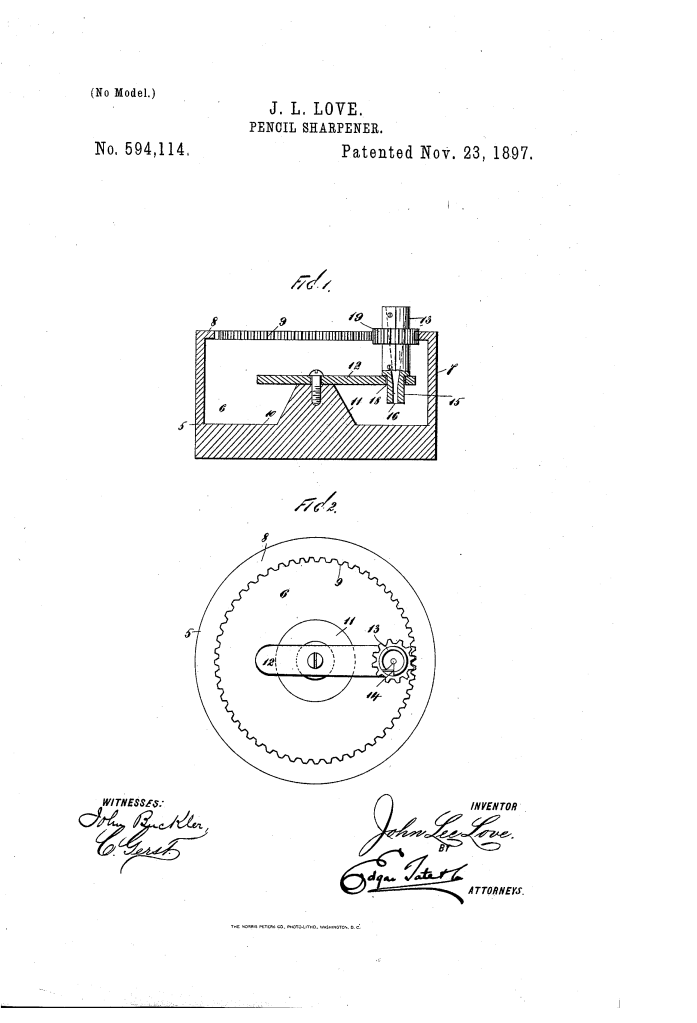
Pencil-Sharpener (1897)
U.S. Patent No. 594,114, granted on November 23, 1897, to John Lee Love, describes a portable, hand-operated mechanical pencil sharpener designed for simplicity, efficiency, and cleanliness. John Lee Love, a Black inventor residing in Fall River, Massachusetts, created a compact planetary gear system that streamlined a routine daily task while doubling as a heavy desk ornament or paperweight.
This invention solved a common issue with late 19th-century sharpeners: awkward gear mechanisms, messy graphite shavings, and a lack of portability. Love’s design allowed a user to sharpen a pencil cleanly and smoothly by using a revolving arm mechanism contained within a weighted casing.
The Innovation: The Planetary Gear Mechanism
Rather than relying on complex hand cranks or stationary tabletop clamps, Love’s sharpener utilizes a internal planetary gear setup that operates through simple downward pressure and a circular sweeping motion.
The user inserts the pencil into the sharpener body and moves the pencil in a circle around the casing. As the pencil rotates around the central pivot, a small pinion gear on the sharpener engages with a stationary ring gear inside the casing rim, forcing the internal cutting blade to spin rapidly against the pencil lead and wood.
How the Apparatus Functions
The device operates through a streamlined mechanical sequence:
- Insertion: The pencil point is placed vertically into the conical opening of the cylindrical sharpener (13).
- Engagement: Downward pressure and a sweeping circular motion drive the pivoted arm (12) around the raised central pivot (11) on the chamber floor (10).
- Planetary Rotation: The pinion gear (19) attached to the sharpener mesh against the fixed gear teeth (9) lining the upper rim (8) of the casing, causing the sharpener to spin rapidly around its own axis.
- Waste Collection: Lead shavings and wood dust fall downward through a small central bore (16) in the reduced bottom extension (15) directly into the bottom chamber (6), keeping the work area clean.
Key Components
The assembly uses a small set of durable components engineered to work in tandem:
| Component | Function |
| Casing / Chamber (5, 6) | The circular block housing that acts as a waste collector and serves as a heavy paperweight base. |
| Internal Toothed Rim (8, 9) | An inwardly directed flange along the top edge of the chamber with gear teeth to drive the spinning mechanism. |
| Pivoted Arm (12) | An arm mounted to the raised floor (11) that swings 360 degrees around the center of the casing. |
| Cylindrical Sharpener (13) | The rotating body holding the internal cutting blade (14) and conical opening for the pencil. |
| Pinion / Gear Wheel (19) | The small gear attached to the body of the sharpener that meshes with the rim gear teeth (9) to drive rapid self-rotation. |
| Tubular Extension (15, 16) | A reduced bottom tailpiece on the sharpener that sits inside the arm opening (18) and provides an exit path for shavings into the chamber. |
Historical and Design Impact
Love’s “Love Sharpener” represents a milestone in practical office equipment during the turn of the 20th century.
Portability and Utility: Unlike large, wall-mounted or table-clamped commercial sharpeners of the era, Love’s sharpener was compact, lightweight, and completely portable. It was designed to sit on any flat desk as a paperweight while remaining instantly accessible.
Cleanliness: By integrating an internal drop-slot for shavings into the chamber below, Love eliminated the mess of graphite dust on hands and paper—a major drawback of handheld open-blade pocket sharpeners.
Elegance of Mechanical Design: By taking advantage of planetary gear principles, the user could apply minimal effort to achieve high rotational speeds on the blade, making pencil preparation smooth and uniform.
About the Inventor: John Lee Love
John Lee Love was a 19th-century African American inventor based in Fall River, Massachusetts.
In addition to his famous 1897 pencil sharpener patent, Love was granted U.S. Patent No. 542,419 in 1895 for an improved railway plastering device (an expandable “eyebolt” and block system for positioning heavy beams and rails). Love’s sharpener design went on to become one of the most iconic and widely referenced early portable sharpener patents in American industrial history.
Summary of Claims
The patent explicitly claims:
- A chamber open at the top, bordered by an inwardly-directed annular flange with gear teeth, featuring a raised floor with a pivoted arm that holds a revolvably mounted, gear-driven pencil sharpener.
- A pencil-sharpener assembly comprising a main block casing, an internal gear-toothed rim, a center-pivoted arm, and a cylindrical sharpener unit equipped with a pinion gear and a hollow bottom tubular extension extending through the arm.
