
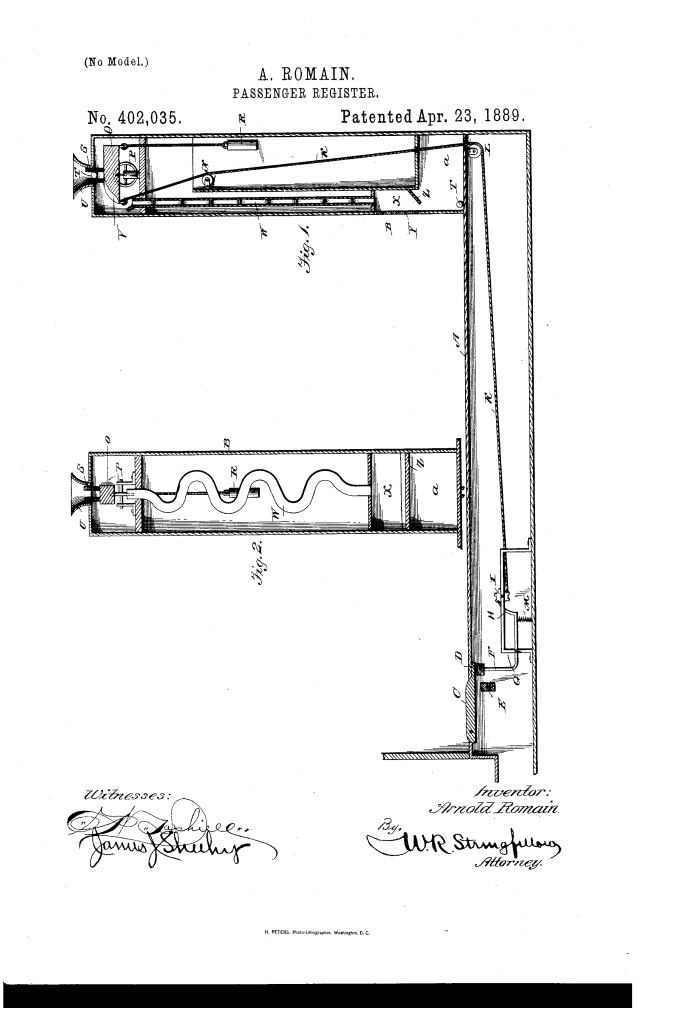
Automatic Passenger Register | Arnold Romain | Patent No. 402,035
The patent by Arnold Romain of New Orleans, Louisiana, describes a Passenger-Register (Patent No. 402,035), issued on April 23, 1889. This invention is an automated mechanical tallying system designed for streetcars and public transit, utilizing a pressure-sensitive floor trap to trigger the release of physical tokens (balls) into a visible counting chamber.
The “Why”
In the late 19th century, fare collection on crowded streetcars relied heavily on the honesty and memory of conductors. Discrepancies between the number of passengers and the fares collected were common. Romain sought to solve the “pain point” of manual counting and fare embezzlement by creating a system that rendered registration “entirely automatic.” By linking the physical entry of a passenger to a visible, undeniable mechanical event, the system provided an objective audit trail for the transit company.
The Inventor: Arnold Romain
Arnold Romain, a resident of New Orleans during the post-Reconstruction era, demonstrated an engineering philosophy of Transparent Accountability. His design reflects the growing industrial need for “foolproof” systems in urban infrastructure. operating in a city that was a hub for innovation in steam and street railway technology, Romain’s work bridged the gap between simple carpentry and complex mechanical logic, emphasizing a system that could not be easily manipulated by the operator.
Key Systems Section
The Kinetic Floor Trap
- Pivoted Platform: Near the car door, a trap (C) is integrated into the floor (A). It is held flush by a spring (M) and limited by a transverse stop bar (E).
- Force Conversion: When a passenger steps on the trap, it depresses a bent lever (F). This lever features a “finger” (H) that engages a ratchet wheel (I), converting vertical foot pressure into rotational torque.
Cable-Driven Displacement
- Torque Transmission: As the ratchet wheel turns, it winds a cord (K) onto a central shaft.
- Remote Activation: The cord travels under the floor, around pulleys (L and N), and up into a vertical cabinet (B) to reach the “tilting table” (O) at the top of the device.
Gravity-Fed Token Tally
- Token Storage: A hopper (U) and guides (S) feed small balls (T) onto a grooved tilting table.
- The Zigzag Audit: When the cord pulls the table, a single ball rolls into a zigzag chute (W). The zigzag path is critical; it retards the ball’s descent, ensuring it stays within the glass-faced passage (X) long enough for the conductor or an inspector to see the registration occur.
Comparison: Manual Conductor Tally vs. Romain’s Register
| Feature | Conductors’ Manual Tally | Romain’s Automatic Register |
| Activation | Subjective (Conductor pulls a cord). | Objective (Passenger steps on floor). |
| Verification | Difficult; no physical proof. | Visible ball movement through glass. |
| Audit Method | Counting paper receipts/hand tallies. | Counting physical balls in a locked receiver. |
| Error Margin | High (Human forgetfulness or theft). | Low (One step = one ball). |
Significance
- Early Data Collection: By requiring the final count to be halved (since passengers step on the trap both entering and exiting), Romain utilized a basic algorithmic approach to data processing (Total \div 2 = Fares).
- Visual Audit Trails: The use of a “glass front” passage (Y) to allow public witnessing of the count is a precursor to modern transparent transaction interfaces.
- Mechanical Automation: The system converted human kinetic energy directly into a data record, a foundational concept in early industrial automation.
