
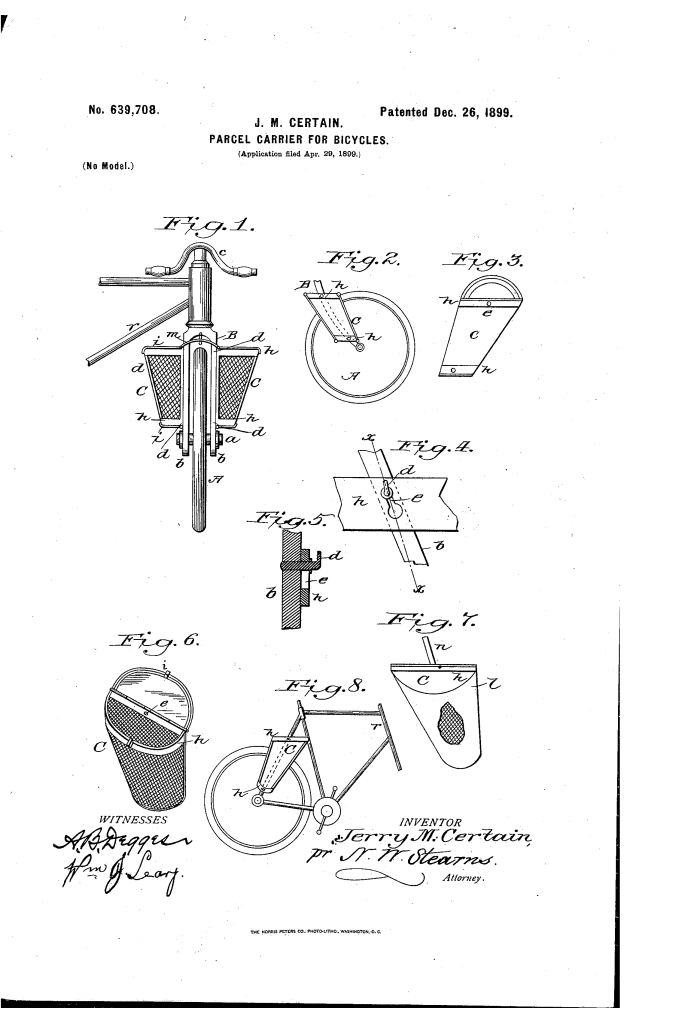
Parcel-Carrier for Bicycles (1899)
U.S. Patent No. 639,708, granted on December 26, 1899, to Jerry M. Certain, details an innovative balanced luggage-carrying system designed specifically for bicycles. Certain, an inventor based in Tampa, Hillsborough County, Florida (assigning one-half interest to Antonio Toffaleti of the same city), addressed the challenges of transport utility during the height of the American bicycle craze of the late 1890s.
Prior to Certain’s invention, carrying luggage or packages on bicycles typically involved cumbersome front-handlebar baskets or top-mounted rear racks that raised the center of gravity and severely destabilized steering. Certain solved this by designing a modular, low-mounted, dual-sided basket assembly that mounted symmetrically along the fork blades of either wheel.
The Core Design: Symmetrical Low-Center Mounting
The core of Certain’s design relies on balancing load distribution across the wheel fork while ensuring rapid attachment and removal without interfering with the rider’s steering arc.
- The Balanced Dual-Basket ArchitectureRather than using a single bulky container, Certain engineered a matched pair of baskets (C, C) mounted on opposite sides of the wheel fork.
- Semi-Oval Profile: Each basket features a substantially semi-oval cross-section with a flat back designed to rest flush against the fork blade.
- Tapered Form: The basket’s bottom is smaller than its top, creating an inverted truncated profile that preserves lateral heel and pedal clearance while optimizing storage volume.
- Clearance Awareness: The top rim of each carrier is intentionally positioned low enough along the steering fork to avoid striking the bicycle frame’s stationary inclined brace (r) when turning.
- Hook-and-Aperture Quick-Release FasteningThe mounting interface is built directly into the bicycle’s structural fork blades (b, b).
- Projecting Stud Hooks (d, d): Outward-facing hooks or studs are affixed directly along the bifurcations of the forked steering bar.
- Frame Apertures (e, e): The structural hoop-iron stays (h) that define the top and bottom rims of each basket are stamped with mating receiving slots.
- Interlocking Fit: Dropping the baskets onto the studs locks them securely against lateral and vertical shifting while permitting quick, tool-free detachment.
Technical Components
| Component | Patent Callout | Functional Role |
| Front/Pilot Wheel | A (pivot a) | The steerable wheel assembly housing the axle pivot. |
| Forked Steering-Bar | B (forks b, b) | The front fork assembly terminating at handlebar c, providing rigid anchor points. |
| Basket Receptacles | C, C | Symmetrical parcel containers with flat inward backs and tapered semi-oval profiles. |
| Mounting Hooks | d, d | Outward-projecting studs on fork blades b, b that support the basket frame. |
| Apertures | e, e | Precision-cut slots in hoop-iron frame stays h to engage hooks d, d. |
| Hoop-Iron Stays | h | Metal perimeter bands forming the rigid structural skeleton and rims of each basket. |
| Hinged Lid | i | Top cover providing closure and securing cargo in transit. |
| Protective Covering | l | Weatherproof outer shroud to seal woven-wire or braided rattan baskets against sand, dust, and rain. |
| Connecting Band | m | Arching transverse strap joining both baskets over the wheel for added stabilization. |
| Carrying Straps | n | External handle assembly allowing both baskets to be unhooked and carried together off the bike. |
| Frame Clearance Point | r | Stationary down-tube/brace of the main bicycle frame cleared by the low basket tops during turns. |
How the Apparatus Functions
- Mounting: The cyclist aligns the top and bottom apertures (e, e) of the hoop-iron frame stays (h) over the projecting hooks (d, d) on the fork blades (b, b), sliding the basket downward into positive engagement.
- Cargo Protection: Loose goods are placed inside the basket, and the hinged lid (i) is latched. When constructed of open-work wire or rattan, protective covers (l) are drawn over the exterior to seal out road dust, mud, and weather.
- Dual Stabilization: The connecting band (m) spans across the front wheel tire (or rear wheel when adapted as in Fig. 8), bridging the two units to cancel out vibration and prevent outward sway.
- Transit & Removal: By dividing cargo evenly across both sides of the hub, steering leverage remains neutral and agile. At the destination, the cyclist unhooks the pair and carries them off the bicycle in one hand using integrated straps (n).
Historical and Mechanical Significance
Jerry M. Certain’s December 1899 patent represents a remarkably early ancestor of the modern front “lowrider” pannier rack system widely used today in cycle touring and urban commuting.
- Lower Center of Mass: By positioning parcel weight along the lower fork blades rather than on high handlebar racks, Certain’s configuration preserves handling dynamics and prevents the front wheel from flopping during turns.
- Versatility Across Wheels: The specification explicitly accounts for versatility, detailing application to either the front steering fork or the rear stays (Fig. 8).
- Off-Bike Portability: The integration of carrying straps (n) and quick-release slots anticipated the multimodal commuter workflow, allowing the carrier to instantly transition from bicycle cargo trunk to handheld shopping tote.
About the Inventor: Jerry M. Certain
Jerry M. Certain was an inventor based in Tampa, Florida, active during the turn of the 20th century. Working in the rapidly evolving industrial climate of late 1890s Florida, Certain focused on practical, consumer-facing transit mechanics, securing intellectual property for bicycle attachments and partnering locally with Antonio Toffaleti to commercialize everyday utilitarian mobility hardware.
Summary of Claims
The patent explicitly claims:
- The combination with bicycle forked steering-bars of fixed outwardly projecting hooks.
- Oppositely located, symmetrically formed basket receptacles configured to mount on both sides of the wheel.
- Mating apertures stamped into the basket frame designed to receive and lock onto the fork-mounted hooks.
