
Paper-Bag Machine: William B. Purvis (Patent No. 420,099)
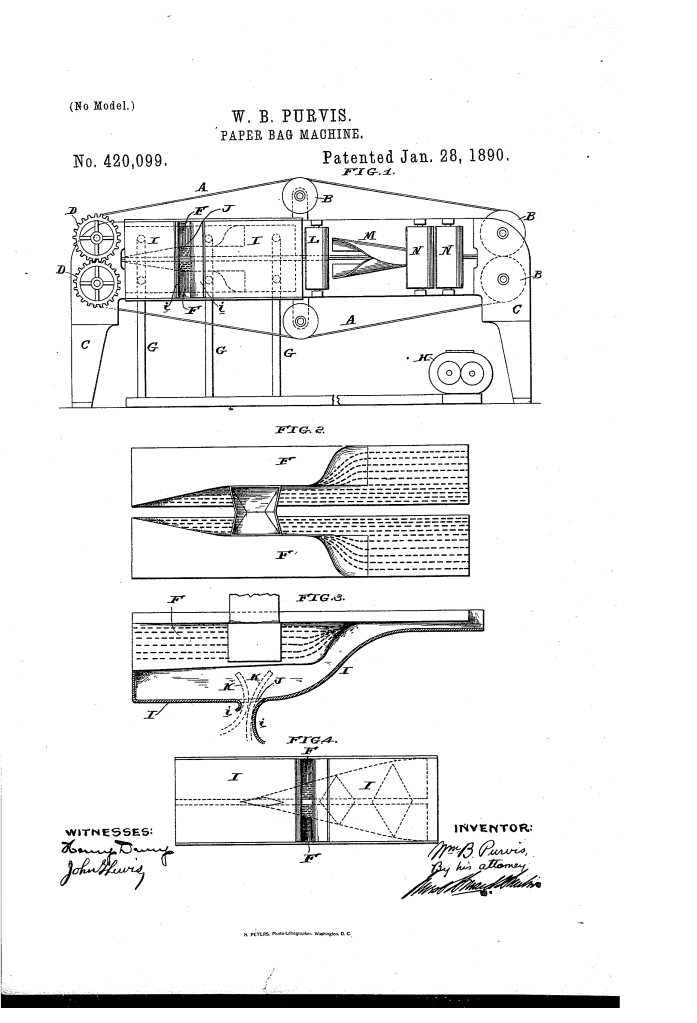
The patent by William B. Purvis of Philadelphia, Pennsylvania describes a Paper-Bag Machine (Patent No. 420,099). This invention is an automated mechanical system designed to improve the high-speed manufacturing of paper bags—specifically focusing on the complex folding and forming of the bag’s bottom using a novel suction and air-direction assembly.
The “Why”
In the late 19th century, the transition from manual labor to industrial automation faced a significant hurdle in the packaging industry: the “bellows-style” or square-bottom bag. Folding these bags by hand was slow and inconsistent. Existing machines often struggled with the delicate task of opening the paper tube and folding the base without tearing the material or jamming the mechanism. Purvis identified that mechanical grippers were often too “clumsy” for light paper; he sought a solution that used pneumatic force to manipulate the paper with precision and speed.
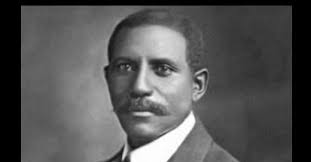
Inventor Section: William B. Purvis
William B. Purvis was a prolific Black inventor whose engineering philosophy centered on fluid dynamics and efficiency. Operating during the post-Reconstruction era and the height of Jim Crow, Purvis defied systemic barriers to secure over a dozen patents, ranging from fountain pens to electric railway improvements. His approach to the paper bag machine demonstrates a sophisticated understanding of pressure differentials—using vacuum and guided air currents rather than just rigid mechanical linkages. He was a “system thinker” who looked for ways to reduce friction and mechanical wear in industrial processes.
Key Systems Section
Suction-Forming Assembly
- Modern Term: Vacuum Mandrel / Pneumatic Formers.
- The system uses two perforated, box-shaped “formers” ($F$). A suction device ($H$) draws air through tubes ($G$), pulling the paper tube tight against the perforated faces to initiate the fold.
The Guided Air Hood
- Modern Term: Air Plenum / Flow Deflector.
- Purvis introduced an enveloping cover or “hood” ($I$) over the suction devices. This hood features a transverse slit ($J$) that strategically admits atmospheric air. This creates a dual-action force: suction pulls from the outside, while guided air currents “strike” the interior of the tube to pop it open.
Transitional Air Jets
- Modern Term: Positive Pressure Nozzles.
- The patent describes optional curved tubes ($K$) that introduce concentrated jets of air. This ensures that even the stubborn side-folds (bellows) of the bag are fully extended before the final flattening rollers ($N$) seal the bottom.
Synchronized Carrier Aprons
- Modern Term: Conveyor Belt Feed.
- Endless aprons ($A$) guided by rollers ($B$) ensure a continuous “line-flow” process, moving the paper tubes through the suction station to the pasting and folding stations without manual intervention.
Comparison: Manual/Early Mechanical vs. Purvis Innovation
| Feature | Standard Methods (Pre-1890) | The Purvis Innovation |
| Handling | Rigid mechanical “fingers” or hand-folding. | Pneumatic Suction (non-contact forming). |
| Opening Mechanism | Mechanical expansion bars (prone to tearing). | Guided Air Currents via the Hood/Slit system. |
| Bottom Shape | Mostly flat/envelope style (simple). | Square/Satchel bottoms (complex bellows). |
| Speed | Limited by physical dexterity/mechanical timing. | High-speed continuous flow via suction timing. |
Significance
- Foundational Packaging Tech: Purvis’s use of suction to handle delicate materials is a direct precursor to modern automated “pick-and-place” robotics in packaging.
- Pneumatic Control: His “hood” design for directing air currents is an early example of boundary layer control in industrial machinery.
- Commercial Evolution: This machine helped move the paper bag from a handmade luxury to a cheap, mass-produced commodity, fueling the rise of the modern grocery and retail industry.
- Economic Impact: Purvis’s patents were often sold to major corporations, proving that Black ingenuity was a vital (though often under-credited) engine of the American Industrial Revolution.
