
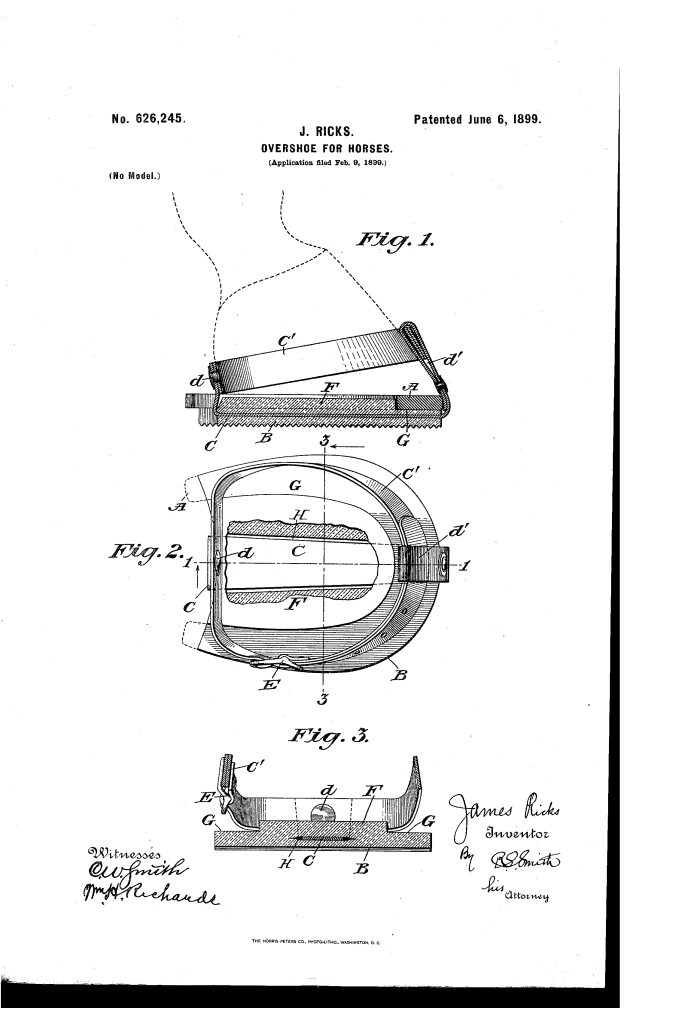
Overshoe for Horses (James Ricks, No. 626,245)
The patent by James Ricks of Washington, D.C., describes an Overshoe for Horses (Patent No. 626,245, 1899), often referred to as a rubber horseshoe. The object is to produce an emergency sleet-overshoe at small cost that can be easily adjusted over the standard metal shoe to prevent slipping in sleety weather and provide noiseless travel.
Inventor Background: James Ricks
James Ricks was an African-American inventor focusing on safety and utility solutions for horse-drawn transportation. His invention addressed the critical urban problem of horses slipping on smooth, icy streets, a major cause of accidents in the late 19th century, while also offering the benefit of quiet travel. His design focuses on affordability and simple, non-permanent attachment.
Invention and Mechanism
The overshoe is a protective pad that covers the entire bottom of the horse’s foot, secured by a unique strap system.
1. Overshoe Structure
- Material: The overshoe (B) is made of a composition of rubber and canvas, which increases its durability and provides a naturally rough outer surface.
- Coverage: It is formed to cover the entire bottom of the horse’s foot, including the metal shoe (A) and the frog of the foot.
- Anti-Slipping: The roughened surface prevents the horse from slipping and also prevents snow or ice from “balling up” in the frog of the foot.
- Internal Lock (F): The upper surface of the overshoe has a U-shaped elevation (F).
- Function: This elevation fits within the metallic shoe (A), acting as an “unfailing and durable cog” to prevent the overshoe from twisting or slipping side-to-side out of place.
2. Strap Fastening System (Key Innovation)
- Inner Strap ($C’$): A strap that passes around the hoof and buckles at the side (E).
- Wide-End Strap (C): A second strap that widens toward the heel. This strap passes through a central, corresponding wide-end slot (H) in the overshoe.
- Attachment: The strap (C) is riveted (d) at the heel of the overshoe to the strap ($C’$). At the toe end, strap C forms a loop ($d’$) through which the main hoof-strap ($C’$) passes.
- Function: This system secures the overshoe firmly to the foot, preventing it from slipping forward or backward, while the U-shaped cog (F) prevents lateral movement.
Concepts Influenced by This Invention
Ricks’s overshoe influenced subsequent designs for non-permanent traction and protective gear by pioneering a mechanically integrated cushion and lock.
- Non-Permanent, Emergency Traction: The design of a flexible, easily applied, and easily removed external traction device for vehicles or animals influenced the development of modern emergency tire chains, snow socks, and temporary cleat systems that can be installed quickly for use on ice.
- Integrated Cushioning and Shock Absorption: The function of the rubber-and-canvas overshoe as a cushion that makes the tread “soft and springy” influenced the design of specialty horseshoe pads and shock-absorbing layers used in farriery and equine therapy.
- Geometric Anti-Rotation Lock: The ingenious use of the U-shaped elevation (F) fitting inside the cavity of the existing metal shoe (A) to act as a durable, non-slip cog is a principle used in modern mounting hardware: relying on the object’s geometry to provide the rotational lock.
- Simplified Strap/Loop Fastening: The method of using a loop ($d’$) on one strap for the primary tension strap ($C’$) to pass through influenced the design of simple, low-cost harness and strapping systems.
