
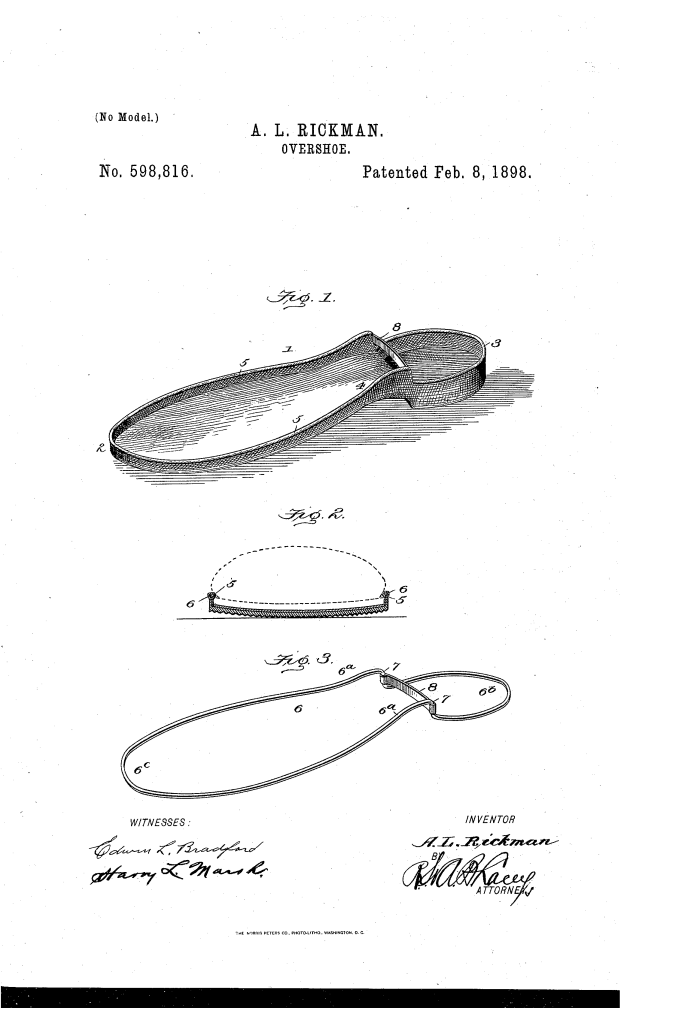
Overshoe (1898)
U.S. Patent No. 598,816, granted on February 8, 1898, to Alvin Longo Rickman (recorded in patent text as Alvin Longo Riokman), addresses the bulk, poor ventilation, and discomfort associated with traditional protective footwear. Alvin L. Rickman, an inventor residing in Scio, Ohio, developed a lightweight, minimalist overshoe alternative to heavy rubber boots.
This specific invention solved a persistent everyday problem: how to keep the sole and welt of a shoe completely dry and impervious to moisture without encasing the upper portion of the foot in unyielding, suffocating rubber.
The Innovation: The Spring-Retained Low-Profile Overshoe
Traditional rubber galoshes covered the entire shoe upper, adding unnecessary weight, trapping heat and moisture, and restricting natural foot movement. Rickman’s breakthrough was an open, ventilated design that covers only the sole, heel, and the seam between the sole and the shoe upper.
To keep this low-cut protector firmly attached without full upper walls, Rickman devised an internal, continuous spring-metal loop designed to clamp directly into the groove between the shoe upper and the sole.
Why This Design?
Ventilation: Leaving the entire upper exposed ensures proper airflow and eliminates the heat buildup common to conventional full rubbers.
Flexibility: It preserves the natural elasticity of the walking shoe, allowing free movement of the foot without drag or stiffness.
Aesthetic and Lightness: Designed to be particularly desirable for use after rain, it prevents the disfigurement and hiding of fine leather uppers while drastically reducing carrying weight.
Key Mechanical Components
The overshoe relies on a coordinated set of molded and formed elements:
| Component | Function |
| Low Edging Rim (5) | A minimal lip projecting slightly above the sole; turns inward to house, conceal, and protect the internal spring fastener. |
| Endless Spring Fastener (6) | A continuous loop-shaped piece of spring metal contoured to the perimeter of the shoe to secure the assembly by elastic tension. |
| Offset Shank Portion (6) | A raised section of the spring wire designed to bridge the arch and fit securely into the space between the sole and the shoe upper. |
| Shoulders (7) | Vertical offsets formed where the elevated shank connects with the lower heel portion. |
| Transverse Clamping Plate (8) | A spring plate connected across the shoulders to bear firmly against the front breast of the shoe heel for positive retention. |
How the Overshoe Functions
The attachment and retention process relies on mechanical spring tension:
| Step | Action | Practical Purpose |
| 1. Alignment | The user aligns the overshoe sole (2) and heel (3) with the bottom of the leather shoe. | Positions the protective rubber base where road moisture contacts the foot. |
| 2. Distension | The spring loop (6) is expanded outwardly as the shoe is pressed into the frame. | Allows the narrow edging to clear the welt and heel of the shoe. |
| 3. Contraction | The spring loop contracts automatically into the recessed space above the sole. | Grips the perimeter seam tightly without requiring straps, buckles, or full rubber walls. |
| 4. Heel Clamping | The transverse spring plate (8) snaps flush against the breast of the heel. | Prevents forward or rearward slipping while walking. |
Historical and Practical Impact
Rickman’s low-profile overshoe represented an early conceptual forerunner to modern minimalist slip-on rubbers and toe rubbers.
Preservation of Fine Footwear: It offered protection against street puddles and mud without covering the decorative leather or fabric uppers popular in late 19th-century footwear.
Material Efficiency: Fabricated from standard rubber, rubber-fabric composites, or alternative waterproof materials, it reduced material costs significantly compared to full galoshes.
Comfort Focus: It directly addressed consumer complaints regarding the rigid, clammy fit of standard Victorian wet-weather gear.
About the Inventor: Alvin L. Rickman
Alvin Longo Rickman was an Ohio-based inventor based in Scio, Harrison County. Active during the late 19th-century patent boom, Rickman developed practical consumer solutions aimed at improving everyday utility, ergonomics, and personal apparel.
Summary of Claims
The patent explicitly claims:
An overshoe comprising a sole, heel, and shank provided with a continuous rim-edging.
A fastening device formed of a continuous loop-shaped piece of spring metal with sole, shank, and heel portions secured within the rim-edging, featuring a shank portion raised above the sole and heel.
Vertical shoulders formed at the junction of the heel and shank portions, combined with a transverse heel-clamping plate extending between and connected to the shoulders.
