
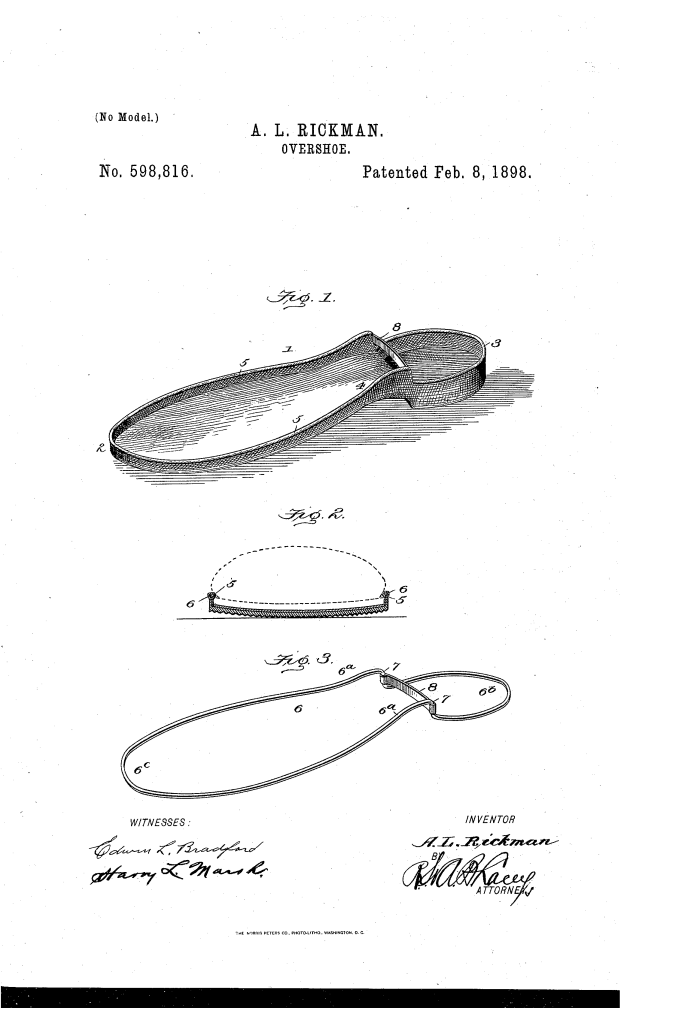
Overshoe (Alvin Longo Rickman, No. 598,816)
The patent by Alvin Longo Rickman of Scio, Ohio, describes improvements in an Overshoe (Patent No. 598,816, 1898) and the means for securing it to a shoe. The primary object is to provide a light and elastic overshoe-sole that only covers the sole and heel of the shoe, leaving the shoe-upper free to allow ventilation and freedom of movement, thereby obviating objections incident to the ordinary, full-coverage rubber boot.
Inventor Background: Alvin Longo Rickman
Alvin Longo Rickman was an inventor focused on improving common consumer goods with specialized features for comfort, aesthetics, and utility. His invention targets a specific consumer—ladies and others who found full rubber boots unnecessarily heavy, hot, or unaesthetic—by creating a minimalist, functional rain guard.
Invention and Mechanism
The overshoe is a minimalist sole protector held onto the foot by an integrated, continuous spring-metal loop.
1. Minimalist Overshoe Body
- Body (1): Constructed like a traditional rubber, with a sole (2), heel (3), and shank (4).
- Edging (5): The upper of the overshoe projects only a short distance above the sole, forming a continuous rim-edging that terminates at the heel/shank junction.
- Function: This design leaves the shoe-upper entirely free and uncovered, providing ventilation and preventing the shoe from being “drawn or otherwise disfigured” by being encased in rubber.
2. Spring-Metal Fastening (Key Innovation)
- Fastening Device (6): A continuous loop-shaped piece of spring metal designed to correspond to the contour of the overshoe.
- Confinement: The metal loop is confined and concealed by the overshoe’s edging (5) being turned inward and secured around it.
- Contoured Shape: The metal loop’s shank portion () is raised above the sole (
) and heel (
) portions, creating shoulders (7).
- Function (Locking): In use, the fastening device:
- Distends when the overshoe is applied over the regular shoe.
- Contracts to fit snugly in the space between the sole and the upper of the shoe.
- The heel portion engages the back of the shoe heel.
- Transverse Clamping Plate (8): A spring clamping-plate is secured to the shoulders (7) and bears against the inner side or breast of the shoe heel to assist in holding the overshoe on.
Concepts Influenced by This Invention
Rickman’s overshoe influenced subsequent designs for temporary footwear, bracing, and retention mechanisms by pioneering the use of internal, continuous spring tension for fastening.
- Integrated Spring Tension for Retention: The core concept of using a continuous, concealed spring-metal loop to provide the fastening force influenced the design of:
- Quick-Attach/Tension Footwear: Devices like cleats, ice grips, and temporary traction devices that use elastic frames or continuous spring loops to stretch over and tightly grip a shoe or boot.
- Minimalist Protective Covers: The design philosophy of creating a protective cover that is lightweight, minimalist, and focused only on the high-contact zone (the sole) influenced the design of various specialized protective sleeves and tool guards that cover only the essential area while maximizing air exposure and flexibility.
- Contoured Spring Bracing: The technique of shaping the spring metal with raised portions and shoulders (7) to leverage the structural contours of the object (the shoe) for locking influenced the design of internal bracing and clip mechanisms in consumer products.
