One-Pipe Heating System Regulating Plate: David N. Crosthwait, Jr. (Patent No. 2,102,197)
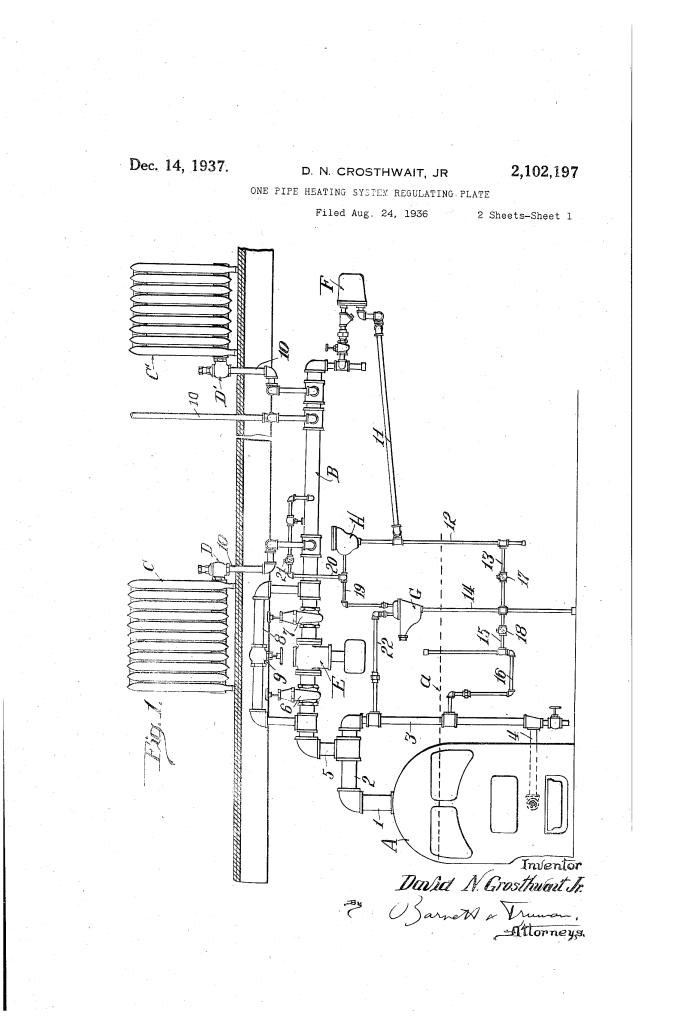
The patent by David N. Crosthwait, Jr. of Marshalltown, Iowa, describes a One-Pipe Heating System Regulating Plate (Patent No. 2,102,197), granted on December 14, 1937. This invention provides a mechanical solution to one of the most persistent problems in early 20th-century plumbing: the “traffic jam” that occurs when steam and water try to move through the same pipe simultaneously. By using a specialized orifice plate, Crosthwait enabled a continuous, noiseless flow of steam into a radiator while ensuring the liquid condensate drained out without causing the dreaded “clanging” or “water hammer.”
The “Why”
In traditional one-pipe steam systems, steam travels up to the radiator and condensed water travels down through the exact same pipe. The primary “pain point” was mechanical interference: as steam pushed upward, it would often trap water inside the radiator. This led to loud banging noises, uneven heating, and inefficient fuel use. Crosthwait’s goal was to create a “passive regulator”—a device with no moving parts that could use the physics of water pressure to manage these two opposing flows automatically.
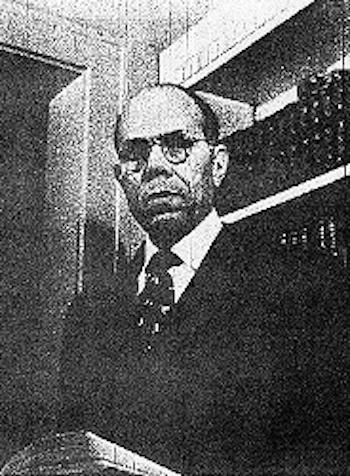
Inventor Section: David N. Crosthwait, Jr.
David N. Crosthwait, Jr. was a master of fluid dynamics and sub-atmospheric pressure. His engineering philosophy was defined by simplicity and reliability. In this patent, he addressed the challenges of low-income and older residential buildings that relied on one-pipe systems. Rather than requiring expensive, multi-pipe overhauls, Crosthwait provided a small, inexpensive metal plate that could “smart-regulate” a radiator, proving that high-level engineering could solve everyday domestic problems.
Key Systems Section
1. Dual-Orifice Metering
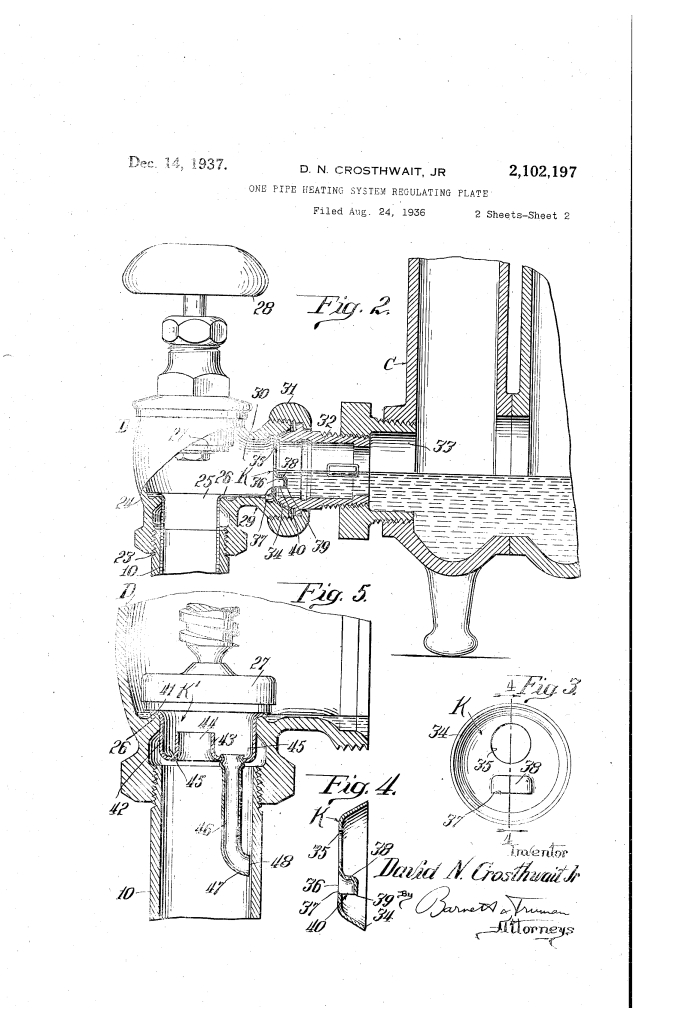
The core of the invention is a circular plate (K) featuring two distinct openings.
- Modern Term: Bifurcated Flow Regulator.
- The upper orifice (35) is sized specifically to “meter” or limit the amount of steam entering based on the radiator’s size. The lower orifice (36) is dedicated strictly to the departure of liquid water.
2. The Hydrostatic Water Seal
The lower orifice is protected by an “overflow lip” (37) and a downward-projecting web.
- Modern Term: Liquid Trap / Static Head Seal.
- This design ensures the lower hole is always submerged in a small pool of water. This creates a “seal” that prevents steam from entering the bottom hole, forcing it to use only the top hole.
3. Pressure-Balance Drainage Logic
Because steam pressure inside a radiator is lower than in the supply pipe, water is naturally “held back.” Crosthwait’s plate allows a small “head” of water to build up.
- Modern Term: Pressure-Driven Gravitational Outflow.
- Once the water level in the radiator rises slightly, the weight (gravity) of that water becomes stronger than the steam pressure pushing against it. The water then “overbalances” the pressure and drains out smoothly through the lower orifice.
4. The Anti-Incrustation Design
Crosthwait intentionally designed the plate with no moving parts (valves, springs, or hinges).
- Modern Term: Solid-State Fluidic Control.
- In 1930s heating systems, mineral deposits (“incrustation”) from hard water frequently caused moving parts to seize. A static plate remains functional for decades without maintenance.
Comparison Table
| Feature | Standard One-Pipe Inlets (1930s) | Crosthwait’s Regulating Plate |
| Flow Conflict | Steam and water fight for the same space. | Dedicated separate paths for steam and water. |
| Noise Level | Frequent banging (Water Hammer). | Noiseless, continuous operation. |
| Moving Parts | Prone to sticking/leaking. | None; permanent and maintenance-free. |
| Steam Control | Inconsistent/All-or-Nothing. | Precisely metered based on radiator capacity. |
Significance Section
- Ergonomic Maintenance: By solving the “noise” problem, Crosthwait improved the living conditions of thousands of apartment dwellers.
- Energy Efficiency: Precision metering prevents radiators from being “over-fed” with steam, directly reducing coal or oil consumption at the boiler.
- Hydraulic Logic: The use of a liquid seal to steer gas flow is a fundamental principle in chemical engineering and modern HVAC systems.
- Retrofit Engineering: The plate’s design allowed it to be clamped into existing pipe unions (31) without replacing the entire radiator, making advanced engineering accessible to existing infrastructure.