
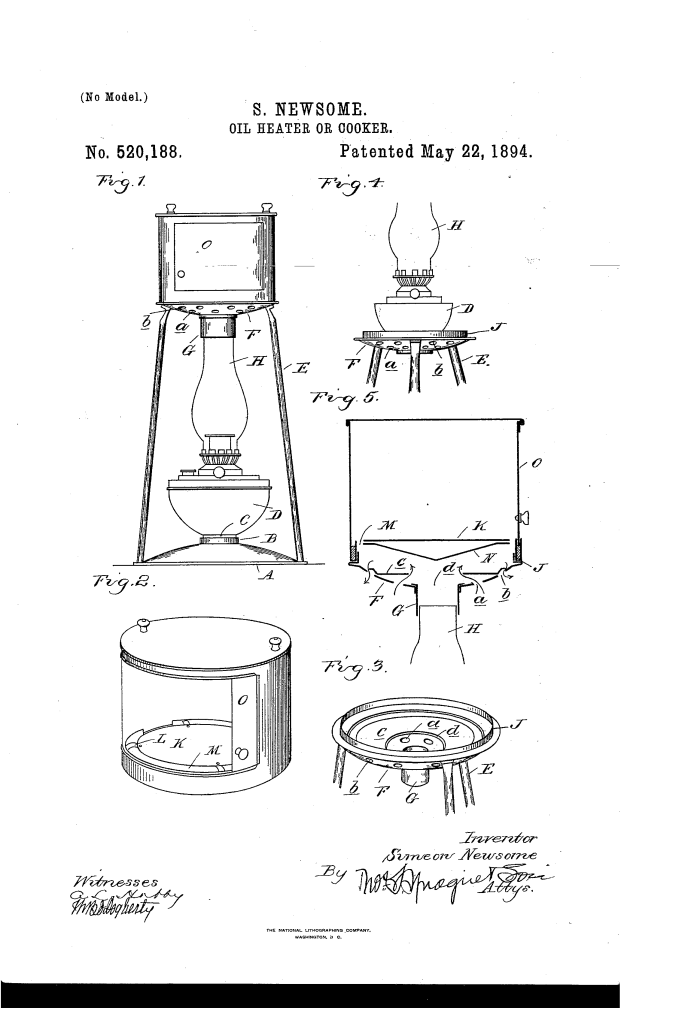
Oil Heater or Cooker (1894)
U.S. Patent No. 520,188, granted on May 22, 1894, to Simeon Newsome of Detroit, Michigan (with half-interest assigned to William Wright), describes a highly adaptable, multi-functional oil stove. Designed during an era when domestic energy relied heavily on kerosene and oil, Newsome’s invention provided an all-in-one appliance capable of shifting seamlessly between room heating, cooking, baking, and primary household lighting.
This invention solved a common economic and spatial problem for late 19th-century households: the financial burden and clutter of owning separate specialized appliances for different domestic chores. Newsome engineered a single framework that safely redirected heat and light depending entirely on how the components were stacked.
The Innovation: The Modular Support Standard
The core breakthrough of Newsome’s patent is its adaptable vertical architecture. Instead of a fixed-use stove, the design utilizes a central platform (or “standard”) equipped with a precisely perforated top plate and an adjustable diaphragm. By changing where the oil lamp is placed or adding modular attachments, the entire function of the unit transforms.
One Device, Three Modes:
- The Boiling Mode: The oil lamp sits securely in the base, channeling intense, direct heat upward through a chimney to heat a kettle resting on the top plate.
- The Baking Mode: A specialized, double-walled circular oven slides directly onto the top plate, utilizing built-in air pathways to bake food evenly without scorching it.
- The Lighting Mode: The lamp is lifted completely out of the base and placed on top of the upper platform, turning the entire appliance into a tall pedestal lamp to illuminate a room.
How the Apparatus Functions
The appliance relies on a clever sequence of airflow management to transition between its primary functions:
| Step / Mode | Action | Operational Purpose |
| 1. Boiling | Place the lamp in the base ring (B); set a pot or kettle over the central aperture (d) of the top plate. | Heat rises through the chimney, strikes the bottom of the cooking vessel directly, and escapes through the inner perforations (a). |
| 2. Baking | Slide the detachable oven over the marginal flange (J) on the top plate. | The inverted conical deflector plate (N) blocks harsh direct flames, forcing hot air into side passages (M) to bake food evenly. |
| 3. Lighting | Remove the lamp from the base and rest its collar inside the top aperture (d). | Converts the structural stove standards into an elevated table or pedestal, raising the flame to cast light broadly across a living space. |
Key Mechanical Components
Newsome’s design uses simple physics to maximize thermal efficiency and structural safety:
- Raised Ring Base (B & C): A specialized collar system at the floor of the device that keeps the semi-spherical oil reservoir perfectly centered and locked into place so it cannot tip over.
- Perforated Top Plate (F): Features two distinct concentric rings of air holes (a and b) divided by an annular diaphragm (c). This dual-zone airflow layout ensures proper oxygen intake for the flame while systematically routing exhaust heat.
- Inverted Conical Deflector (N): Suspended just below the oven floor, this shield prevents the intense, localized heat of the lamp chimney from burning the bottom of baked goods, distributing temperatures evenly throughout the baking chamber instead.
- Segmental Sliding Door (O): A curved door built into the circular oven that slides horizontally, allowing the cook to check on food without lifting a heavy lid and losing trapped heat.
Historical and Practical Impact
Simeon Newsome’s oil heater represents a fascinating look into late Victorian industrial design and domestic economy:
- Space and Cost Efficiency: For working-class families or urban apartments of the 1890s, buying separate rigs for a winter heater, a cooking stove, an oven, and a lighting lamp was cost-prohibitive. Newsome’s design condensed four appliances into a single, portable footprint.
- Advanced Thermodynamics: Before the widespread availability of gas or electricity, managing the intense, pinpoint heat of an oil wick without burning food was incredibly difficult. The use of a conical deflector combined with strategic outer airflow passages showed a sophisticated understanding of heat distribution.
About the Inventor: Simeon Newsome
Simeon Newsome was an inventor operating out of Detroit, Michigan, during the city’s late 19th-century industrial boom. Working alongside partner William Wright, Newsome focused on practical engineering solutions aimed at improving the efficiency, affordability, and safety of daily domestic life.
Summary of Claims
The patent explicitly claims as the inventor’s proprietary design:
- The specific combination of a stable base and supporting standards holding up a multi-zoned top plate.
- A top plate engineered with a central aperture alongside an inner and outer series of perforations (a and b).
- An interlocking, centrally apertured diaphragm (c) arranged directly between the two sets of perforations to control the flow of heated air.
