
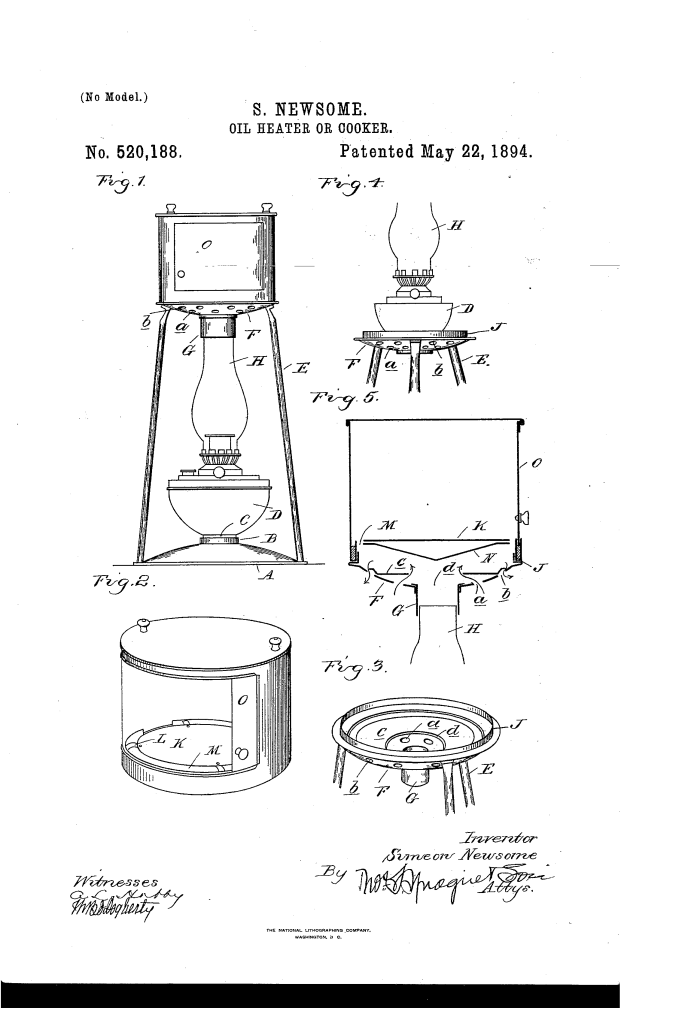
Oil Heater or Cooker (Simeon Newsome, No. 520,188)
The patent by Simeon Newsome of Detroit, Michigan, describes a versatile, multi-purpose Oil Heater or Cooker designed to be used for heating, cooking (boiling and baking), and lighting. The invention focuses on a modular standard and a detachable lamp and oven, allowing the device to be quickly converted for different domestic uses.
Invention and Mechanism
The device is a modular oil stove with a standardized base and a convertible top:
- Base and Lamp Support:
- Base (A): The bottom platform.
- Lamp (D): The oil receptacle is semi-spherical. It fits into a raised ring (B) on the base (A) via a collar (C) when used for cooking or heating.
- Standards and Top Plate:
- Standards (E): Secured to the base, they support the main working surface.
- Top Plate (F): A perforated concave plate that forms the top of the standard. It has a central, downward-extending nipple or collar (G) into which the lamp’s chimney (H) engages, helping to secure the lamp from accidentally falling.
- Heat Regulation and Airflow:
- The top plate (F) features two sets of perforations: an inner series (a) and an outer series (b).
- A diaphragm (c) (a ring) rests on the plate (F) between the two series of perforations. The diaphragm has a central aperture (d).
- Heating/Boiling Function: The vessel is placed on the diaphragm (c), covering the central aperture (d). The heat from the lamp passes through the collar (G) and impinges on the vessel bottom, finding exit through the inner apertures (a). When used for heating, the air circulates freely through the base and the standards.
- Modular Functions:
- Baking (Oven): A circular oven is placed on the top plate (F), engaging a marginal flange (J) to hold it in position. The oven has an inner bottom plate (K) supported by strips (L), creating a passage (M) for hot air. An inverted conical deflector plate (N) is arranged below the oven bottom (K) to prevent excessive heat, ensuring proper baking.
- Lighting: When used as a lamp stand, the base of the lamp (D) is made to fit directly into the central aperture (d) of the diaphragm (c), using the standard as a table (Fig. 4).
Historical Significance and the Inventor
The patent by Simeon Newsome in 1894 is significant within the context of domestic convenience and the widespread adoption of kerosene (oil) heating and cooking technology.
- Oil Stove Era: In the late 19th and early 20th centuries, kerosene stoves became essential household items, especially in urban areas and for summer cooking, as they were cleaner and cooler than wood or coal stoves. Newsome’s design is an example of the industry’s drive toward efficiency and versatility in these appliances.
- Multi-Functionality: The stove’s ability to easily switch between heating a room, boiling/frying, baking, and serving as a lamp stand was a major selling point. For households that couldn’t afford separate specialized appliances, a single, convertible unit represented significant value.
- The Inventor (Simeon Newsome): Newsome, a citizen of the United States residing in Detroit, is part of the cohort of inventors who focused on practical, consumer-oriented domestic devices. The assignment of one-half interest to William Wright suggests a partnership to finance or market the invention. While detailed personal records on Newsome may be scarce, his patent clearly demonstrates an active role in improving household technology for the mass market.
Relation to Current Items
The Oil Heater/Cooker utilizes several modular and heat-transfer principles found in modern appliances:
- Modular Appliances: The design is a conceptual precursor to modern modular camping or backpacking stoves and small kitchen appliances that feature interchangeable tops (grills, griddles, ovens) that all fit onto a standard base/burner unit.
- Heat Deflectors and Convection: The use of the diaphragm (c) and the deflector plate (N) to manage heat flow, prevent scorching, and facilitate convection baking is a core principle in modern oven design. Today’s commercial and domestic ovens use complex fan-driven systems and internal baffling to achieve the precise heat distribution that Newsome attempted to control passively.
- Integrated Air Circulation: The structure of the standards (E) and the perforated top (F) promoting air circulation for heating purposes is analogous to the design of modern portable space heaters which use internal channels and vents to maximize the distribution of warm air.
