
Improvement in Oil-Cups (1898)
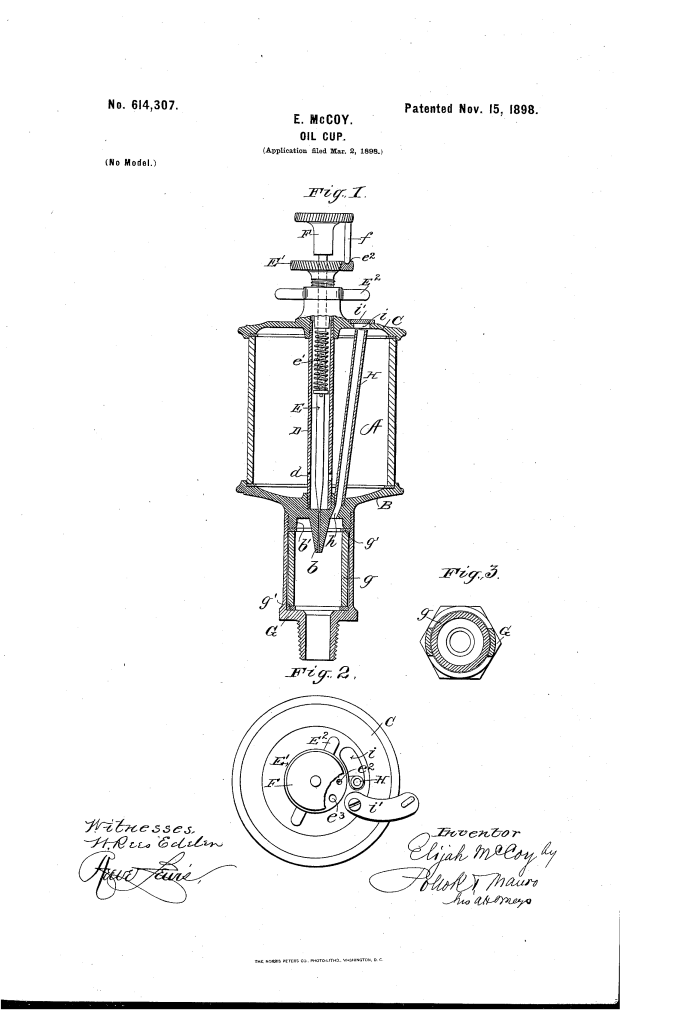
U.S. Patent No. 614,307, granted on November 15, 1898, to Elijah McCoy, describes an advanced sight-feed lubricator engineered for journal-bearings and moving parts in steam engines and industrial machinery. Assigned to the Detroit Sheet Metal and Brass Works, this design tackled the operational risks of automated engine lubrication.
Sight-feed oilers allowed operators to visually monitor drip rates, but they posed serious vulnerabilities: foreign debris could clog the primary nozzle, air displacement issues slowed down gravity feeding, and overfilling caused messy exterior spills. Because shutting down heavy machinery during a clog was costly and impractical, McCoy invented a dual-purpose internal bypass mechanism that allowed manual oiling on the fly while simultaneously venting the chamber and managing overflow.
The Innovation: The “Emergency Feed-Tube”
McCoy integrated an independent vertical conduit, termed the emergency feed-tube (H), directly within the main reservoir body. Running parallel to the central valve stem, this tube creates a direct, isolated channel from the top filling port down through the bottom plate and straight into the bearing feed.
Rather than redesigning the entire casing, McCoy positioned the top of this tube directly beneath an elongated opening in the cup’s lid, sealed by a swinging cover. This simple structural addition served three critical functions at once:
- Emergency Manual Bypass: If the automatic feed-nozzle clogged with sediment, an engineer could swing open the top cover and pour oil directly into the emergency tube with a standard hand-can, keeping the bearing lubricated without stopping the engine.
- Overflow Containment: If the reservoir was overfilled—especially common in factories using continuous piping from overhead tanks—excess oil flowed safely down tube H directly to the journal instead of spilling over the exterior glass and wasting lubricant.
- Atmospheric Equalization (Venting): Because high-speed machinery like flywheels generated localized air suction that could scatter dripping oil, McCoy utilized an air-tight and dust-tight sight-feed glass. Tube H acted as an open vent to the atmosphere, preventing displaced air from backing up into nozzle b and stalling the drip rate.
Key Mechanical Components
| Component | Function |
| Glass Reservoir (A) | Transparent storage chamber held between metallic top plate C and bottom plate B. |
| Valve-Stem Assembly (D, E, F) | Central regulating rod passing through casing tube D to adjust or shut off the flow of oil through nozzle b. |
| Emergency Feed-Tube (H) | Standalone vertical pipe providing an independent path from top opening i to passage h at the bearing feed. |
| Sight-Feed Tube (g) | Air-tight, dust-tight glass viewing chamber sealed with packing rings (g1, g2) within supporting arm G. |
| Elongated Top Opening (i) | Dual-access port fitted with swinging cover i1, wide enough to insert a filling funnel while leaving tube H accessible. |
How the Apparatus Functions
McCoy’s oil-cup balances automatic metering with immediate manual override:
- Filling and Priming: Oil is introduced through elongated opening i. Funnels fit neatly beside tube H; any accidental excess immediately drains down tube H directly to the machinery.
- Regulated Drip: Adjusting disk E1 and head F lifts valve stem E, allowing oil to pass through lower side ports d and drip from nozzle b into sight-feed glass g.
- Pressure Neutralization: As drops fall through the sealed sight-feed chamber, displaced air vents up through passage h and emergency tube H to the outside air, maintaining uniform drop formation.
- Clog Override: If foreign contaminants block nozzle b, the operator swings cover i1 aside and delivers oil directly into the top of tube H using an ordinary hand-can, bypassing the closed valve entirely until repairs can be scheduled.
Historical and Industrial Impact
Elijah McCoy’s 1898 improvement resolved one of the most frustrating maintenance bottlenecks of the late Industrial Revolution.
- Zero Downtime: Factory lines and locomotives no longer had to halt operations simply to clear a clogged lubricator valve.
- Cleaner, Safer Workspaces: Eliminating exterior overflow significantly reduced oil slicks across engine housings, mitigating both fire risks and manual cleaning labor.
- Reliability Under Suction: Enabling the use of completely sealed sight glasses protected oil streams from the violent drafts of high-speed belts and flywheels.
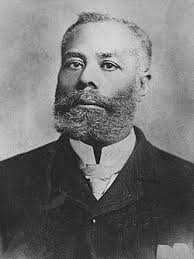
About the Inventor: Elijah McCoy
Elijah McCoy was one of the most prolific African American inventors of the 19th and early 20th centuries, amassing nearly 60 patents over his career.
- Pioneering Lubrication: Trained in Scotland as a mechanical engineer, McCoy revolutionized rail travel and factory operations with his continuous automatic lubricators, famously giving rise to the popular idiom “the real McCoy” to denote authentic, superior craftsmanship.
- Versatile Engineering: Beyond engine lubricators, McCoy patented practical designs spanning multiple fields, including portable ironing boards, lawn sprinklers, and shoe treads.
- Enduring Legacy: McCoy’s systematic refinements to mechanical lubrication laid foundational principles for continuous-feed fluid dynamics that modern industrial machinery still relies on today.
Summary of Claims
The patent explicitly claims:
- An oil-cup featuring a sight-feed chamber and an independent emergency tube extending upward within the reservoir, terminating below the top and discharging separately into the sight-feed chamber.
- The combination of a valve-regulated drip nozzle with a distinct bypass tube functioning through an elongated top filling aperture.
- The arrangement of an air-tight sight-feed chamber vented to the atmosphere through an internal emergency conduit separate from the main oil-feed passage.
