
Non-Capsizable Container (1968)
U.S. Patent No. 3,367,525, granted on February 6, 1968, to Clarence L. Elder, describes an unsinkable, multi-purpose floating tray engineered for use in bathtubs, swimming pools, and open water. Elder, an inventive designer based in Baltimore, Maryland, assigned the patent to the Elder Products Company.
This specific invention solved a common stability problem with aquatic accessories: floating trays carrying uneven loads (such as drinks, soap, or food) frequently capsize due to a high center of gravity and turbulent water displacement. Elder developed a modular floating assembly that positions cargo low relative to the water line, combining hydrodynamic balance with interchangeable, snap-in utility trays.
The Core Design: The Low Center of Gravity Floating Frame
The primary innovation is a buoyant, semi-rigid peripheral frame that defines a closed geometric shape with an open center. Rather than resting cargo on top of a buoyant raft, Elder suspended the payload within the interior perimeter of the frame, displacing water scientifically to create an exceptionally low center of gravity that resists tipping.
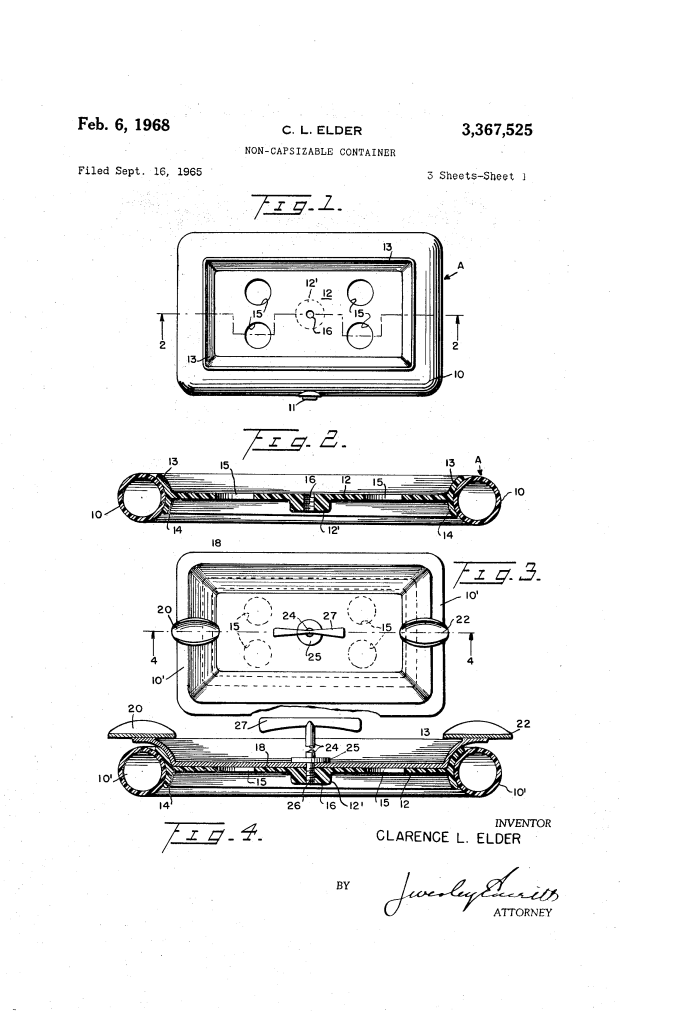
- The Interlocking Peripheral Float (10, 30, 40)The buoyant perimeter can be constructed from expanded plastic foam (such as Styrofoam) or as an inflatable semi-rigid chamber fitted with a gas inflation valve (11). The inner perimeter features an integrated channel or bead designed to securely mate with the payload insert.
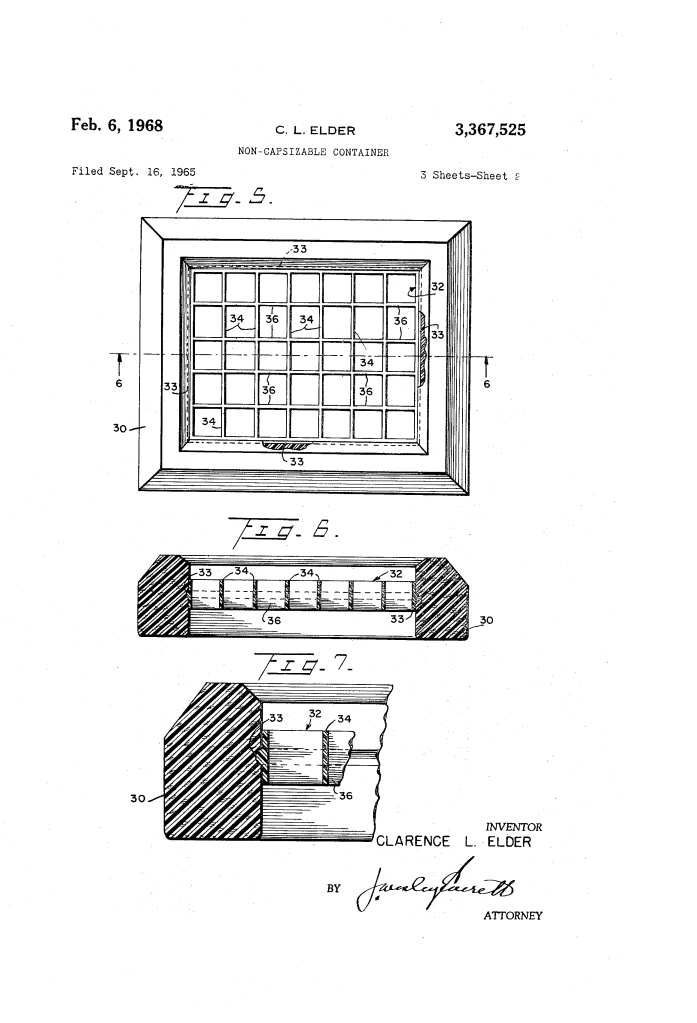
- The Modular Snap-Fit Tray (12, 32, 42)The cargo-carrying insert conforms to the interior dimensions of the float. It incorporates a peripheral dual-flange arrangement (13, 14 or 43, 44) or a locking bead (33) that snaps directly into the inner rim of the float, creating a firm mechanical lock that can be detached for cleaning, reconfiguration, or replacement.
How the Apparatus Functions
The container functions through a coordinated structural configuration that balances buoyancy, cargo restraint, and splash protection:
| Step | Action | Practical Purpose |
| 1. Assembly | The article-supporting insert (12, 32, or 42) is pressed into the open center of the float until the flanges snap into place. | Secures the cargo platform below the upper buoyant rim, locking the center of gravity low. |
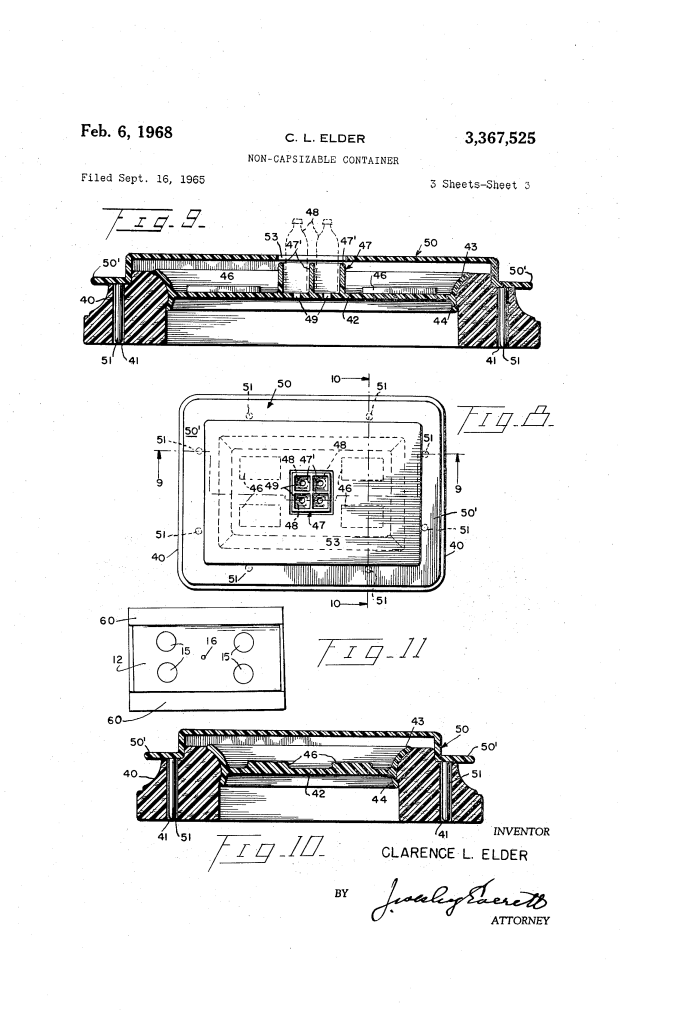
| 2. Centralized Loading | Heavy items (such as beverage containers 48) are placed into the deep central partitioned well (47, 47′). | Concentrates maximum payload weight directly at the center of displacement to prevent roll. |
| 3. Drainage / Venting | Liquid runoff drains through perforations (15) or open grid bars (34, 36); central air relief vents (49) bleed trapped air. | Prevents water accumulation from destabilizing the tray and prevents air pockets from lifting the insert. |
| 4. Protective Shielding | Removable cover (50) is seated over the float using alignment pins/legs (51) fitting into perimeter holes (41). | Shields refreshments from pool splashes while allowing cans/bottles to extend through cutout (53). |
Technical Components
- Buoyant Float Member (10, 30, 40): Annular or geometric perimeter frame formed from expanded closed-cell foam (Styrofoam) or inflatable elastomeric bladder with inflation valve (11).
- Retaining Interlock (13, 14; 33; 43, 44): Cooperative rib-and-groove or double-flange border providing a secure, tool-free snap fit between the float and inner insert.
- Central Walled Partition (47, 47′): Deep interior compartment designed to hold canned or bottled beverages firmly in place to prevent tipping during wave motion.
- Drainage Openings (15, 49) / Grid Matrix (34, 36): Open passages that prevent captive water buildup on soap dishes or food trays.
- Removable Cover / Table Stand (50, 51): Outer canopy that protects contents from pool water; when detached, support pins (51) act as table legs to convert the cover into a standalone serving stand.
- Threaded Hub (12′, 16) & Stem (24, 26): Reinforced center fixture on the base tray that threadably receives modular attachments, such as elevated metal ashtray (18) with cigar/cigarette rests (20, 22) and carrying handle (27).
Versatility and Consumer Applications
Clarence L. Elder designed the platform to adapt across several commercial recreation and household use cases:
- Bath Soap Caddy: Configured as an open perforated tray (12) or molded grid (32) to keep bath soap, sponges, and washcloths dry and accessible without collecting scummy water.
- Elevated Ashtray Caddy: Threading the stem (24) into center opening (16) elevates metal ashtray (18), providing smokers a steady, fire-safe ash receptacle in the bath or pool.
- Poolside Refreshment Center: Scaled up into a snack tray (42) with raised food sections (46), beverage wells (48), and splash cover (50), providing an unsinkable party caddy.
- Novelty Buoyant Forms: The buoyant frame can be cast in playful silhouettes, such as floating ducks or toy boats, combining utility with recreation.
About the Inventor: Clarence L. Elder
Clarence L. Elder was an African American inventor, entrepreneur, and research director based in Baltimore, Maryland.
- Elder Products Company: Headquartered in Baltimore, Elder established his own manufacturing and development enterprise to commercialize consumer goods and electronic systems.
- Energy Conservation Pioneer: Beyond consumer products, Elder is best known for developing the “Occustat” in the 1970s—an early smart energy-conservation system designed for hotels, offices, and schools that monitored room occupancy to automatically dial back heating, cooling, and electrical loads, earning him widespread industrial recognition.
- Prolific Innovator: Elder held multiple U.S. and foreign patents across consumer goods, automotive safety monitors, surveillance electronics, and automated energy control hardware.
Summary of Claims
The patent explicitly claims:
- A floating tray comprising a buoyant semi-rigid frame of closed geometric shape with an open center area, an article-supporting member fitting inside, and cooperating interfitting snap-action rib-and-groove structures on their mating peripheral surfaces.
- An article-supporting member provided with a secondary mounting means to secure an auxiliary utility support (such as an ashtray) above the primary tray surface.
- An article support featuring centralized partition holding means configured to retain multiple heavy items (beverage containers) directly adjacent to the center.
- A floating tray assembly featuring an open grid floor or a full canopy cover equipped with a peripheral flange resting on the buoyant frame.
