
Motor Vehicle Elevating and Parking Device: John P. Thompson (Patent No. 2,086,142)
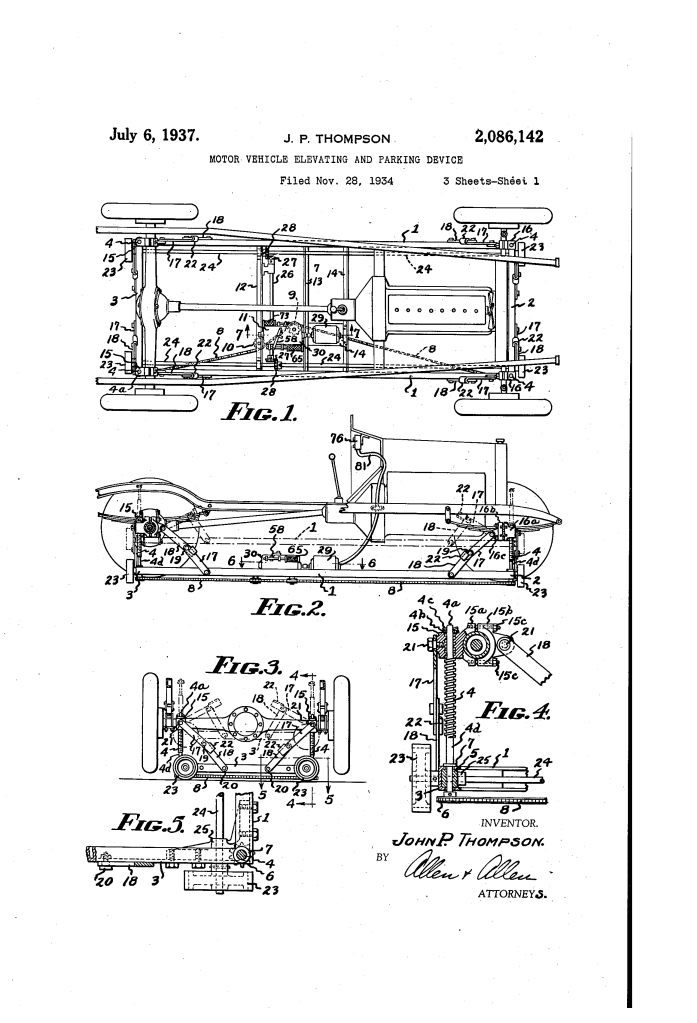
The patent by John P. Thompson of Cincinnati, Ohio, describes a Motor Vehicle Elevating and Parking Device (Patent No. 2,086,142), granted on July 6, 1937. This ambitious invention is an early mechanical solution for “lateral parking” and vehicle maintenance. It consists of a rigid rectangular frame integrated into the vehicle’s chassis that can bodily lift the car off the ground using four synchronized jack screws and then drive the vehicle sideways on secondary rollers. Thompson’s design allowed a driver to maneuver into tight parking spaces or perform repairs without ever leaving the driver’s seat.
The “Why”
In the mid-1930s, as urban centers became more congested, the “pain point” Thompson addressed was twofold: the difficulty of parallel parking in cramped streets and the safety risks of manual jacking. Traditional jacks were unstable and only lifted one corner of the car. Thompson sought to provide a powered, stable platform that eliminated the “tipping” hazard and allowed for “sidewise travel,” enabling a car to effectively “slide” into a parking spot that was barely longer than the vehicle itself.
Inventor Section: John P. Thompson
John P. Thompson was an African American inventor whose work focused on the intersection of power transmission and automotive ergonomics. His engineering philosophy emphasized autonomous utility—creating systems that worked independently of the vehicle’s main engine. This was a critical foresight; if a car’s engine failed, Thompson’s battery-operated device could still lift the vehicle for repairs or move it out of traffic. His work reflects the high level of technical sophistication present in the Black inventing community during the industrial surge of the 1930s.
Key Systems Section
1. The Synchronized Four-Point Jacking System
The device uses four vertical jack screws (4) located at the corners of a rectangular frame.
- Modern Term: Synchronous Linear Actuators.
- A single sprocket chain (8) loops around all four screws, ensuring they rotate at the exact same speed. This lifts the vehicle “bodily” and level, preventing structural strain.
2. The Lateral Drive Transmission
Once the vehicle is elevated, power is diverted to longitudinal shafts (24) equipped with rollers (23).
- Modern Term: Transverse Drive Train.
- Using bevel gears (27, 28), the system converts the motor’s torque to rotate these rollers, moving the entire car perpendicular to its normal direction of travel.
3. Electromagnetic Clutch and Braking Logic
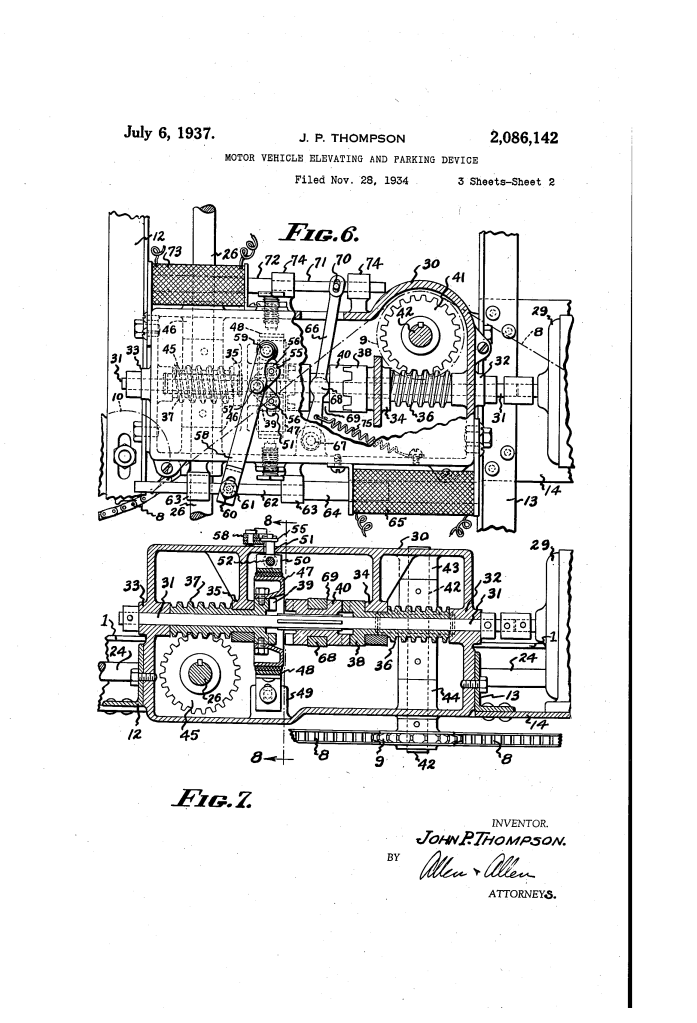
Thompson utilized a sophisticated control casing (30) containing a worm-gear assembly and electromagnetic solenoids (65, 73).
- Modern Term: Solenoid-Actuated Power Take-Off (PTO).
- A “clutch member” (40) slides to engage either the jacking worm (36) or the parking worm (37). Crucially, an automatic brake (47, 48) sets the moment the parking motor stops, preventing the car from “rolling” away while elevated.
4. The Remote Control Dashboard Interface
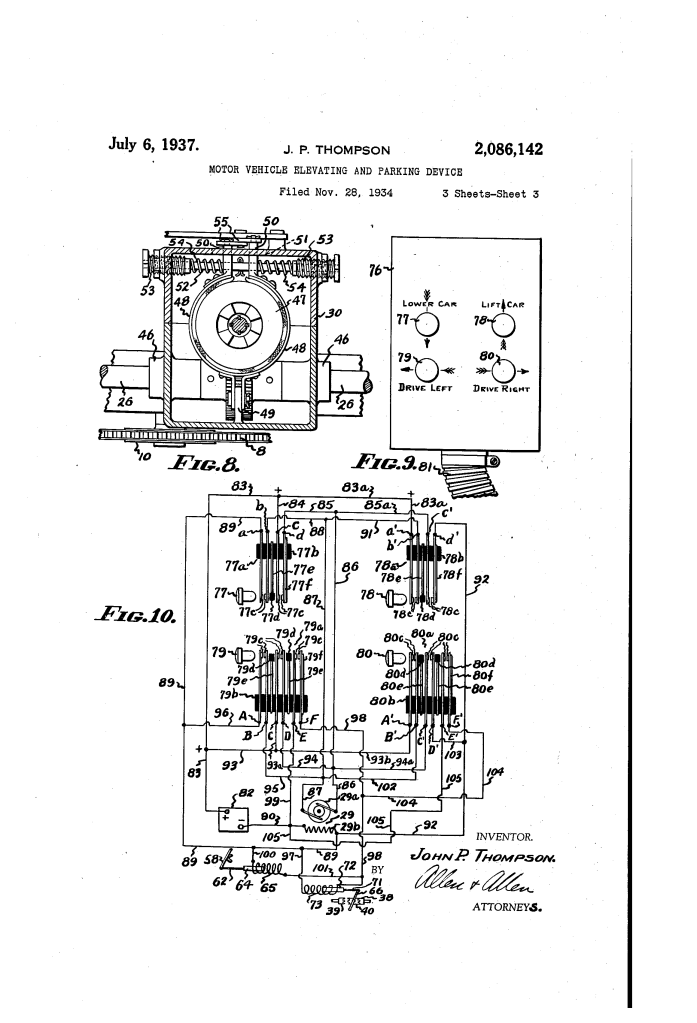
The system was operated via a four-button control board (76) located on the car’s dashboard.
- Modern Term: HMI (Human-Machine Interface).
- The buttons—Lower, Lift, Drive Left, and Drive Right—controlled a complex series of electrical shunts and switches, predating the modern power-window or seat-adjustment interfaces.
Comparison Table
| Feature | Standard 1930s Parking/Jacking | Thompson’s Innovation |
| Parking Maneuver | Difficult multi-point parallel parking. | Direct lateral (sideways) entry. |
| Lifting Method | Manual hand-cranked corner jack. | Electric four-point synchronized lift. |
| Power Source | Human physical labor. | Dedicated electric motor (Battery/Generator). |
| Stability | High risk of tipping/falling. | Rigid frame with collapsible safety braces. |
Significance Section
- Precursor to the “Fifth Wheel” Concept: Thompson’s idea of lateral movement was a direct ancestor to various “parking wheel” concepts that attempted to solve urban congestion.
- Early Power Jacking: The use of synchronized screws to lift a vehicle level is a principle still used in modern industrial vehicle lifts found in mechanic shops.
- Automated Safety Braking: The integration of a solenoid-released brake that defaults to “locked” is a fundamental safety feature in modern robotics and elevators.
- Modular Infrastructure: By designing the frame to fit under any standard chassis, Thompson anticipated the need for “aftermarket” automotive upgrades.
