

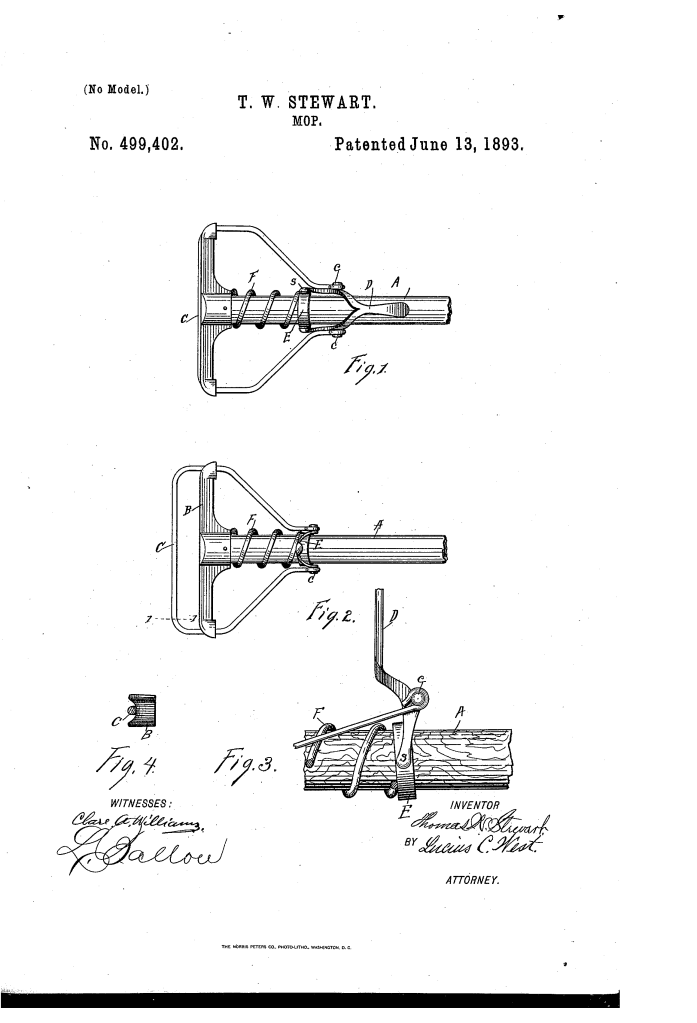
Mop (1893)
U.S. Patent No. 499,402, granted on June 13, 1893, to Thomas W. Stewart, introduces a revolutionary, mechanical advancement in household sanitation: the first modern quick-release clamp mop.
Stewart, an inventor residing in Detroit, Michigan, designed this apparatus to solve a major grievance of 19th-century domestic work—the tedious, unsanitary, and physically demanding chore of manually unlacing or unscrewing dirty rags from old-fashioned wooden mop heads. Stewart’s design provided a heavy-duty, spring-loaded lever mechanism that allowed workers to change or wring out mop rags completely hands-free.
The Core Design: The Spring-Loaded Toggle Clamp
The brilliance of Stewart’s invention lies in its mechanical advantage and over-center locking mechanism. Instead of utilizing a threaded screw that could rust or strip over time, this design utilizes a dynamic leverage system that pulls a heavy wire clamp tight against a crosshead using a spring-loaded lever.
1. The T-Head and Grooved Cross-Piece (B)
- The business end of the wood mop stick (A) is fitted with a rigid, perpendicular T-head (B).
- This T-head forms the fixed upper jaw of the rag clamp.
- The outer ends of the T-head feature open guide-grooves that channel the moving components of the frame smoothly.
2. The Converging Wire Rod (C)
- The moving jaw of the clamp consists of a robust metal rod (C).
- It features a perfectly straight section that runs parallel to the T-head to sandwich the rags.
- From there, the rod bends sharply backward, passing through the T-head grooves and converging toward the stick, where its free ends hook into the operating lever.
How the Apparatus Functions
The mechanism operates through a seamless, pull-and-lock sequence that converts simple lever rotation into immense clamping force:
| Step | Action | Mechanical Purpose |
| 1. Release | The operator raises the handle of the lever (D) away from the mop stick (A). | Pushes the wire rod (C) forward, opening a wide gap beneath the T-head to drop out old rags. |
| 2. Loading | Fresh mop rags are bundled and placed directly between the open gap of the clamp. | Positions the material cleanly without requiring any manual tying or threading. |
| 3. Compression | The operator pulls the lever (D) down until it straddles the wooden stick. | Pulls the wire rod backward, heavily compressing the internal spiral spring (F). |
| 4. Over-Center Lock | The lever pivots (c) slide just past the alignment plane of the loose ring pivots (s). | Creates an “over-center” geometric lock that forces the clamp to stay trapped shut under spring pressure during vigorous scrubbing. |
Key Mechanical Components
The system functions as a synergistic assembly where tension and compression work in absolute harmony:
- Mop Stick (A): The main wooden handle that acts as the structural spine for the entire mechanism.
- Lever (D): A forked, dual-pivot handle that straddles the stick when closed, keeping it entirely flush and out of the user’s way during operation.
- Loose Ring (E): A free-sliding collar wrapped around the stick. It serves as a moving fulcrum for the lever, shifting up and down as the system opens and closes.
- Spiral Spring (F): A heavy iron coil trapped between the fixed T-head and the sliding ring. Its powerful expansive force provides the continuous tension required to grip rags of varying thicknesses.
Historical and Scientific Impact
Thomas W. Stewart’s invention was a watershed moment in industrial and residential cleaning technology, establishing structural principles still used in janitorial hardware today.
- Labor Efficiency: It fundamentally transformed commercial cleaning. Janitors could swap out saturated, filthy rags for fresh ones in a matter of seconds, exponentially increasing efficiency in large-scale facilities like factories and hospitals.
- Sanitation and Safety: Before Stewart’s clamp, changing a mop rag meant touching toxic, black cleaning water or handling sharp wire ties. This mechanism insulated the worker’s hands entirely from the chemical-laden cleaning surface.
- Economic Durability: By utilizing an adjustable, spring-tensioned frame rather than fixed-size holders, users could upcycle scraps of old textiles, burlap, or worn clothing into highly functional mop heads, minimizing operation costs.
About the Inventor: Thomas W. Stewart
Thomas W. Stewart was a visionary African American inventor who lived and worked in Detroit during the late 19th century.
- Patents: Aside from his definitive 1893 mop patent, Stewart was an active independent researcher who later secured U.S. Patent No. 648,363 in 1900 for an improved coilless street-railway switch, demonstrating a remarkable versatility that ranged from household consumer goods to heavy urban infrastructure.
- Legacy: Stewart stands as one of the earliest Black inventors to successfully patent an everyday appliance that achieved widespread industrial adoption. His basic architecture—a wire bail pulled taut against a metal cross-T via a spring-actuated over-center lever—remains the gold standard for heavy-duty commercial janitorial mops around the globe.
Summary of Claims
The patent explicitly claims:
- A mop-stick assembly containing a T-head with grooved ends, a converging rearward rod forming a movable clamp, a dual-pivoted lever handle, a free-sliding ring on the stick, and a compression spring acting between said ring and head.
- The specific structural combination where a movable rod clamp is pulled shut by a lever fulcrumed onto a sliding support, relying on an adjacent spring to exert a secure locking resistance when the lever is thrown back into its resting position against the handle.
