

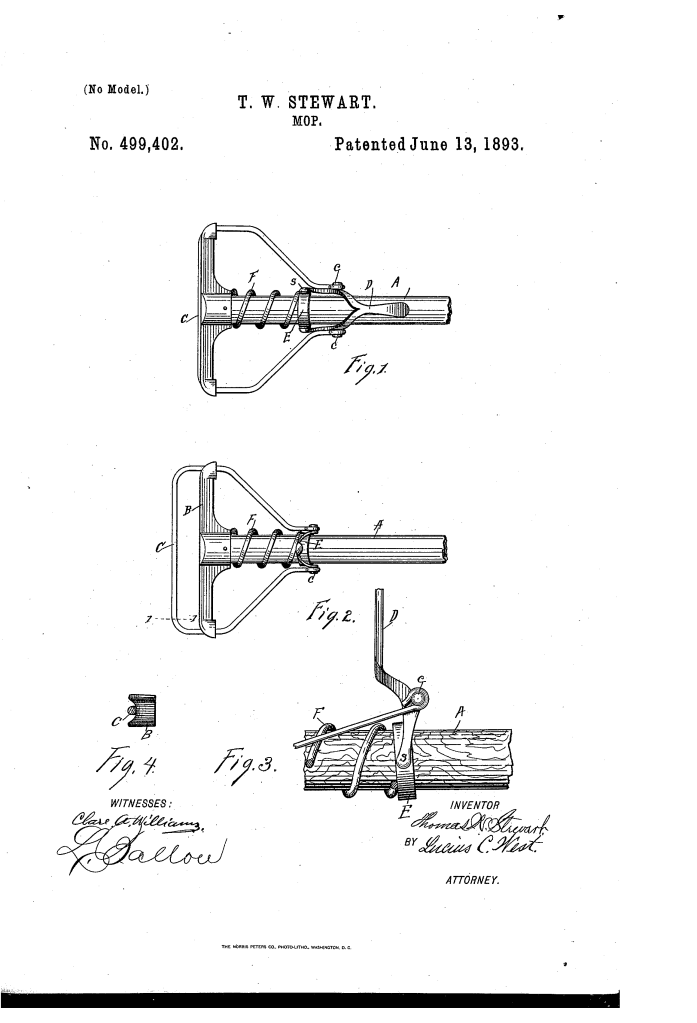
Mop (Thomas W. Stewart, No. 499,402)
The patent by Thomas W. Stewart of Detroit, Michigan, describes an improved Mop focusing on a novel mechanical clamp for securely holding the mop rags. The invention aimed to provide an easy-to-operate, self-locking mechanism to attach and detach the mop head material.
Invention and Mechanism
The mop utilizes a robust spring-loaded, over-center lever system to clamp the rags:
- Clamp Structure:
- T-head (B): A transverse piece rigidly fixed to the end of the mop stick (A). This forms the fixed part of the clamp and features open grooves on its ends.
- Movable Rod (C): This forms the other part of the clamp. It has a straight section that clamps against the T-head. From the ends of this straight section, the rod converges rearwardly, passing through the grooves of the T-head.
- Actuation and Locking:
- Lever (D): A forked lever whose base straddles the stick (A). The free ends of the movable rod (C) are pivotally attached to the lever at point (c).
- Sliding Ring (E): A ring that is loose on the stick (A). The forked ends of the lever (D) are pivotally attached to this ring at point (s).
- Spiral Spring (F): A spring positioned between the sliding ring (E) and the T-head (B). Its expansive tendency provides the clamping force.
- Operation (Self-Locking):
- Opening: Raising the lever (D) forces the ring (E) backward, compressing the spring (F) and pulling the rod (C) forward, opening the clamp.
- Closing/Locking: When the rags are inserted and the lever (D) is thrown back, the spring (F) expands, pushing the ring (E) forward and forcing the movable rod (C) to clamp the rags against the T-head (B). The critical feature is that the pivotal points (c) are carried a little below the horizontal plane of the lever’s fulcrum (s) on the stick. This creates an over-center lock, ensuring the spring pressure keeps the clamp firmly closed until the lever is deliberately raised.
Historical Significance and the Inventor
Thomas W. Stewart’s mop, patented in 1893, is an example of the continuous refinement of domestic tools following the American Civil War, a period where manufacturing and patents for household conveniences flourished.
- Replacing the Primitive Mop: Before such mechanical devices became common, mops often consisted simply of rags tied to a stick or rudimentary screw-on heads. These were often messy, difficult to replace, and prone to losing material during use. Stewart’s invention was part of a wave of patents aimed at creating a secure, reusable, and easy-to-change mop head.
- Engineering Simplicity: The use of the over-center mechanism was a common but effective mechanical solution utilized in everything from locks to bicycle brakes. Applying this simple, self-locking engineering principle to a household item like a mop demonstrated a dedication to durable, reliable design for the consumer market.
- The Inventor (Thomas W. Stewart): Stewart was part of the large class of late 19th-century inventors focusing on specialized, practical improvements. While many inventors patented complex machines, Stewart focused on a high-utility, low-cost household implement, enhancing the daily life of domestic workers and homeowners.
Relation to Current Items
Stewart’s design is a direct ancestor of several modern cleaning tools and mechanisms:
- Quick-Change Mop Heads: The core concept—a lever-activated, quick-release clamp for mop material—is the basis for nearly all commercial and industrial mops today, including string mops and flat-head dust mops. The ability to switch out a dirty head quickly and without tools is essential for modern sanitation standards.
- The Over-Center Mechanism: The self-locking design (where the pivot drops below the center line) is still fundamental in many everyday clamping devices because it ensures the system remains locked under high tension or resistance. This principle is widely used in:
- Toggle Clamps (used in workshops).
- Luggage Latches and Case Closures.
- Bail Handles on buckets (where the handle locks upward when in use).
- Spring-Loaded Clamps: The use of a spring (F) to provide the constant clamping force is a standard feature in many modern cleaning accessories, such as squeegees, floor scrubbers, and window washers, to ensure firm contact between the tool and the surface being cleaned.
