
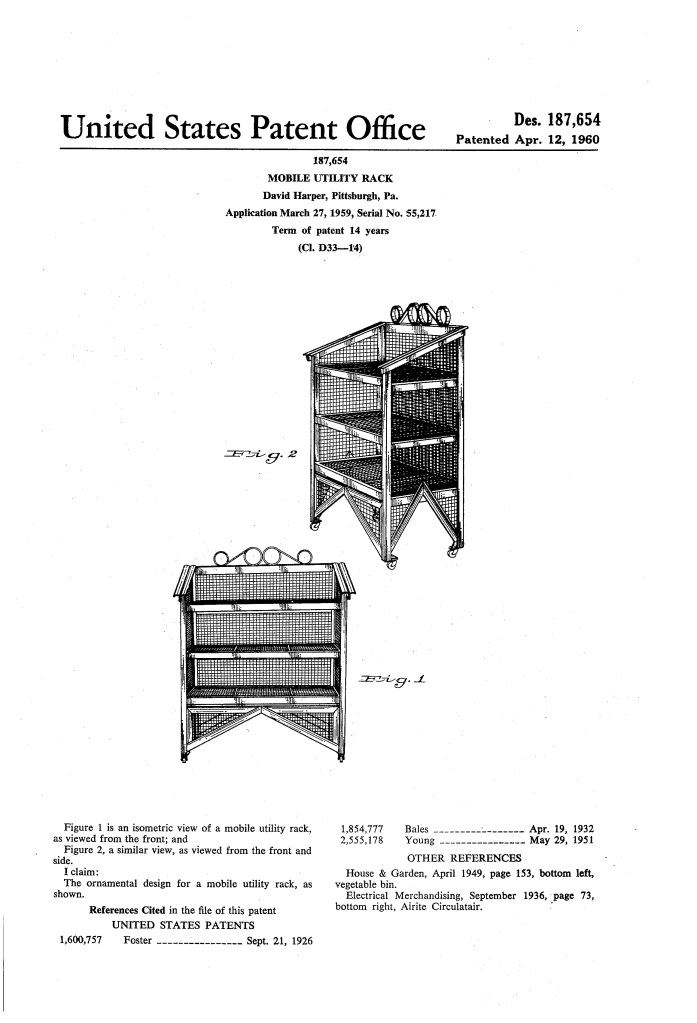
Mobile Utility Rack (1960)
U.S. Design Patent No. D187,654, granted on April 12, 1960, to David Harper of Pittsburgh, Pennsylvania, protects the “ornamental design” of a mobile utility rack. Unlike the previous functional patents discussed, this is a Design Patent, which focuses exclusively on the unique visual appearance and aesthetic form of an object rather than its internal mechanical workings.
The Design: A Mid-Century Aesthetic
The utility rack designed by Harper reflects the industrial design trends of the late 1950s—emphasizing portability, clean lines, and tiered storage. Based on the patent figures and historical context, the design features:
- Tiered Construction: A multi-level structure (typically three tiers) consisting of open-work wire or mesh bins.
- A-Frame Support: The side supports are slightly angled, providing a stable base that narrows toward the top, a common motif in mid-century furniture.
- Mobility: The base is equipped with four casters (wheels), allowing the rack to be easily moved around a kitchen, workshop, or retail space.
- Open-Air Design: The use of mesh or wire was specifically noted in references to “vegetable bins,” as it allowed for airflow to keep produce fresh.
Historical Context and References
Design patents often cite “Other References” to show how the new design differs from what already exists in the marketplace. The references for this rack provide a glimpse into 1950s domestic life:
- House & Garden (1949): Cited for a “vegetable bin” design. Harper’s design likely modernized this concept by making it more “mobile” and “utility” focused rather than just a stationary kitchen bin.
- Electrical Merchandising (1936): Cited for the “Airite Circulatair,” an early air-circulating device. This suggests that the mesh or tiered structure of Harper’s rack shared a visual “language” with high-end appliances of the era.
Practical Applications in 1960
While the patent is for the ornamental design, utility racks of this specific style were ubiquitous in three main areas:
- The Kitchen: Used as a rolling “pantry” for onions, potatoes, and fruit.
- The Office: Used for sorting mail or moving files between desks.
- The Workshop: Serving as a mobile station for tools and hardware.
Design Patent Facts
- Term of Patent: At the time, this design was protected for 14 years.
- Claim: The legal claim is very short: “The ornamental design for a mobile utility rack, as shown.” In design patents, the drawings (Figures 1 and 2) are the patent.
- Classification: It was filed under Cl. D33-14, a category for furniture and household storage.
About the Designer: David Harper
David Harper was part of a wave of designers in the post-WWII era who focused on making household chores more efficient through “utility” furniture. By securing a design patent, Harper and his associates could ensure that competitors couldn’t produce “knock-offs” that used the same specific proportions and visual style.
